A Penney Spent
What Do You Think You're Looking At? #260
I always wondered how the Ross Dress for Less store in Old Town Alexandria, which recently closed, began life. It seems like a very large storefront for the otherwise granular streetscape of Old Town, with tons of little storefronts. Here it is on Google Maps in April 2025, before it closed:
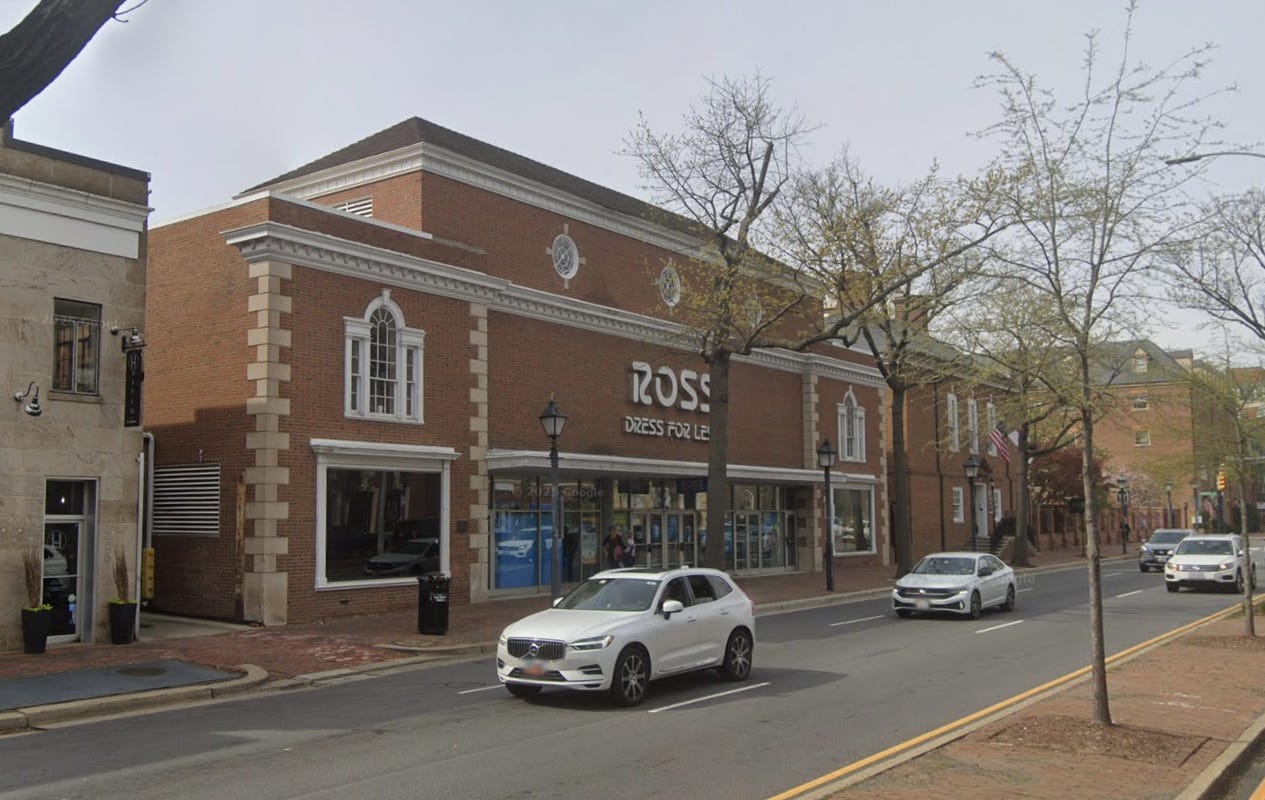
At first I speculated that it was a recent building that had replaced part of an old block, lost maybe to fire or structural damage. It looks a little un-ornamented compared to its surroundings, too, so my guess was that whoever built it had been required to make a bit of a concession to the historic surrounding fabric (ornamented windows, brick) but had not done it too elegantly.
But I was wrong. The building, with few alterations, is from 1953, and it began life like this:
So it is recent, for Old Town, which in the 1950s still had enough population and commercial clout to attract a department store—despite the fact that the 1960s would bring suburban dispersal and urban renewal, which much of Old Town only narrowly survived.
A clarification now: this Facebook post where I found one of those old photos, from the Alexandria History Tours page, explains that this was a move: J.C. Penney had operated in Alexandria since 1927, when it opened on King Street. Or so one source says. Another says 1929, and the Washington Post says 1925.
This article hints, possibly—it’s unclearly written—that J.C. Penney preexisted even the “original” King Street building, which could account for some of the confusion:
In 1929, the two buildings that stood at 615 and 619 King Street were demolished and replaced with the two-story commercial building that is located on the site today. The original two buildings were bought by JC Penney and demolished in order to build a new commercial structure to house their Alexandria store. JC Penney shut its doors in 1954.
(I’ve also seen different blocks given for the location—it is definitely the 600 block, unless the addresses were shifted over the years, but the Post says the 400 block, despite the building in question definitely being the same. A LoopNet commercial real estate listing even gave this little cluster of buildings a build date of 1980, which is funny given that one of them says “1906” at the top.)
A little more on that “first” King Street store:
It was replaced by a Drug Fair drug store until 1967 when a women’s clothing store took over the property. In 1975 Pier 1 occupied the building and remained until they closed the location in 1979. Despite protests by some citizens,
A McDonald’s moved into the building in 1980, eventually closing the location in 2003. The most recent tenant in the building was Walgreens.
It happens that this building is undergoing a major renovation—the article I just quoted describes a new mixed-use project which will basically be a new retail and residential structure retaining the facades of the old J.C. Penney and a couple of other old storefronts.
And it happens that I have a photograph of this building from a recent visit to Alexandria:
And an earlier one, from August 2025:
I photographed it twice, and I had no idea what this building had once been!
The Penney’s finally closed in 1989, as reported by the Washington Post—just about the same time that a Penney’s and a Hecht’s closed in downtown Silver Spring, Maryland.
More from the Post piece:
The store has been experiencing declining sales for 15 years, according to Donald Thompson, the store manager. “Sales began to drop off when the suburban shopping malls opened,” Thompson said. “People have trouble finding parking in Old Town, so they go to a mall instead to do their serious shopping.” The store originally opened in the 400 block of King Street, where a McDonald's restaurant is now. The department store, famous for its catalogue sales, moved to its present location in a rented building in 1955. No plans have yet been made for the building when Penney’s leaves Feb. 18. Penney’s is one of the few businesses still open that were operating in 1955. During the past two decades, the King Street corridor has seen hardware stores and stores that catered to low-income residents close to make way for shops and restaurants that cater to wealthier residents and upwardly mobile professionals who work in Old Town.
That tracks. It’s a good thing that Old Town was preserved, of course, but like so many other pieces of historic towns and cities, it has lost a lot of the everyday retail and services that it once had. I’d bet even the wealthy people who live there, and can afford Old Town prices, still have to go to suburbia (or Amazon) for some things.
That’s a much subtler shift than the redevelopment of buildings or neighborhoods, but it’s still something of a loss. In a sense, suburban malls really do function as downtowns now, and downtowns function as destinations at least as much as neighborhoods. Things change.
But you can always take a stroll down memory lane.
Related Reading:
Three Cheers For The Blue & White
Thank you for reading! Please consider upgrading to a paid subscription to help support this newsletter. You’ll get a weekly subscribers-only piece, plus full access to the archive: over 1,500 pieces and growing. And you’ll help ensure more like this!


