A Perfect Little Example Of What My Work Is All About
Food, land use, immigration, and people doing normal things when we let them
A couple of months ago, I noticed this curiously packaged product at my Fairfax, Virginia H-Mart (Korean supermarket chain with other Asian products/ingredients):
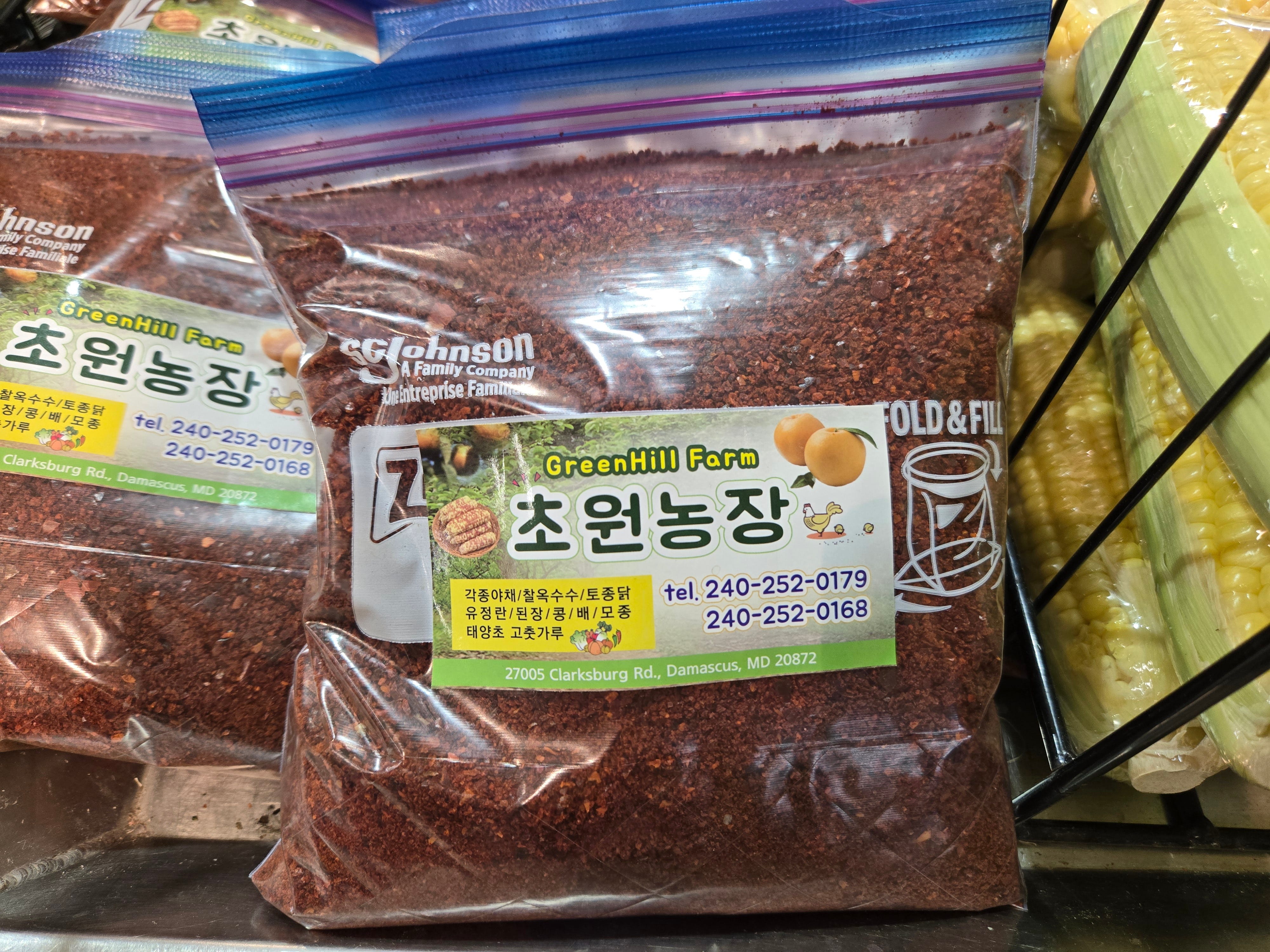
I obviously cannot read the label, but it appears to be finely crushed pepper flakes, a pretty common ingredient in Korean cuisine. What really caught my attention, though, was not the product itself, nor the low-tech packaging, which is just a consumer Ziploc freezer bag.
What I noticed, rather, was the address on the label: 27005 Clarksburg Road, Damascus, Maryland.
That’s in Montgomery County, which most people, probably, assume is mostly urbanized. Montgomery County is where Rockville and Silver Spring and Chevy Chase are, and its eastern half is heavily developed and fairly densely populated. The county’s population overall is just over one million. Most people probably only ever go to one of the county’s major cities, or drive through along I-270.
However, Montgomery County also has a famous (among land-use nerds) experiment known as the Agricultural Reserve. I wrote about that at Greater Greater Washington, after a friend gave me a tour of it, and followed it up with a brief post with lots of photos here at this newsletter.
From the first piece:
What makes the Agricultural Reserve unique is that unlike farmland preservation in many other places (like New Jersey, where I’m originally from), the Reserve is a contiguous piece of land hugging most of the country’s outer border. It preserves not just green or open space, but an actual working, functioning countryside. It is much more than an amenity for affluent homeowners, or NIMBYism posing as environmentalism.
Of course there are critics, complaints about the costs of farming, shortcomings, etc., but the basic idea of a major metro county cordoning off a major connected chunk of land to preserve the actual economy of the old countryside—imperfect or difficult as that may be to truly do—is vanishingly rare. And it has been both envisioned and executed here probably about as well as it can be.
So, the red pointer is where 27005 Clarksburg Road, Damascus, Maryland is on the map:
It’s about an hour’s drive from downtown D.C., so not exactly close, but still within the metro area. It’s about 50 minutes from the Fairfax H-Mart to the GreenHill Farm; that has got to be one of the most local products in a D.C. metro area store.1 The Google reviews also indicate that produce is sold directly from the farm.
From the Google business page, there’s this photo of the farm’s sign, which I screenshotted:
I’m guessing from that sign that the farm owners are Korean Americans, and online reviews call it a Korean farm. Now this all might seem like a recitation of minor trivia—interesting, maybe, but not important.
But it is important. This is a little story illustrating so many of the things I write about, and that urbanists, and urbanism as an area of inquiry or a way of thinking about the built world, are interested in.
One of the difficult things about explaining it is that we wouldn’t really notice if it didn’t exist. We don’t really notice that it mostly doesn’t exist. Sprawl is so normal, nationally distributed foods and products are so normal, that the occasional divergence looks more like a neat little anecdote, or an upscale lifestyle amenity, than a little gasp of a whole lost world.
This is why I’m so interested in the idea of “lasts”—how long the last holdout of a thing once common manages to hang on. In some ways a local farm in an experimental county project selling to a Korean supermarket seems newfangled. But it’s also a kind of old normal. My own home in Fairfax County was once a dairy farm, as were much of the county.
Take a look at this, from a Fairfax County history:
In the first quarter of the twentieth century, Fairfax County again began to prosper, much of it on the wheels of new railroad and electric trolley lines. By 1906, perhaps one-million passengers or more were carried in a year on the Washington, Alexandria, and Mt. Vernon electric railway, which ran thirty trains a day.
Many of these passengers were destined for the District of Columbia schools, as there was no high school in Fairfax County until that same year. This railroad and others, also gave Fairfax County dairymen reliable access to the Washington market for their perishable dairy products. The Great Falls and Old Dominion Railway was soon opened between Rosslyn and Great Falls. In 1904, the Washington and Falls Church Electric Railway was extended to Vienna and Fairfax Courthouse. In 1911 the Washington and Old Dominion electric railway was established on the tracks of the Alexandria, Loudoun, and Hampshire Railroad. Each day numerous Fairfax County residents boarded the electric trains to travel to government jobs or schools in the District of Columbia. Fairfax County was becoming a residential as well as a dairying community. By 1930, the population was at 25,000; twice what it had been in 1870.
So much of what urbanism is about is looking at how we got from that to where we are now, and thinking about how, where, and why we took a wrong turn. This is why I think of urbanism as fundamentally conservative, in the dispositional or temperamental sense.
This story of the local peppers is also a story of local, small-scale commerce. There may have been some regulatory reform or exemption needed for that ground pepper in a Ziploc bag to be legal to sell in a supermarket. I’m not sure. There was certainly some local business relationship needed to get that to happen. We used to have dense networks of business and social relationships like that everywhere.
It’s a story of land-use policy, and how the Agricultural Reserve makes it possible for the peppers to exist in the first place, within a range close enough that that local business relationship is able to form. Proximity makes things easier.
And it’s an immigration story. A county policy from 1980 (the year the Agricultural Reserve was created) ended up dovetailing with a later influx of Korean immigrants to the Washington, D.C. area. That H-Mart in Fairfax, long ago, was a Hechinger’s home-improvement store; then a Giant, a mainstream American supermarket; and now an H-Mart, which serves the Korean-American community but also everyone else (the crowd there is pretty diverse). It may also be that immigrants are more entrepreneurial, and more willing to engage in this kind of local, somewhat informal commerce.
But it’s all of these elements, coming together in organic ways that can’t quite be foreseen. Getting land use and transportation and small-business regulation right—having the right built environment and the right ground rules—creates magic down the line.
This is why “policy” is not arcane or elitist or technocratic. Good basic policies help us build great places, to make connections, and, I’d go as far as to say, be more fully and properly human.
Related Reading:
There are other local products in D.C.-area stores, like Ben’s Chili Bowl products, Logan sausages in Alexandria, and Roseda Farms beef.


