A Temple Of Food
What Do You Think You're Looking At? #262
Well I wish I had gotten to visit this when it was still open, in West Caldwell, New Jersey:
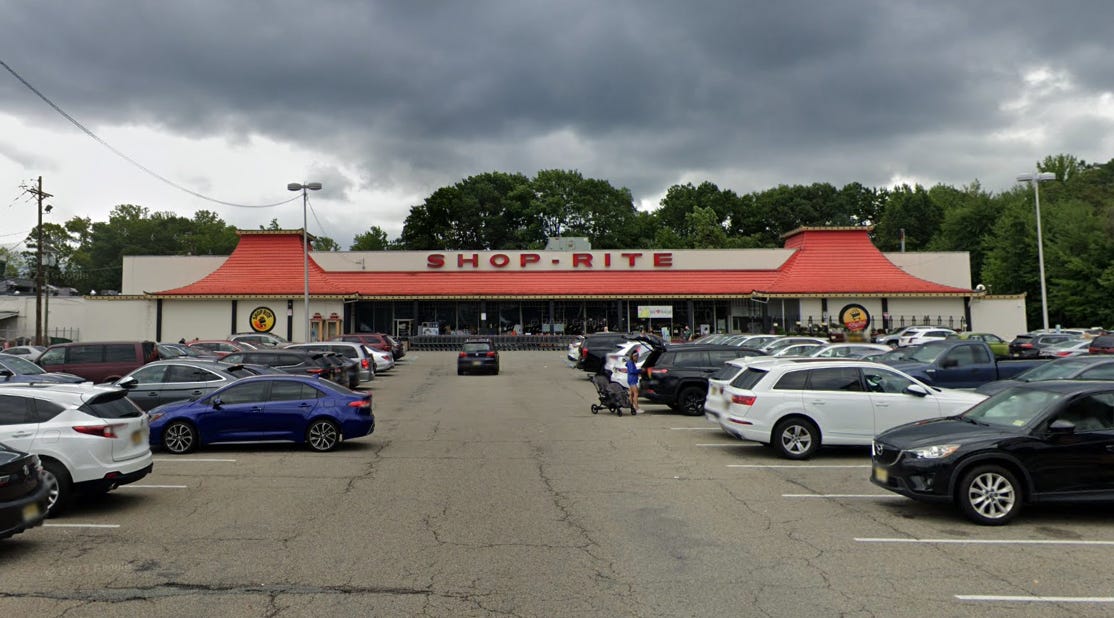
From an October 2025 article, which describes a parade from this old location, since vacated, to a big new ShopRite store nearby:
The former ShopRite of West Caldwell was known for its distinctive red pagoda roofline, inspired by founder Irving Gladstein’s interest in Japanese architecture and culture. He was a World War II veteran who served in the Pacific theater and made several trips to Japan over the course of his life. Archival photos tracing the Gladsteins’ family history in West Caldwell will be on display in the new location. The new store will also feature such distinctive elements as the phone booths that are posted outside the current location on Passaic Avenue.
Sunrise ShopRite’s local roots date back to 1940, when Nathan Gladstein opened his first small food store, Sunrise Market, in Caldwell, N.J. His son, Irving, took over the business after Nathan’s death in 1948. Irving joined the supermarket cooperative Wakefern Food Corp. in 1951 and transitioned Sunrise Market to a ShopRite store. The West Caldwell ShopRite store on Passaic Avenue opened in 1967, and in 1980, Irving’s son, Ned, opened the first ShopRite of Parsippany location. Sblendorio, Ned’s daughter, is the current president of Sunrise ShopRite.
So, in keeping with the “what do you think you’re looking at?” theme, but also not quite in keeping with it, this Japanese-inspired ShopRite was built like this and never really changed until it was replaced by the new store in 2025.
As far as I can tell it is still empty and unaltered; I’m curious whether the building will be torn down, and if not, if the next tenant will keep the facade. (It’s about a 50,000 square foot building, which is an awkward size for stores nowadays.)
A fellow on Reddit shares some photos of the building after it was vacated, here. Here’s a screenshot from the Google reviews. They used that font you see in Asian restaurant logos or karate places:
Also from a Google review, these look like old phone booths:
And these tapestries, including, on one wall of the store, paintings of dragons:
Apparently the store was worn out, and the parking lot was insufficient for the store’s traffic. (Or so people feel—I’m one of those weirdos who thinks the famously cramped Trader Joe’s parking lots are examples of excellent design and use of space.)
I like this so much. Sure it’s little tacky, and nowadays would possibly read as a little culturally insensitive (although it seems at least a little more culturally sensitive than the whole tiki/Polynesian craze). But it was whimsical, the architectural equivalent of those old peppy advertising jingles.
I know I can be a bit of a curmudgeon, but is it crazy to think we were happier back then? more laid back? More fun-loving? So much architecture today really is just flat and bland and colorless. I wonder whether that has some effect on us, or whether it reflects a change in us.
The new store kept a little bit of the Japanese theme, but much more minimally. Notice the Mt. Fuji painting in the background:
So that’s nice. Some people will always pine for what was. I find that even just a little acknowledgement of what came before—the new store also has photos of the old store on display—is “enough” to not make it feel as if progress is erasing the past.
Related Reading:
Nostalgia Should Not Be Locked Behind NIMBYism
Host of the Highways, Afterlife Edition


The blandness that replaced the whimsicality of earlier days is probably because of the transactional and faster-moving economy we have now. For example, staging of home for sale is notoriously gray and bland to make it more universally acceptable.