
Archive Dive: The Baby Plow
Seasonally appropriate thoughts on urban-scaled vehicles

This weekend post is unlocked. I’ve been busy wrapping up the slate of pieces for the week before Christmas, when I run a discount for new subscribers, and I always make those pieces longer and fuller explorations of themes I’ve been on working here generally.
This piece feels topical because 1) we just had our first snow of the season, and 2) Donald Trump said the other day he’d like “tiny cars” to be manufactured in America. We’ll see if that pans out, but it’s a good idea! I like to call small cars and other vehicles “urban-scaled vehicles”—that is, they’re not just small, they’re properly scaled for operation within a traditional city.
I’ve written about city vehicles a lot, but this is probably the most unique vehicle I’ve come across!
I have a vehicle to show you.
But first, I want to share a couple of comments from a piece I wrote awhile ago on small trucks and urban vehicles. I’ve written about this a few times, actually: basically, how the United States doesn’t lack “real cities” as much as we lack all of the properly scaled accoutrements to complement cities.
For a concrete example of what I’m talking about, here’s a picture I took in Sicily of a baby garbage truck:
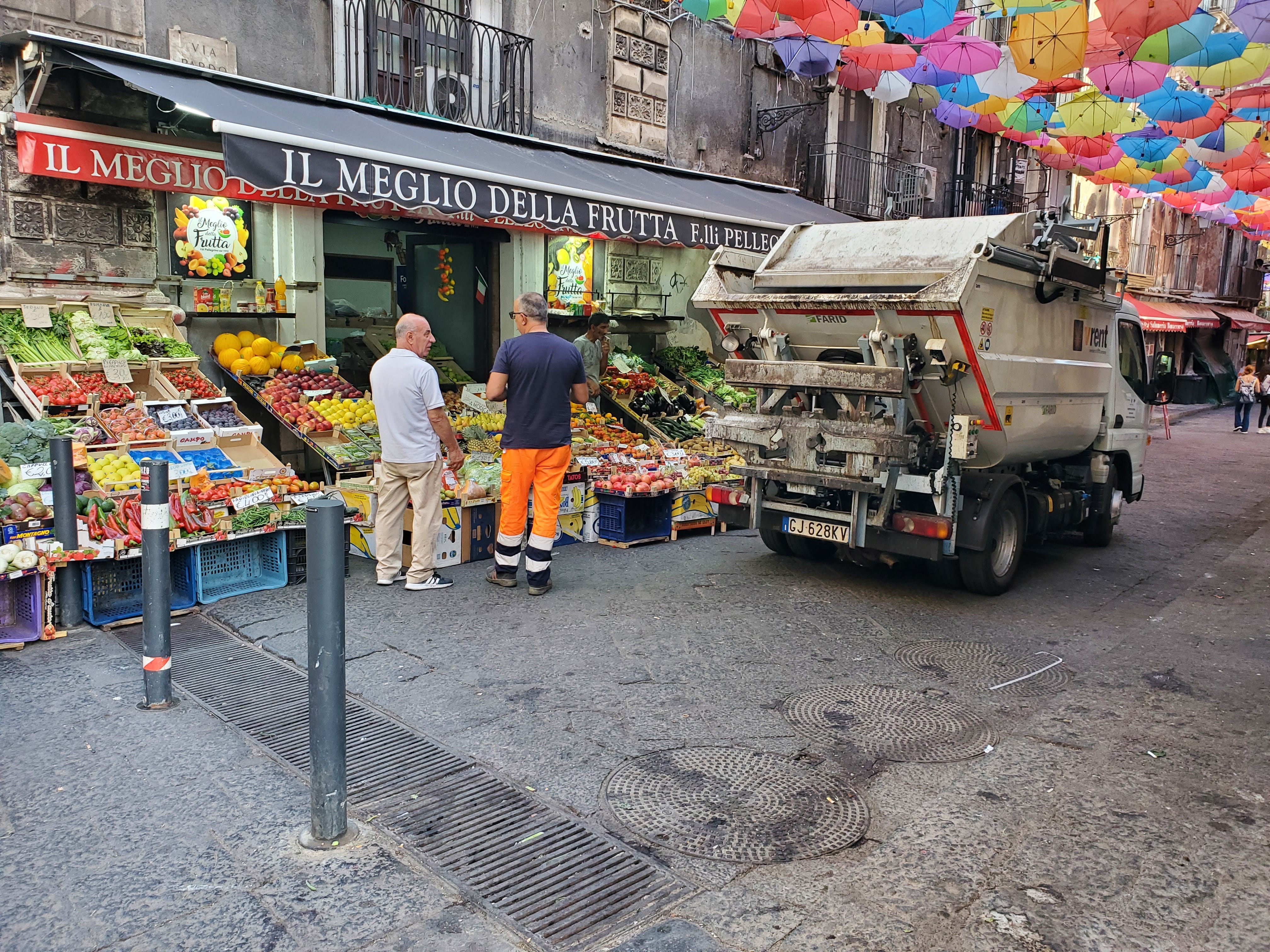
At least, “baby” is what I call it. As an American, it almost looks like a toy. You want to squeeze it and exclaim how cute it is. But none of that properly understands what it is. What it is is an urban-scaled utility vehicle.
America’s utility vehicles—firetrucks, garbage trucks, dump trucks, etc., (along with most of our consumer vehicles)—are basically suburban-scaled vehicles. We’re missing the bottom half of the “scale ladder” that corresponds to traditional urban spaces. That’s how I think about it, anyway. I think that comes closer to capturing the reality of what we’re seeing than just complaining that cars and trucks are “too big.” It’s a question of what is scaled properly for a given environment.
Here is a really good comment from one of my readers that expressed this idea well:
When I first visited New Zealand, I was amused by the 2/3 scale of everything compared to what I was used to in Toronto. Cars and trucks, kitchen appliances, houses — everything was smaller.
Actually, my North American perspective had it all wrong — things had not yet been scaled up.
That has since been rectified. Now, in our (I’m a New Zealander now) eagerness to copy every bad idea from overseas, New Zealanders drive larger (more expensive) cars, buy larger (more expensive) appliances, and live in larger (more expensive) houses. And, like the countries we are so eager to emulate, the number of people who are homeless, the number of children who are living in poverty, and the number of renters who are spending 40%, 50%, or more of their income on housing — all are now much larger.
And another one, which touches on a whole adjacent question of markets and manufacturing:
I live in a pretty standard suburb. Wide roads, plenty of room... but our fire department is lobbying for a large “safety complex” (when combined with police) because they struggle to buy/refurbish trucks SMALL ENOUGH to fit in our main fire station, built in the 1960s.
There aren’t any huge buildings in our town that would necessitate a extra large ladder truck or other huge trucks. But American fire trucks just aren’t built on that small scale anymore.
It’s hard to believe that the typical sizes for utility vehicles actually determine the street widths in American development. But it’s true; here’s one article about that.
Anyway, here is the vehicle I want to show you today, courtesy of Alex Goyette, a housing advocate in Alexandria:
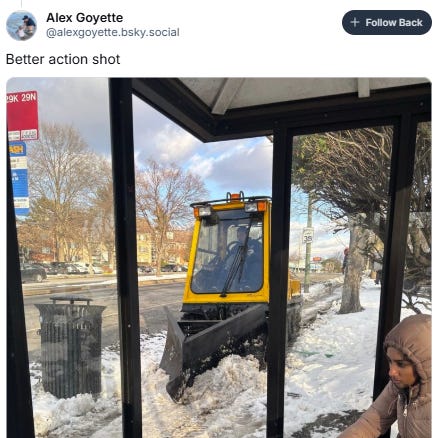
This is a sidewalk snow plow! I have never seen one of these before. Even after years of following urbanist folks online and working in this field, I have never come across this vehicle. In residential areas, responsibility for sidewalk plowing typically falls on homeowners/residents, not the city. This is on a major commercial/mixed stretch, I think, near a bus stop, so it makes sense for the city to clear it. However, in actuality, sidewalk plowing is often done poorly, late, or not at all.
While these vehicles are not common, many cities have or use them, or vehicles like them. As described in this news article from Rochester, New York, contractors use them on behalf of the city:
Many contractors use what Jones described as grove tractors, designed for navigating the narrow spaces between rows of trees in orchards. Per the city’s expectations, these tractors are usually fitted with V-shaped plow blades the width of a typical sidewalk.
That’s interesting. That’s a repurposing of a different kind of vehicle because, perhaps, there isn’t a large market for purpose-built sidewalk plows. However, here is a company that makes snow plow vehicles specifically for sidewalks. (Curiously, though, even here the illustrative photos are in front of buildings or in parking lots, not on actual sidewalks on urban streets.) Many of these vehicles are, or were, made by Bombardier, a Canadian company. You know who doesn’t specifically market a sidewalk plow? Caterpillar.
Despite Rochester’s sidewalk plowing program, the city still does not consider itself responsible for sidewalks:
The city’s sidewalk plowing program costs a little more than $1 million a year and is funded through a fee of about $35 on the annual property tax bill for an average home. Property owners within a downtown enhancement district – an area bounded roughly by Plymouth Avenue and Church, Chestnut and Broad Streets – pay an additional fee for enhanced sidewalk snow removal.
The city hires a fleet of private contractors who fan out after storms to plow more than 850 miles of public sidewalks. But City Code § 104-11 makes clear that property owners are ultimately responsible to keep their sidewalks free of snow and ice. The city’s website also stresses that sidewalk plowing is “supplemental.”
Here’s an article from Michigan about sidewalk plows, which the author doesn’t like:
It comes in the night, disrupts our sleep, blocks the driveway and rips the grass, and leaves in its wake what it touches at its point. I refer, of course, to the sidewalk plow.
When I was a lad in Holland, Mich., I use to thrill at the sight of the sidewalk plow, and thought it must be, along with Zamboni driver and professional baseball player, the best job in the world. I’ve grown to loathe these snow beasts, for they also symbolize how governments can disrupt the obligations, and thus the cultivation, of neighborliness.
They do not come cheaply. The city of Holland pays about $120,000 per plow and earmarks roughly $57,000 a year for the service. Under its sidewalk fund, the city of Wyoming in 2010 spent over $363,000 on snow removal. Then too, there is the problem of emissions.
The problem with “just clear the sidewalk yourself” is that often they just don’t get cleared. The idea that the city has no responsibility for clearing the sidewalks is not just a dry legal technicality. It reflects the deeply held assumption in America that walking is merely a discretionary activity, or even a luxury, not a basic necessity. Not a fully valid and normal means of transportation. Nobody considers plowing the roads optional. The argument will kind of go, “It sure costs a lot to clear the sidewalks, and who uses them anyway?” Well, there you go.
One of the aha! moments you have as an urbanist is you go from inheriting an opinion like “Huh, isn’t it kind of unfortunate that reality and adult responsibility just entail driving everywhere?” to realizing “Hold on, do we really have to do it this way?”
Of course we don’t. It’s chicken and egg, whether the dearth of urban vehicles erodes an urban mindset, or whether the abandonment of an urban mindset reshaped the way we build vehicles and other things. It’s probably both of those things working in tandem, and that reinforcing cycle is hard to break.
But the important point is that the little snowplow isn’t “cute” or “European-style” or anything else like that. It’s just a plain old vehicle properly sized for use in an urban landscape.
Social card image credit Flickr/Simon Law, Attribution-ShareAlike 2.0 Generic
Related Reading:
Thank you for reading! Please consider upgrading to a paid subscription to help support this newsletter. You’ll get a weekly subscribers-only piece, plus full access to the archive: over 1,400 pieces and growing. And you’ll help ensure more like this!
I just came in from shoveling not our sidewalk but the neighbors on both side because they never bother. I miss living in Royal Oak where we had a cute little broom mobile that swept the sidewalks for us.
I would like to propose that plowing right-of-ways for taxpayers inside of motor vehicles but not for taxpayers outside of motor vehicles is a violation of the Equal Protection clause.