

Readers: Because Independence Day is a Friday and a holiday, I’m doing an “Independence Day” special today. For today and tomorrow, I’m offering a discount for new paid subscribers! If you’ve been thinking about upgrading, please go ahead! Sign up free or paid below. And as always, thank you for reading!
I like to publish especially strong pieces whenever I have a new-subscriber offer, and it feels like a good time for this one: my thinking about the fundamental urbanity of small towns, and the fact that, if this is understood, America likes urbanism more than is often thought. Enjoy!
While in Providence, Rhode Island for the Strong Towns National Gathering earlier this month, I wrote off this tweet with some photos of tall buildings downtown. As you can see from the like count, it took off a bit!
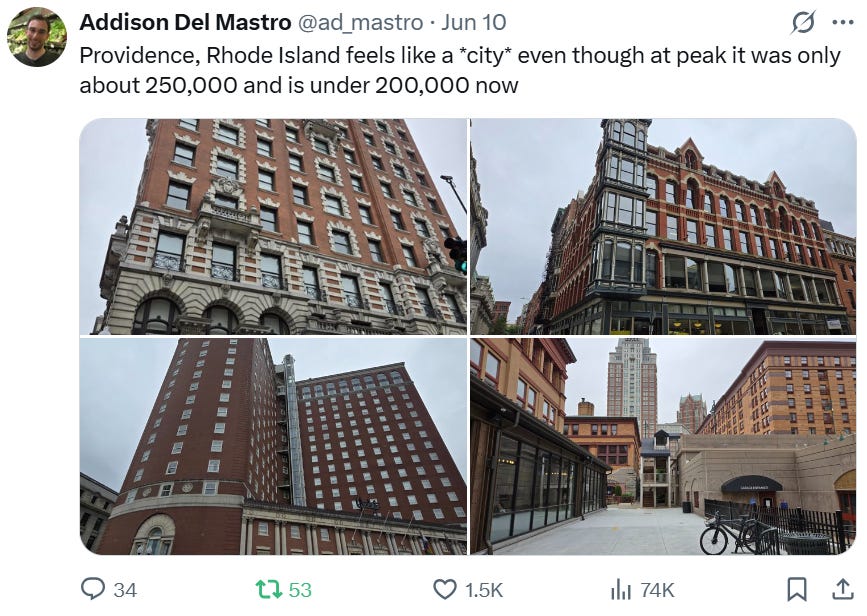
Most people simply liked, retweeted, or agreed that Providence is a bit of an underrated city (which I think it is, because it was quite nice!). A few comments, however, were snarky: like, Gee, who would have thought 250,000 people was a *city*!?
That—foolish amazement that a city environment might exist outside of New York/D.C./L.A./SF/Chicago—wasn’t my point. In fact, my point is kind of the opposite of that. What I meant wasn’t exactly that Providence felt like a city. More precisely, I meant that it feels urban. That is, that urbanity—the design DNA of a true city—is not dependent on very high population numbers, or even very high densities.
This is one of the first topics I ever wrote about: the urbanity of small towns and small cities. And it’s a topic that has always gotten some surprised responses from people who never really thought of that. And visiting a relatively small new city has me thinking about it again. So here’s a piece revisiting one of the core themes that inspired me to start an urbanism newsletter.
Urbanity, of which a “city” is the most intense form or example, resides in the multistory buildings with a mix of retail, offices, and residences; the wide sidewalks and legible street and block arrangements (grids versus winding streets and cul-de-sacs); the secondary place of cars; and the granular, visually interesting architecture, building size, and general streetscape.
In other words, basically every settlement from the pre-car era was a city. This is something that is obscured or lost today, because we talk so much about “small towns” as if they were not only different from, but in opposition to, “cities.” But they are really different intensities of traditional urbanism.
Take a look at this piece from A.M. Hickman, an interesting writer who (based on his writing) is a devout Catholic who lives in a small, somewhat distressed town in upstate New York:
On the walk back home, I was struck with an unusual thought: where had I done this before? Exactly this — rising from bed, realizing that there is no more bacon, walking down the street, purchasing the same package of the same brand of bacon, even hearing the usual “have a good day honey!” from a silver-haired old woman — I’d done it all before, somewhere else. And to my memory, I’d done it all without riding in an automobile or placing an order on a smartphone, and had done it all in less than ten minutes… I began to wonder whether I was suffering a strange and potent case of early-morning amnesia.
“Oh, I remember now,” I thought. “I did that when I lived in New York City.”
This was a bizarre connection to make — for our village is, at least on its surface, a perfect antipode to New York City.
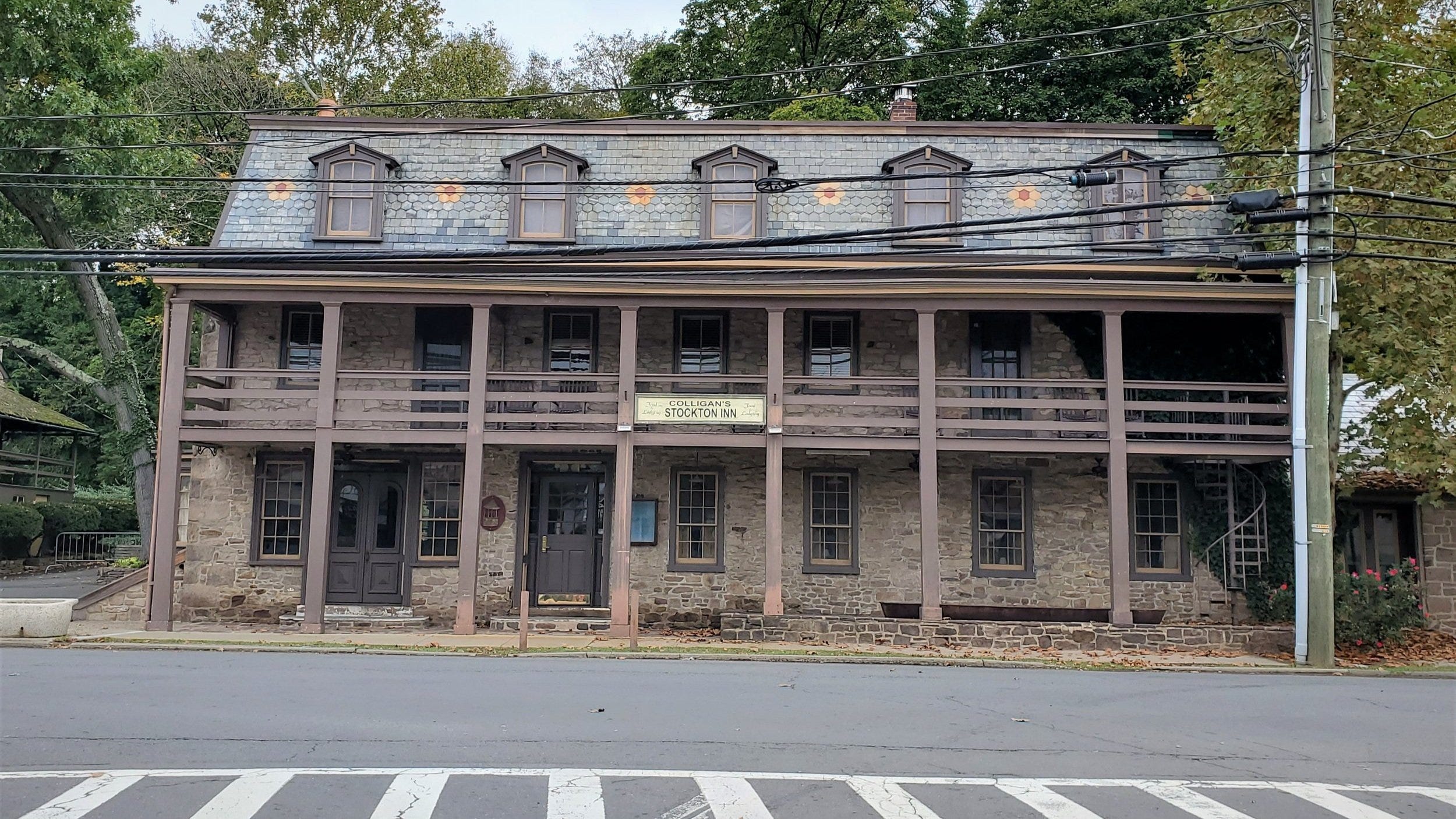
Hickman presents this as a sort of eureka moment. Much as I write confidently about this topic now, when I first got into urbanism several years ago, I had that same moment. I had it when I learned that the old show tune There’s a Small Hotel, now coming up on a century old, was inspired by the stately old hotel in the tiny town of Stockton, New Jersey, so quiet and timeworn today you would never know of its little connection to Broadway.
I had it even more with my hometown of Flemington, a town of about 5,000 today and closer to 4,000 when I was born. I had always seen Flemington, probably because it was familiar to me, as comforting, quiet, quaint—the opposite of New York City or Philadelphia, which felt loud, aggressive, intimidating. That town/city dichotomy in the culture and in my head stopped me from seeing what I was looking at.
But on one of our visits back to New Jersey, I suddenly realized—looking out at the multistory buildings, the walk-up apartment entrances nestled between the ground-level shops, the curtained or blinded upper windows, the surprisingly deep, boxy three-story buildings with restaurants built out of their fronts, once serving as tiny hotels or boarding houses—this is a city.
I recall seeing a scan of a newspaper story from the very late 1920s or very early 1930s from Flemington (it was from a Facebook post and I can’t find it again, unfortunately). It was very illustrative of this point. The column noted with pride that everybody from the surrounding countryside—the adjacent townships which are now thoroughly suburbanized and are home to most of the town’s real commerce—then came into downtown Flemington to do business. Flemington didn’t just resemble a city outwardly. It functioned as a city.
Nor was it merely a market town with a perfunctory Main Street. It once had rail service to New York City; it once had a glass factory; it even once had a foundry, just a couple of blocks off its downtown, staffed in part by European immigrant workers who lived in inexpensive homes nearby and walked to work. These are simply not things that happen in “small towns,” as we conceive of them today.
Most people, I think, assume there is some clear division between “town” and “city,” that they are not the same kind of place. Of course, there are ways in which the settlements commonly called “towns” differ from those commonly called “cities.” Jane Jacobs, for example, distinguished towns from cities based on population size (obviously) but also on privacy: a true city, in her telling, was large and crowded enough to offer anonymity, and this changes the way in which people interact and in which social norms are observed or enforced.
But even granting that, a town and a city are clearly not sortable into rigid categories (and social changes since the early 1960s mean that, probably, even small towns today are much more anonymous than when Jacobs wrote). Both of them are urban settlements, at different sizes and intensities, but not different in kind. In what way could they possibly be different in kind?
This is one of my favorite photos of downtown Flemington:
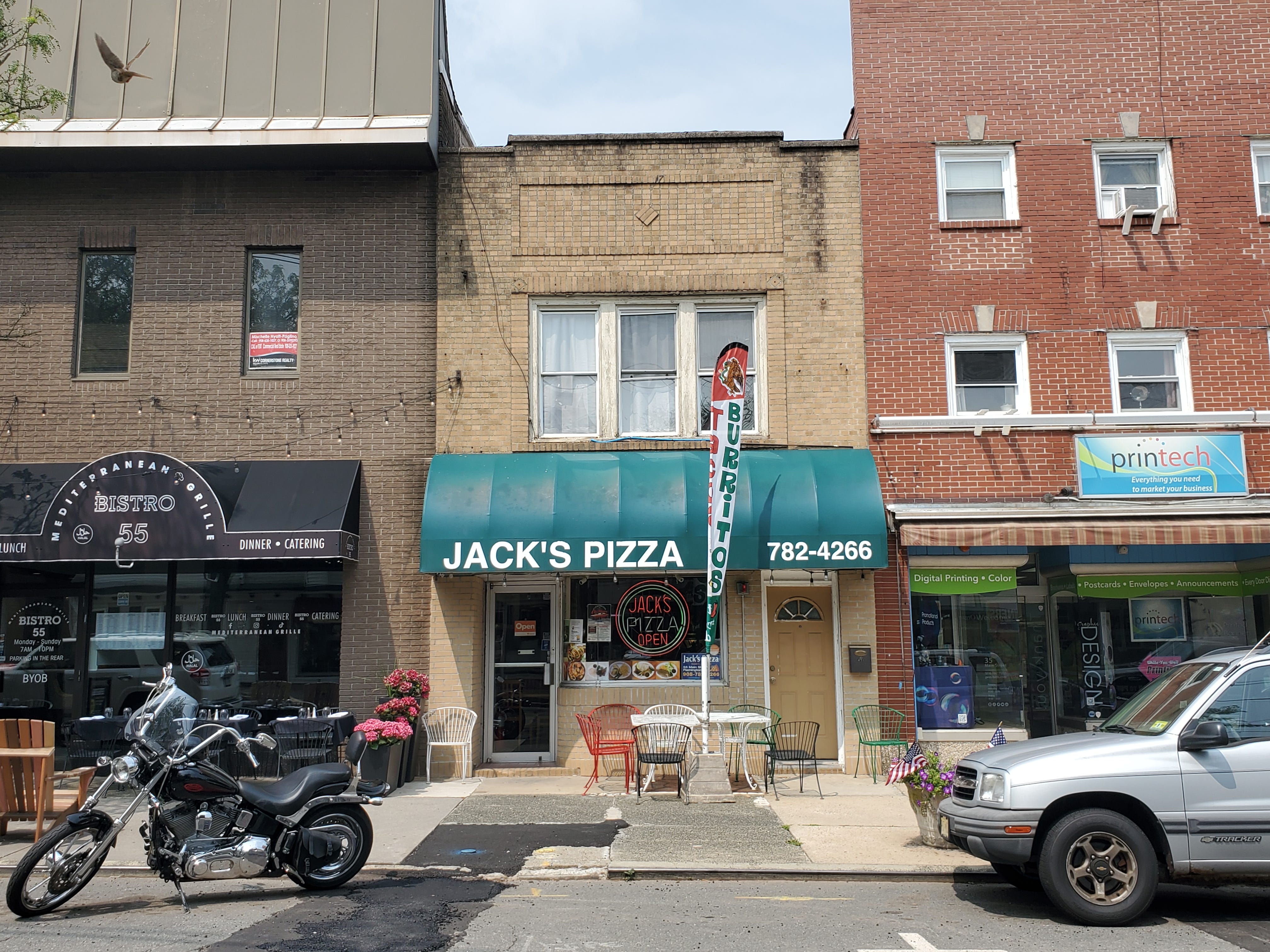
This photo, to me, is a challenge to many decades of American assumptions about towns, cities, and urban places. Because you could not tell whether this is from a town of a few thousand people with a two-block main drag, or one tiny fragment of a big city.
This piece of Flemington’s Main Street is simply not distinguishable in any meaningful way from, for example, wide swaths of outer New York City. You might say a real city needs tall buildings, but Paris is famously a fairly low-rise city, despite being quite dense and quite urban in its feel. Baltimore, Philadelphia, and Washington, D.C. are chiefly rowhouse cities.
And speaking of skyscrapers, here’s another piece of evidence that complicates this assumed town/city distinction:
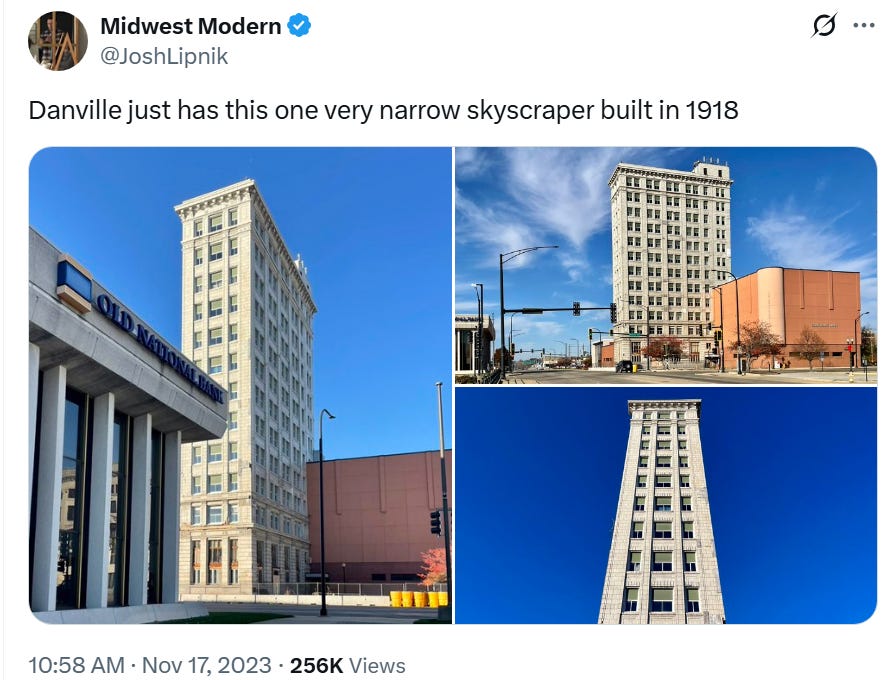
In 1918, Danville, Illinois had about 30,000 people. It peaked at just over 42,000 in 1970. The 1980 census was the first census in which Danville lost population. It’s again just under 30,000. Danville sits on the line between the common use of “town” and “city,” population wise.
Its old urban core, some of which was torn down for a mall project unfortunately, was otherwise typical relatively short multistory urban buildings. Is this a town? A city? Certainly, in 1918, the people who built a skyscraper understood themselves to be living in a city, and hoped to be more like the big cities with more skyscrapers. Surely, nobody at that time intended Danville to be in the present day a town of 30,000 people with one lonely skyscraper. The growth was supposed to continue.
That old culture of boosterism, in which every town saw itself as the next New York or Chicago, belies the way we think about what we call “small towns” today, as places that exist as alternatives to the “big city.” Whatever differences these settlements may have, no such clear line exists in history, and it exists only in our imaginations today. To put it differently, it is not possible to look at a given settlement decades or centuries ago and slot it confidently into the “town” or “city” category, nor is it possible to look at one today and discern what it was or how it was understood in that time.
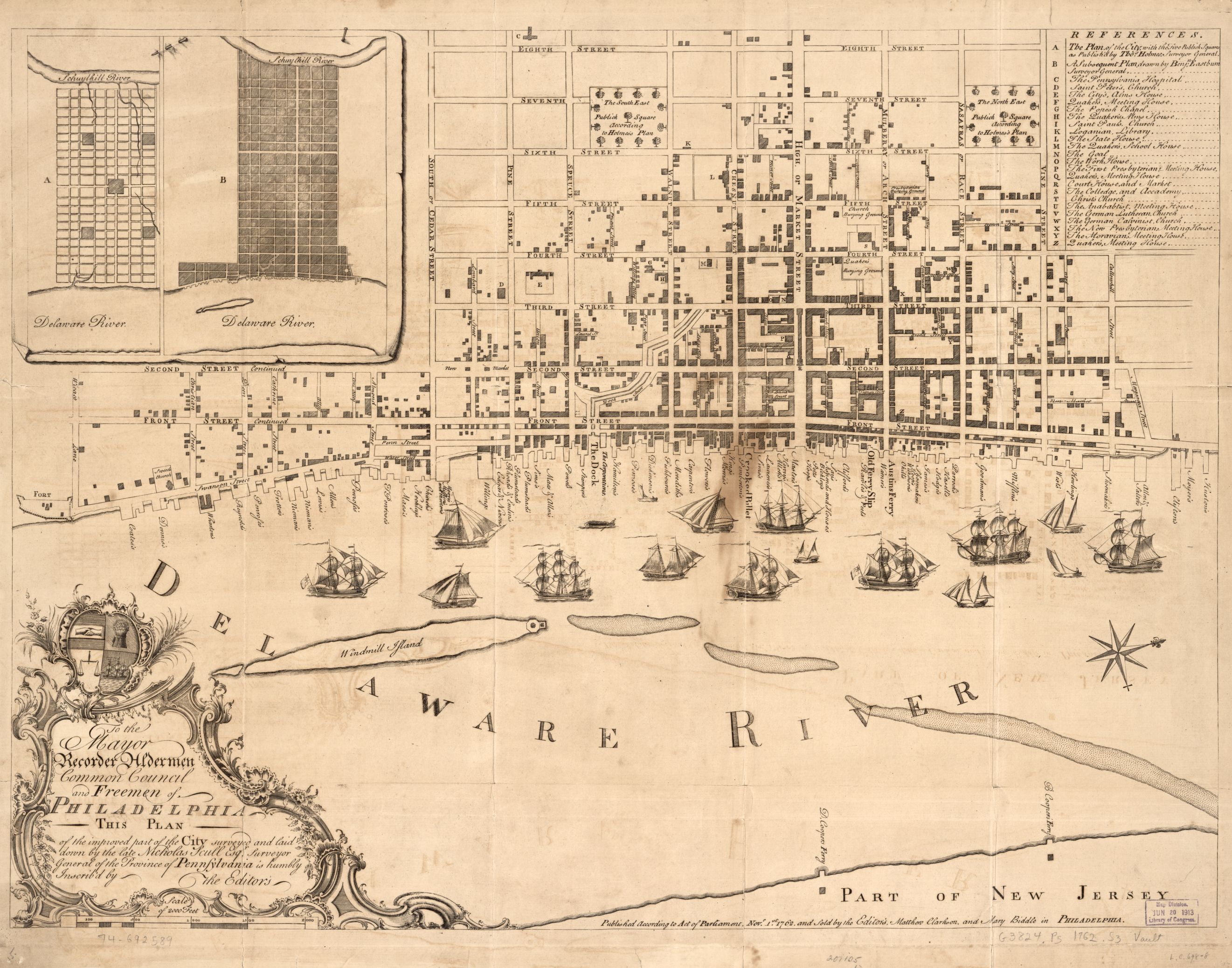
Culpeper, Virginia (clearly today a “town”) and the historic colonial-era core of Philadelphia are virtually indistinguishable. One grew much, much more than the other. But is it possible for things which begin in precisely the same manner to grow into things which are fundamentally different? Old Town Alexandria, historic Savannah, historic Annapolis—these “cities” are built in almost the exact same pattern as American “small towns.”
Of course, many of our old towns and cities have been tremendously hollowed out, either via vacant buildings or actual demolitions. Some of that is economic, some of it was urban renewal. Rockville, Maryland, now a D.C. suburb of strip malls and stroads, was once a gridded town with trolley service straight to D.C. In the urban renewal era, the Rockville government demolished almost the entire town.
You can find old photos of every old city, and many places that don’t look at all urban today, showing that America once had bustling, thriving urban settlements in every region, at every level of population. For example, here’s one of Little Rock, Arkansas. If the undated photo is from 1950, which is probably too late, Little Rock had only 100,000 people. But even many small towns enjoyed trolley connections within and outside of town.
What this all has to do with Providence is that Providence shows you that you can have more or less the same urbanity—less, but the same—as a “big city” with only 250,000 people. Flemington shows you that with only a few thousand people you can still have a little of it, even in the middle of what was once farm country. The notion that America only has a few “real” cities could not be more wrong. America is full of cities, large and small, quieter and more intense, and is more full of them the further you go back in time.
Many Americans love our “small towns,” and look askance at our “big cities,” but do not understand that they are substantially the same thing. Even some urbanists do not understand this. The “small town” and the “big city” in one sense are different sorts of places. But in another sense, they are modern fictions invented by a country that has forgotten what urbanity is, but perhaps is learning once again.
Related Reading:
A City’s a City No Matter How Small
Thank you for reading! Please consider upgrading to a paid subscription, discounted today and tomorrow, to help support this newsletter! You’ll get a weekly subscribers-only piece, plus full access to the archive: over 1,300 pieces and growing. And you’ll help ensure more like this!
I agree this collective misunderstanding / memory hole is one of the biggest problems in our cities and towns. It’s a big part of why we named the organization Strong *Towns*, not Strong Cities or something similar.
The closest word that I think almost works is “historical.” I think everyone kind of realizes that we used to build differently and that they like the old stuff that’s still around. The hard part is, as you point out, so many places self-destructed in the mid century that most examples we have are kind of compromised or scarred versions of the “real thing,” or are a small part of a much bigger city.
But the even more important point you make is our lost dynamism. The idea that most towns in 1900 saw themselves as naturally growing into the next Chicago — and that was a good thing — is really hard to relate to today. But of course this is the problem with the suburban pattern. In the historic pattern more people made everything better — it scaled up continuously and gracefully. In the suburban pattern more people means more traffic and less remaining nature but almost no additional amenities.
When my friends from Iowa ask me to describe what DC is like, I say: "It's like Main Street but copy-pasted ten thousand times." If you took the main street of any Iowan town and copy-pasted it ten thousand times, you'd get a big city.
I also think that people living in big metro areas have a different idea of what "small town" means versus people who live in the "hinterland". Here in DC, it seems people's imagery of a small town is more like a vacation town, like Shepherdstown, WV; in Iowa, a small town is a working-class settlement far from large metro areas. Your article actually seemed to touch on the former perception when you wrote:
"[I]t once had a glass factory; it even once had a foundry, just a couple of blocks off its downtown, staffed in part by European immigrant workers who lived in inexpensive homes nearby and walked to work. These are simply not things that happen in “small towns,” as we conceive of them today."
These are *precisely* the things that happen *today* in small towns in Iowa, like Marshalltown and Storm Lake. Immigrants from Latin America and Southeast Asia live in inexpensive homes near meatpacking plants and walk to work. One of my friends lives with his parents in a town of 1,500 people and walks to work at *his* local meatpacking plant.