

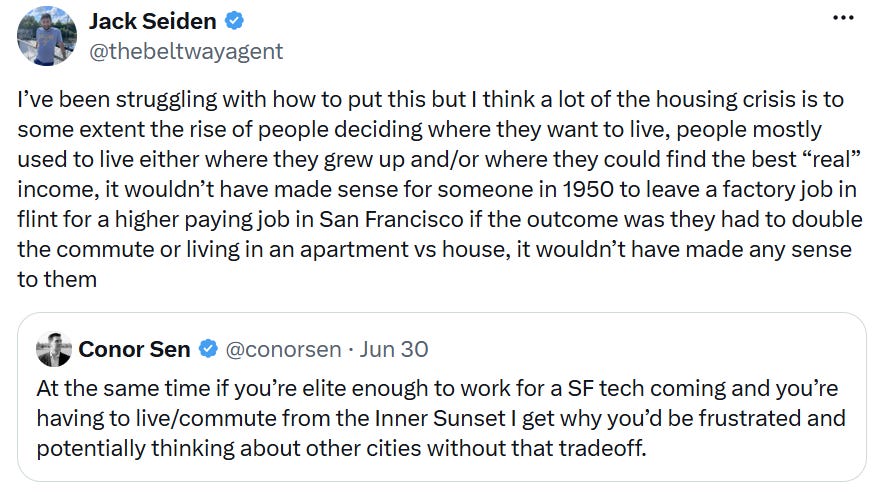
I saw this post on Twitter the other day, and I thought it was an illuminating frame for thinking about the housing crisis:
This makes me think of an old anti-YIMBY essay that inspired one of my first long pieces here at this newsletter, back in 2021. It’s a simplistic and moralistic article, but it’s full of ideas I grew up hearing: that owners care more for their properties than renters, that ownership builds virtue, etc. Maybe there’s a grain of truth in that, but ironically, I think it abstracts what are supposed to be practical considerations into an ideology.
A similar piece, which I’m not able to find now, mentioned in passing how all the young people want to move to the same 3-5 big cities because they see them on social media. There’s an idea that what we call the “housing crisis” is just a figment of a small handful of cities taking up too large a share of our economy and culture. Ross Douthat, back in 2017 when the housing crisis was first becoming a mainstream issue, demanded that we “Break Up the Liberal City,” arguing that the big cities are more like monopolies than wealth-generating assets.
Jack Seiden, the guy who wrote the tweet above, is not someone I’m familiar with, but his social media profile suggests he’s a YIMBY with some reservations—a pretty normal stance, and not a basically anti-urban right-leaning person like the ones I’ve just quoted. His point is that we kind of imagine we’d like to live somewhere in a way that is maybe relatively modern.
If that’s true it suggests that there is something to the conservative gripe about the small number of big cities. Descriptively, at least. Now it’s not true that
social media or even economic concentration drives the housing crisis—lots of smaller cities and towns have also seen price increases, because basically all communities pulled back on housing production for a few decades.
But part of the reason that’s become a problem is because