

I was at a happy hour the other night for a regional urbanist/housing advocacy organization. We were in Tysons this time, the car-oriented-hellhole-turned-up-and-coming-urbanist-exemplar which looks like this from the air:
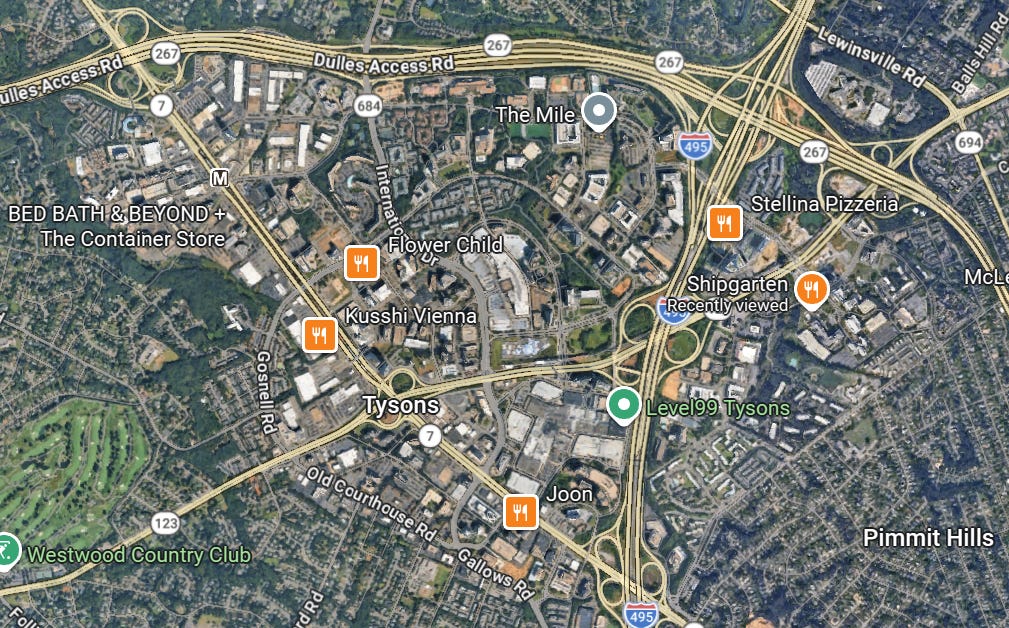
It’s a bit uncanny on the ground, too. On the way to our happy hour venue, I felt like I was trespassing a bit, almost like walking past the boundaries of a simulation into some unrendered quasi-space.
That’s fitting, though, because this whole area is an area in transition. In the 1950s and early 1960s, before the mall, it was still more or less a little crossroads. There’s a picture that circulates on Northern Virginia Facebook groups of a gas station along a dirt road. That was Tysons.
For a few decades, it was the epitome of a suburban, car-oriented landscape, albeit one with many “edge city” characteristics. Joel Garreau, the author of the 1991 book Edge City, used Tysons as an example. If the edge city meant something like an assemblage of urban amenities outside of an old downtown, Tysons is even more of that today, as it adds more housing and attempts to retrofit walkability into its severely car-oriented road network.
It’s fitting, then, that at the happy hour I was chatting with a few people about the idea of a place being “done” or “full.” A young woman in advocacy recounted being asked, at a public input session a couple of towns over from her home, where she lived. What the person meant was, if you don’t live in our community, what we do is none of your business. Someone else observed that people frequently open their comments at these sessions with how many years they’ve lived in the community, as if their vote is worth more.
This hyperlocal NIMBYism is understandable to me at a personal level, purely at the level of people not liking change. It doesn’t make sense as public policy, however. Housing and transportation are inherently regional issues, or at least inherently have regional effects.
A local politician in attendance said that one of the challenges with fragmented land-use authority is that no given locality can “solve” the housing crisis, no matter how much they build within their boundaries. This creates a kind of zero-sum or prisoner’s-dilemma attitude, where no community wants to bear the brunt of new development alone.
This is all familiar to you, if you’re at all involved in housing advocacy. This is what NIMBY/YIMBY is about. It’s what the debate over state preemption of zoning authority is about. But underneath the policy aspects of all of this is a conceptual error.
There is no such thing as a place being “full” or “done.” A community is not a consumer product that is built and maintained exactly as it is until it is discarded or disused. The NIMBY position, at its deepest, is that new housing/development/construction is a concession, an abnormality, an unreasonable demand. The most basic NIMBY assumption is that most given communities are already full, and the only option is to build somewhere else—wherever that is—or not at all.
People who implicitly hold this idea, including many who are just sort of casually opposed to disruption and change, probably find housing advocates to be a bit crazy. Who would want more housing? Why do these people hate existing communities? Only pro-housing sentiment is an agenda; NIMBYism is just…normal. Where do you live?
In fact, I think there’s a tendency to view every given moment in a place’s long evolution as what that place is, or is supposed to be. You could always have found people, in Tysons, who preferred the previous iteration. We have a way of fitting what was once revolutionary change into a narrative, smoothing it over and treating it as if it were always so, while the next change will really be a problem. We mistake a snapshot of a place for the place itself.
Really, “NIMBYism”—at least among normal people, as opposed to dedicated NIMBY activists—is largely that natural aversion to change applied to housing and development.
You can see it everywhere, when you start looking. For example, it’s funny how many restaurant reviews say something like “This place has really gone downhill.” There was a restaurant I used to really like in the mid-2010s, and it, well, went downhill in the post-pandemic years. Lots of recent reviews agreed.
But out of curiosity, I read some older reviews, from the period when I used to love the place. There was more or less the same mix of sentiments, with several negative reviews stating that the place had—yes—really gone downhill!
Was it that much better five years before I started going? Or is there just something about memory and nostalgia that create this perception? As an incisive comment I came across on Reddit put it, “Nothing is ever as good as it was.”
It may be that many if not most of us are wired to experience reality through this bias. It may be that a lot of housing advocates—though absolutely not all—are people who are naturally more excited about, and less averse to, change.
I am probably naturally averse to change myself, or at least prone to nostalgia. But as someone who cares about ideas, it was immensely helpful to my urbanist “conversion” to realize that my own feelings were perceptions I was reading into things, rather than realities that I was discerning.
My favorite restaurant in 2015 wasn’t necessarily my favorite restaurant. Maybe in its current, gone-downhill form, it’s someone else’s favorite restaurant. Tysons in 1960 or 1990 or 2026 is not Tysons. The entire Northern Virginia region has grown astronomically since the middle of the 20th century.
There is no “real” place in the ether, some Platonic form of it, from which the actually existing place on the ground is illegitimately diverging. There is no correct or final end state. Human settlements change every bit as much as humans do.
This is not a negation of community or local character; it is a more expansive understanding of community and local character. A place is what it is—and what it was, and what it will be. We are all, all the time, part of it. We are building it together. This is the philosophy that underlies urbanism and housing advocacy.
In a way, this makes me hopeful. It means that people with NIMBY sentiments may feel those feelings strongly. But it also means that they may be operating from the point of view that there isn’t really any other point of view. If “this place is full” is a kind of uneventful, uninterrogated fact in your mind, like the existence of gravity, that means there is an opportunity for an alternate worldview to at least be presented.
In other words, by explaining housing advocacy as following from a coherent if unfamiliar understanding of what a place is, we may reach people for whom the apparent absurdity of housing advocacy is such a bare fact that they have never really considered the underlying ideas at all.
I really was like that, before I became involved in these issues. I liked cities well enough—at least visiting them—and I liked the proximity and variety of stuff in College Park, Maryland, where I lived during grad school, a couple of years before I got into urbanism and housing.
But I didn’t have the framework or the vocabulary to explain to myself what I was experiencing, or what I liked about it, or what allowed those attributes to exist. I still “saw” the traffic and the sense of crowdedness more than I “saw” the subtle way that density and proximity create human interest. I still preferred Virginia to Maryland, because it felt more open and spread out, like you could take a mental deep breath. I didn’t see reliance on cars as a factor in anything, because I understood it to be as much a fact of life as the weather. I compartmentalized my life and the built environment; cities were cool, but they didn’t quite exist the same way the places I knew and lived in existed.
I was amenable to urbanism—to what was originally to me a curiously counterintuitive idea that it might be good to have more growth and more people—exactly because I had never encountered it, and found it to be a fascinating and highly credible framework not just for public policy, but for explaining, almost at a metaphysical level, what it means to build and inhabit a place.
And I think we are not anywhere near the saturation point with the American public, where anything close to a majority of us could explain this alternative, expansive, positive-sum philosophy of growth, as those of us who hold it understand it.
There is, in other words, a lot of room to grow. To help explain, advocate, and build a world in which the evolution of the places we call home is not an aberration or a concession or a conspiracy, but the point itself.
Related Reading:
If You Build It, They Won’t Care
One of your best and most insightful posts. “A place is what it is—and what it was, and what it will be.” Despite our efforts to “plan” what a place will become, there is an unpredictable randomness to what disappears (Blockbuster, Sears, roller skating rinks) and what takes their place (brewpubs, data centers) and how, in just a matter of years, the cycle repeats (“Remember back when we used to think we needed land the size of ten football fields to use A.I. on the Internet? Now look at all those empty 2026 data centers”). I like the way you reflect on your own nostalgia for the things of your relatively recent (from my perspective) past, because you understand what motivates both NIMBY and YIMBY viewpoints.
This was terrific! I am passing it on to people at our local housing nonprofit. In my community, we have been having a lot of ongoing angst about the building of new apartment houses, affordable housing, and the location of a homeless shelter. Many of the anti-change people say Cape Cod is full, but of course that never happens. They would like to close the bridges to anyone who doesn't want, need, or can't afford a cozy cottage! I enjoy your posts, but particularly this one, as it addresses a subject near and dear to my heart. Communities that are "full" don't change, and that means a slow death.