Fan Service
Why can't I replace the little metal piece that attaches my fan blade to the motor?
You wouldn’t believe how much trouble this gave me:
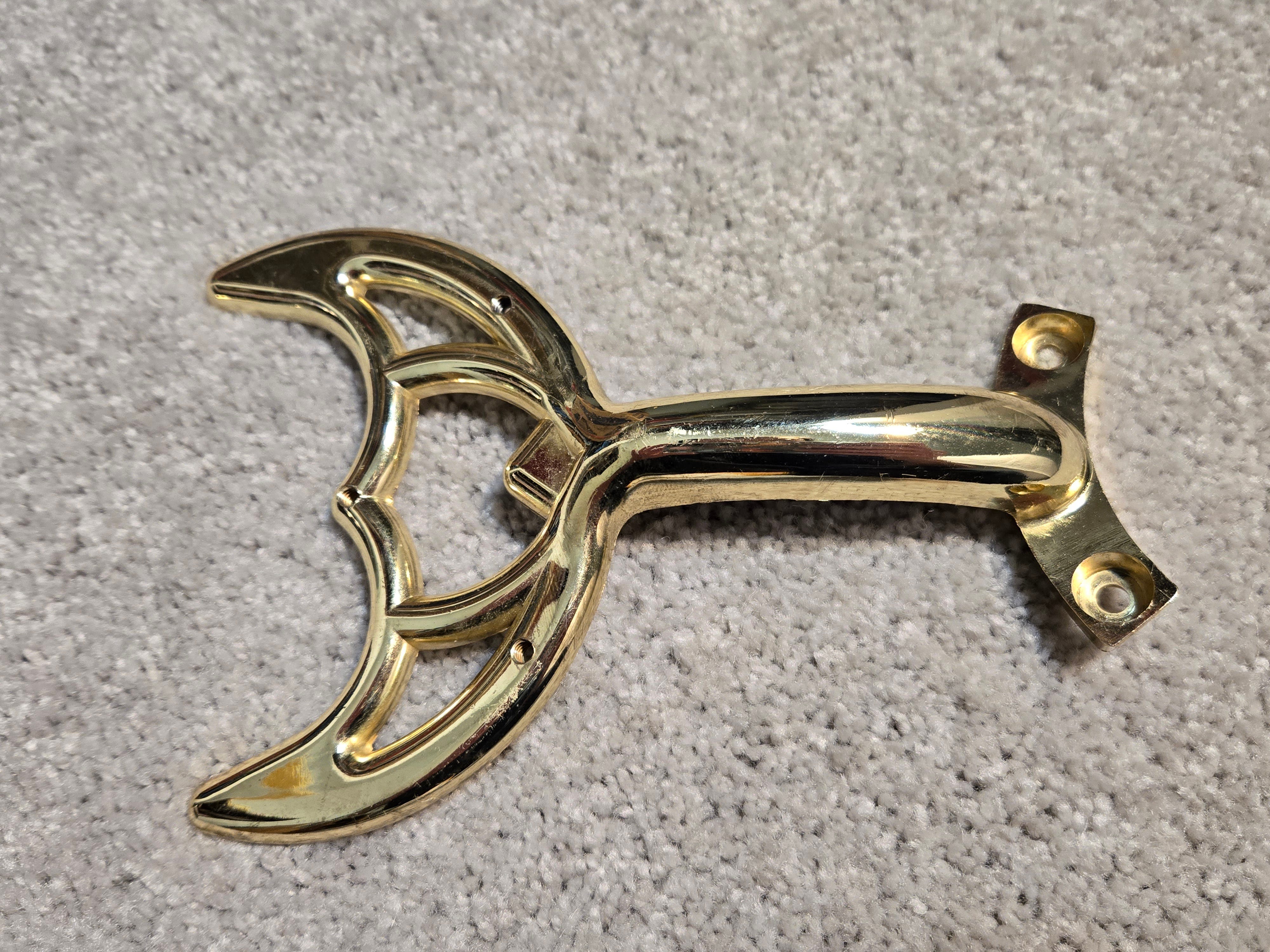
This is the “arm” of a ceiling fan: the piece of metal that attaches to the motor base on one end and the fan blade on the other end.
I learned this because one of the arms on the fan above our bed cracked, luckily not when we were there or when the fan was actually in use. One day I just found a fan blade attached to half a fan arm on the floor.
A little annoyance, right? You would imagine—or at least I did—that this was a pretty universal part, or at least one of those things with maybe two, three, four variations. You know, a limited number of identifiable standards. That is…not the case.
I went to Lowe’s, bought a universal fan arm kit, and it didn’t even close to fit. The holes where the arm screws into the fan motor were much closer, so there was no way to get the arm to attach. And the sizing and placement of the screw holes and how they meet the fan blade were all different, too.1
Next I looked on eBay for old fan arms, figuring someone would have one that I could at least narrow down to being a likely fit based on appearance. But on close inspection nothing available on eBay even looked like it would fit! This seemed puzzling, because the fan in our house couldn’t be that rare, could it?
It was this model:
There’s very little about Supreme Fan online; it certainly doesn’t exist anymore. Here is a YouTube video of someone demonstrating a different Supreme Fan model. The video description notes:
This ceiling fan was made by the Supreme Fan Company in Taiwan. Not much is known about Supreme, they were around in the 70’s and 80’s. This particular fan seems to be a slightly later model with a stamped vented motor. Features a 3-way light/fan pull chain and a 3 speed click knob speed control. The canopy is that of a Hunter Original [not identical, a copy of the design]. Odd fan, definitely a cool one though.
The video maker is a vintage fan collector, so I imagine it is really true that not much is known about this company!
That was important for my purposes, because it meant the chance of finding this particular part was probably slim to none. And that meant—and ultimately did mean—that instead of being able to buy a $5-$10 stamped metal part, I had to scrap an entire completely functional fan because of one broken part. (We replaced it with a ceiling light, because the cheap new ceiling fans seem to have a 6.5 watt limit per lightbulb socket—meaning you might not even be able to safely run three-to-five 60-watt equivalent LEDs, and a bunch of 40-equivalents was not bright enough for us—and the fans that have better lighting cost a lot more than a decent light fixture.
The one other thought I had was to try an arm from another fan we have. Here’s one elsewhere in our house that looks basically identical to to the one with the broken arm. Yet upon close inspection even these arms are not precisely the same (the inside here is just a hollow circle, the other one has two metal lines running through the inside).
They might be interchangeable, because the “hole pattern”—the points where the blade screws into the arm—look the same, as does the spacing of the screw holes where the arm meets the motor base. But they might not be, because these might be off by just so; in any case I did not try, because I didn’t want to cannibalize a part from a fan that was just fine.
Wait, there was one more attempt. I found an entire ceiling fan a few blocks from our home out on the curb, and it looked very similar, so I drove there, picked it up, and took off an arm and blade and tried it with mine. Not only is the hole pattern different—and if I remember correctly, the motor screw hole spacing was a fractional amount off—the pitch, or angle of the blade, is different too!
Here they are side by side, the one I was trying to replace on the left and the salvaged one on the right: the holes are all differently placed, and you can see how different the pitch/angle is when you look closely. (Bonus difference: the screw holes aren’t even visible from the top on the salvaged one; meaning, the blade screws in from the opposite side!)
The blades between my fan and the salvaged fan were also a little different; though if the new arm did fit the motor, it would have been possible to swap the entire salvaged fan’s set of arms and blades onto my old motor.
Anyway, having given up the search for a cheap part and given in to consumerism, I still wanted to know why something so simple and economical was so difficult. I had no luck calling an online fan parts company, but I had one place in mind: Dan’s Fan City, in this neat old double-decker strip mall on Rockville Pike in Rockville, Maryland:
Dan’s Fan City is a Florida-based company that both manufactures its own lines of ceiling fans and runs retail stores. There’s a good corporate history on the company’s about page. Some of the stores are independent dealers, so they only sell Dan’s fans/parts, but they’re independently owned. The one in Rockville is one of these. It’s a little old-school shop with so much stuff crammed into a small space:
I figured if anybody could tell me anything about these fan arms, it would be someone working in a store like this. I went in with my two fan arms, and asked the lady working the counter if she had a moment.
She was happy to chat about fans for a few minutes—she’d taken over from the store’s owner who was too old to work the sales floor, and had learned a lot more than she ever expected (or knew there was to learn) about ceiling fans.
It took her only a glance to confirm that in this whole store, there was no fan arm that would be interchangeable with mine. (The Dan’s stores only sell their own products.) There was no standardization on the screw spacing, hole pattern, angle, or blade size. Every manufacturer did their own thing, and might change it over time. She pointed me to a pile of boxes full of fan arms, and said that she invited customers trying to match one to take a look, but you’d be lucky to find one just right.
She gave me the pitch about how the Dan’s products are better than the box-store stuff, which I don’t doubt; those may work fine, but they’re hard to find parts for, and are basically just sourced from a factory and not really designed or manufactured by their retailers.2
But the big point here is that the issue is standardization, or the lack thereof. Some things are standardized, such that you never have to think about them: computer peripherals using USB, battery-powered devices using one of several types of commonly available batteries. Other things, like laptop charging cords, are often not standardized. Some things, like phone charging cords, have become standardized over the years.
This is why consumer advocacy is such an important area of advocacy and policy. The standardization of basic, user-replaceable parts is low-hanging fruit for consumers, and yet this sort of thing is barely talked about. (It was talked about somewhat with regard to Apple using proprietary charging plugs, which they did eventually change; I can’t think of another example where a question of consumer-product standardization became something of a popular issue.)
In any case, ceiling fan parts are not only not standardized, but come in a wild array of minute differences. This does not even mean you’re “locked into” a brand, so much as it means parts are often impossible to source at all. It’s incredible to think of the amount of frustration, and the amount of waste, that results from such a dry, wonky issue as this—and how little it would take to fix it.
Related Reading:
A Repair Journey Through Low-Cost Manufacturing
Thank you for reading! Please consider upgrading to a paid subscription to help support this newsletter. You’ll get a weekly subscribers-only piece, plus full access to the archive: over 1,500 pieces and growing. And you’ll help ensure more like this!
Not relevant here, but the weirdest thing happened when I went to return the fan arm set: they couldn’t refund me because the receipt didn’t show the fan arm set. It showed a blade set. I was and am absolutely certain I did not ring up a blade set and then swap it at the checkout for an arm set. After getting a manager involved, I got them to take the arms back and do the refund, but they still didn’t seem to quite accept that they had, in fact, somehow keyed the barcode from the arms to the blades.
A little side note: if you look up Dan’s online, some folks on the internet speculate that it’s a front for illicit activity. I’m quite sure that’s not the case, and it’s kind of sad that people think that about these quirky old specialty stores (sew-and-vacs get this too). Stores that focus on something specific, that can provide employment to people with a specific interest, and that can offer actual knowledge of the product they sell, are a good thing. We lose something in the texture of everyday life when we lose that.


Addison, your basic problem is that you are no Eugène Christophe. During the 1913 Tour de France, Christophe broke his front fork while descending the Col du Tourmalet, a steep mountain pass in the Pyrenees. Race rules at the time forbade outside assistance, so he had to fix it entirely on his own. He carried his bike for about 10 km to the village of Sainte‑Marie‑de‑Campan. There, he went into a local blacksmith’s forge and repaired the fork himself, hammering and welding the metal back into shape. Officials watched to ensure he received no help, and he was even penalized because a young boy pumped the bellows for a moment. The repair cost him hours and ultimately the race, but it made him a legend.
Accordingly, Addison, stop looking for the easy way out!!! But I guess there are no blacksmiths left in Arlington.😳😳😳
Brillaint breakdown of how micro-differences snowball into real waste. The pitch angle variance between those salvaged parts is a detail most ppl would overlook, but it perfectly shows why this isn't just about buying the "right" fan. I ran into smth similar with a laptop charger where the voltage was identical but the barrel size was off by like 0.5mm.