
Grasping At Creation
Preservation is important; building things is hallowed, too

Readers: Every full week before Christmas, I publish a series of longer, fuller pieces, and offer a discount for new yearly paid subscribers (newly signing up or upgrading from free). This week is no different. The new-subscriber discount runs until the end of Sunday, the 21st. If you’ve been on the fence about upgrading to a paid subscription, this is a great time. Your support keeps this going. Here’s to a sixth year of The Deleted Scenes!
I took this photo in my hometown back in September 2024, in the thick of a major redevelopment project on Main Street which is now wrapping up:
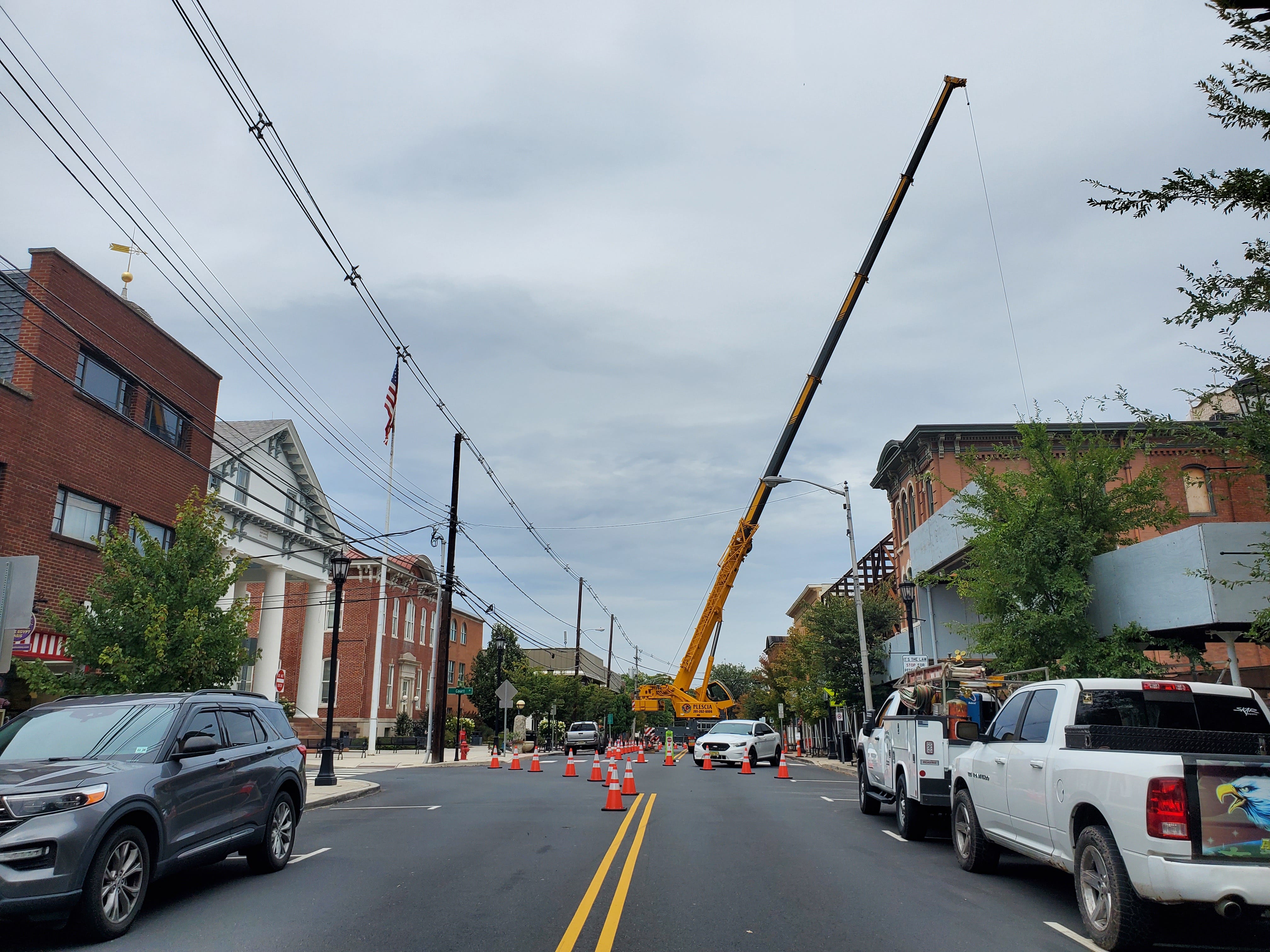
As I took that photo, I also just stopped and looked for a moment. That image of a crane reaching into the sky inspires something in me. Some would say it’s Tower of Babel; I was thinking more Notre Dame spire.
As I’ve followed these issues around development, housing, and urbanism, I’ve increasingly come to see building things as good; almost hallowed. I don’t think of it only as a technocratic question of building enough housing units. I see the human work of building and maintaining, transforming the dust of the earth into something beautiful, as a sort of shadow of the miraculous. In this little sandbox of ours, we are grasping at the act of creation.
Building things in this fragile world is a dignified thing. Paradoxically, perhaps, I’ve come to feel this more as I’ve read about the history of places, and learned in particular about the history of my own hometown. It’s made me appreciate that history has not always existed. Someone built and left us what we now view, shorn from its history and context, as always having been there. We see these artifacts as signs of stability, not signs of the dynamism of the past.
I wouldn’t want to see the historic buildings on my town’s Main Street torn down, of course, and nobody wants to do that. But the project that crane was working on was, to me, a perfect mix of new and old: our historic old hotel was renovated and really, more or less rebuilt; a sturdy historic building next door was preserved; and one building in rather poor condition was taken down, and part of its footprint is going to be a public plaza with some small retail spaces facing out onto it. The really controversial thing, though, was new apartments, which loom above the little old hotel structure and are, as a literal matter, “out of scale” with the other buildings.
I really do understand just wishing it could stay the way it is. But that just isn’t always viable. The big hotel/apartments project was not the town’s idea, or pro-development folks’ idea; it was, after many years, the one project that a developer found worth doing and actually seeing through to the end. There were many fits and starts, during which the historic hotel decayed so badly we’re lucky it was saved at all.
I think many NIMBYs are sincere, in that they really do care about about character and community and history of the places they live. Some, of course, are not sincere, but when I write about these things, I’m addressing the people who I think are sincere, whoever they are. I say that because had I not discovered urbanism and seen the need for housing advocacy, I would probably be one of those sincere NIMBYs.
What I see now, though, is that NIMBYism looks like a kind of defeatism. It looks to me like a kind of scarcity mindset that sees no brighter future, only a slow decline. No excitement for what comes next, only clinging with white knuckles to whatever crumbling beauty is left.
We are naturally risk averse, naturally wired to see what we have being taken away. I think that is a natural sentiment to an extent, and I understand it. The problem is a public policy regime in which that sentiment has veto power over housing and planning and the built environment.
But I think we often fail to see the beauty around us, now. And I think of urbanism and the YIMBY mindset as a struggle against that tendency towards risk aversion and a perception of constant loss.
This is why I say that urbanism requires humility. It implies pluralism. It implies acceptance of new things that are not bad, but which may not be comfortable to us. It implies curiosity. It pushes us out of the idea that our preferences are the same thing as the public interest.
Now I noted that I feel sympathetic to the anti-development attitude, as a simple “I like things the way they are” feeling. But there is also a deeper NIMBYism which I find very mistaken: it is a kind of false metaphysics and anachronistic history. It does not—despite its concern about neighborhood character—take account of why or how any human settlement exists in the first place.
NIMBYism, were it in operation at any important hinge point in the history of our legacy towns and cities, would have strangled them in the cradle. It is only because the NIMBYs of the day, who no doubt existed in some number, did not get their way that the NIMBYs of today have these beloved places to freeze in time.
I’m not using this observation as a cudgel against people who oppose any project of any sort anywhere. I don’t favor building anything anywhere. In a small-town setting, at least, maybe it’s okay to limit the height or mass of new buildings. The rules governing what is allowed should be more lenient and should be simpler and more legible, but I’m not against there being some rules.
The point I’m making is a more conceptual one, about understanding what it means to honor and preserve the communities we live in. I do believe we have a responsibility to steward the places we inherit: to consider them, as they exist now, at least presumptively as having some worth.
Failing to do this was the error of the architects—I use that word fully aware of the irony—of urban renewal, who saw in our historic cities nothing but junk to sweep away. That is a mistake that can be made today, even by people who consider themselves urbanists or YIMBYs. (For example, I considered the urbanist case for resisting complete redevelopment in aging suburbs here.)
But this caution does not imply stasis. The legacy and history and character of our places, as they exist, is partly in their buildings, in their visible forms. But it is also in their spirit; every place that exists was brought into existence. Historic preservation is sometimes appropriate, but it can be overused, and then risks losing sight of the fact that every place had to be built, and in being built had to change what came before. Go back in time, and every artifact hallowed by time and remembered with nostalgia was once new, and then, even further back, did not exist yet. Everything old was new.
In other words, preserving the character of a place is not simply a euphemism for encasing its physical form in amber. And doing so is not the highest way to honor a place. Part of what we owe our communities is keeping alive that spirit of creation: keeping alive the dynamism and the belief in the future which their outward forms inwardly signify.
It is not spitting on the past to do big things in our own time. The character of our neighborhoods is in their vitality as much as their form. The people who built the places we now love surely would not have expected us to just stop. They would not have thought they were speaking the last word. In some sense, we owe it to them to continue their project, and we owe it to ourselves to participate in it.
Building things is not a sacrifice to grudgingly accept. It is how we made the places we love, and how we can keep them, living and dynamic, to pass on to the future.
Related Reading:
Thank you for reading! Please consider upgrading to a paid subscription to help support this newsletter, discounted just this week! You’ll get a weekly subscribers-only piece, plus full access to the archive: over 1,400 pieces and growing. And you’ll help ensure more like this!
I truly appreciate the balance in your writing on these topics. I would add two things:
First, building is fun!
Second (and this is what some YIMBYs miss) as we build "stuff," we need to also be building community.
I think about this during science fiction movies that show amazing future cities. How do you think we are going to get there? On the other hand, maybe because 2025 doesn't look like what people thought it would in the 60s, people don't get excited about the future?