

Take a look at this Vietnamese grocery store in St. Paul, Minnesota:
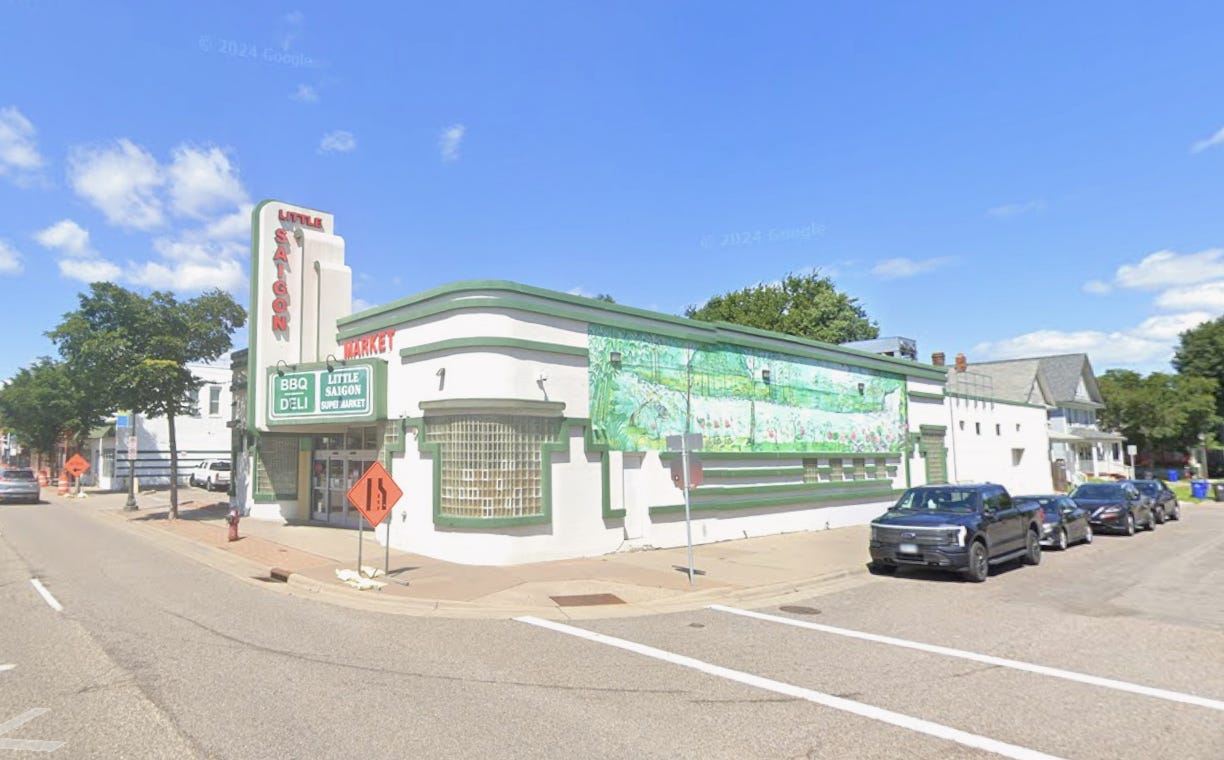
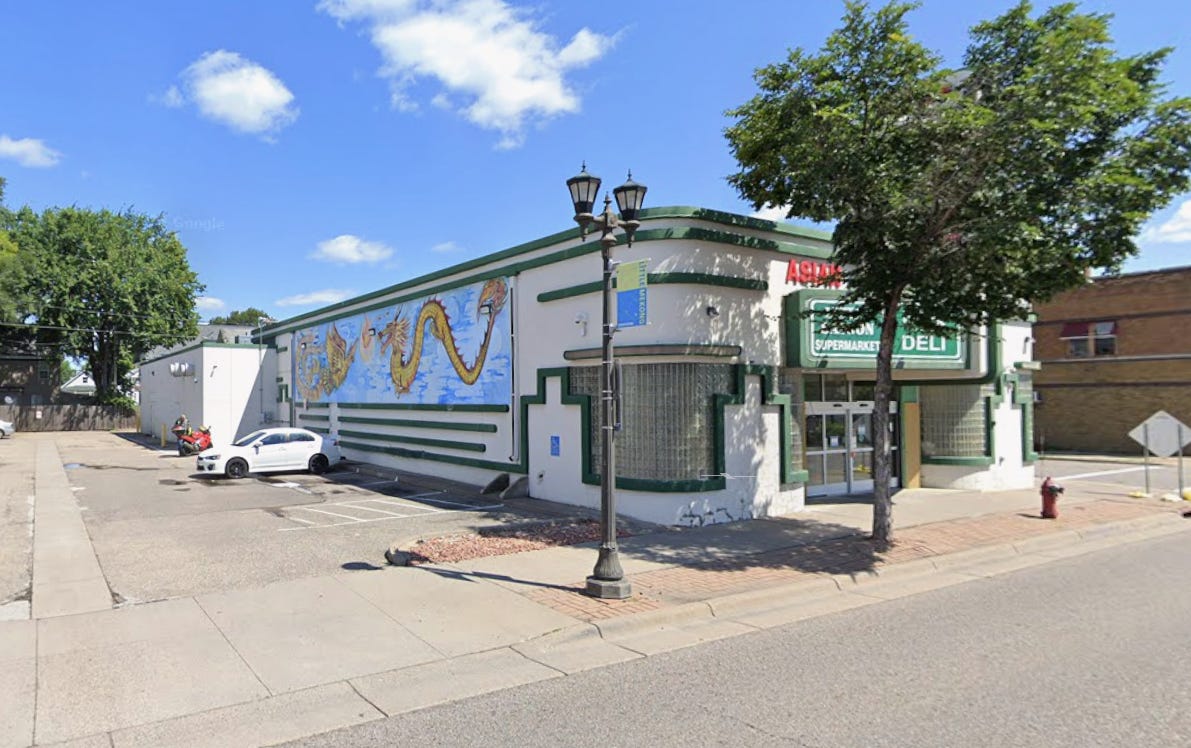
Now that’s cool. It’s some kind of old art deco building that’s now a regular old store. Maybe, though the ceiling is a little low, an old movie theater.
Apparently, some people remember that. However, they are wrong, and it turns out the building is not a vintage art deco building at all!
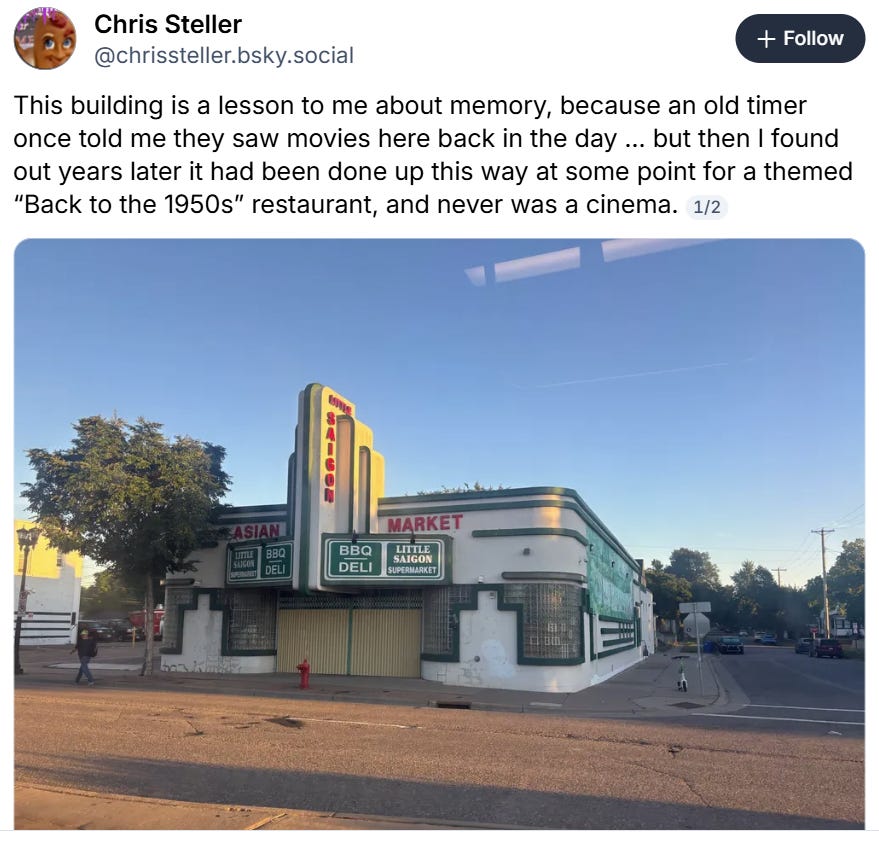
I posted about it once, in fact, and found a 1987 photo of the diner!
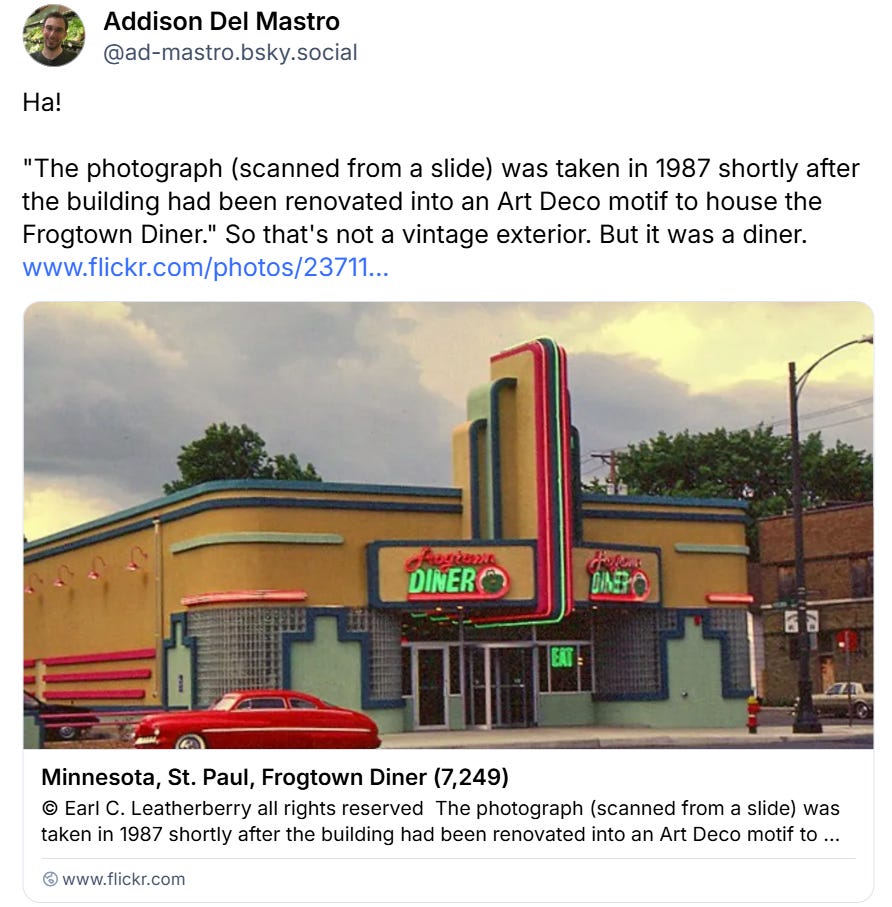
The photographer writes:
The photograph (scanned from a slide) was taken in 1987 shortly after the building had been renovated into an Art Deco motif to house the Frogtown Diner. The Frogtown Diner, on University Ave, was open for only a few years before closing. Another restaurant went in the building and later an Asian meat market.
A local news article from February 2023, occasioned by the death, at 90, of one of two owners of the diner, notes that they were quite a successful business team:
After learning from mistakes and improving marketing, Armstead and Evans began opening more and more restaurants, at their height owning 25 locations in four states.
While the chain was by far their biggest endeavor, the partners started numerous other businesses, including a ’50s-themed Frogtown Diner that opened on University Avenue in 1988, an idea they had picked up from a similar place in Chicago.
The business was fun to operate, and Armstead and Evans even started their own radio station from the diner. However, it ended up being expensive, costing $1.2 million to open, and difficult to run, Craig Armstead said.
So if the faux-vintage exterior is only from the late 1980s, as a self-conscious nostalgic look, what was this building before that? Let’s do a little newspaper-archive spelunking.
The first reference in newspapers.com to the Frogtown Diner is from April 19, 1987, advertising job positions for a “brand new 50’s style restaurant.” Here, from July, is part of the first review it got. The waitress names are a recurring theme, with different reviews giving a series of different stereotypical 1950s names!
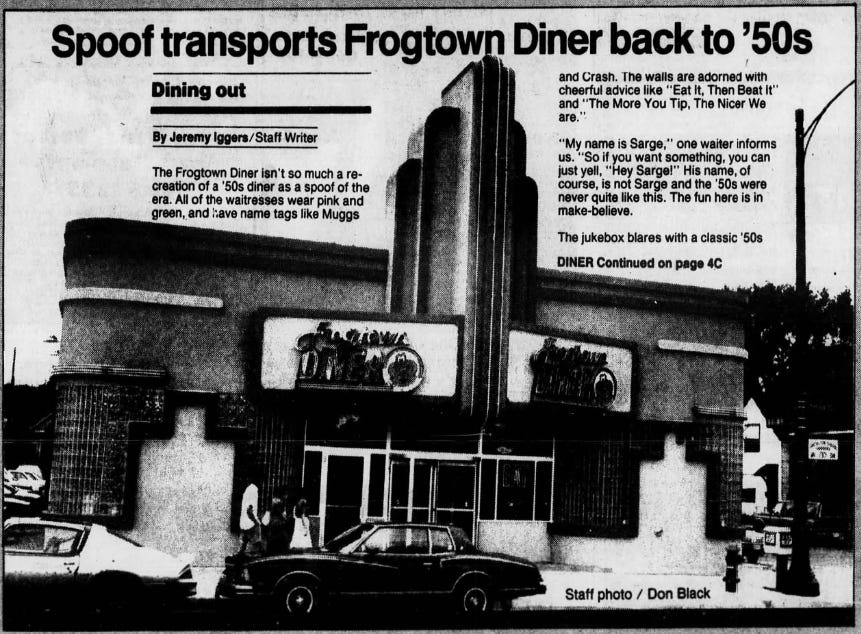
However, he had this to say about the food: “The high point in authenticity is reached in the cuisine. Food in the ’50s was forgettable, and the Frogtown’s cooking is for the most part faithful to that standard. (I read that in a Gordon Ramsay voice.) Here we learn the waitresses chew bubblegum and have names (not their real names) like “Thelma, Madge and Blanche.”
By August 1991, however, the Frogtown Diner had closed. In 1995 the location had a sale for 1950s advertising and memorabilia. In 1996, it first became a Vietnamese grocery store, Ha Tien. The last newspaper reference to the Frogtown Diner is 2001, also by way of mentioning the Ha Tien market and the success of Vietnamese immigrants.
Unfortunately, none of these reviews or profiles give any clue as to the building’s previous occupants, uses, or appearance. So we’ll try searching the address and see if those previous uses were recorded alongside the address.
Believe it or not, the address has a hit as early as 1886, a brief ad for a barber shop!
In 1890, the address is given with an ad for a store clerk position: “Young man, speaking Scandinavian and English, wishes to get a position as clerk in a store, understands care of horses.”1 The ad runs many times, and later on—here’s one from 1891—the language changes, suggesting the address itself might not be a store: “A young man wishes to get a position in a store of any kind; speaks Scandinavian and English.”2
In 1895, newspapers.com gives me an ad for the Branch Bakery at that address—however, I believe the 5 is really an 8, and this is therefore not a match.
An 1896 news item references “the barn at the rear of 353 University Avenue,” in which a young man apparently committed suicide.
1911 gives the address, apparently, as the Zion Presbyterian Church. That congregation was in the Frogtown neighborhood at the time, but according to this page, was a few blocks away. Perhaps it once met at that address.
In 1914, we get a completely opposite association with that address: a saloon! The next hit, in 1931, gives the occupant as Capital Welding Co. In 1944, it’s a tavern—so maybe saloon was correct and there were multiple units/uses at the address. 1947, tavern (a crime story); 1952, Jones Bar and Grill; 1968, an ad for go-go dancing at the Gopher Lounge (the lounge also featured live country music). In 1971, a go-go dancer at the Gopher Lounge was given a “15-day workhouse sentence” for public nudity.
In 1986, it appears to have been listed for sale, and then, in 1987, we finally come to that very first Frogtown Diner hiring ad.
When was the current structure actually built? Real estate listings and even the official property record say 1986. From aerials the building looks like it was extended that year, but it’s hard to tell if it was a completely new building; the references to it being renovated, and its unusual shape, suggest to me that build date is wrong. A boxy building at that corner is there as far as 1947. After it became a grocery store, the back was expanded, but the original structure is completely intact.
Look at the building’s side. I’m almost certain a brand-new diner wouldn’t have this mostly windowless exterior. So I think we don’t know the construction date for sure.
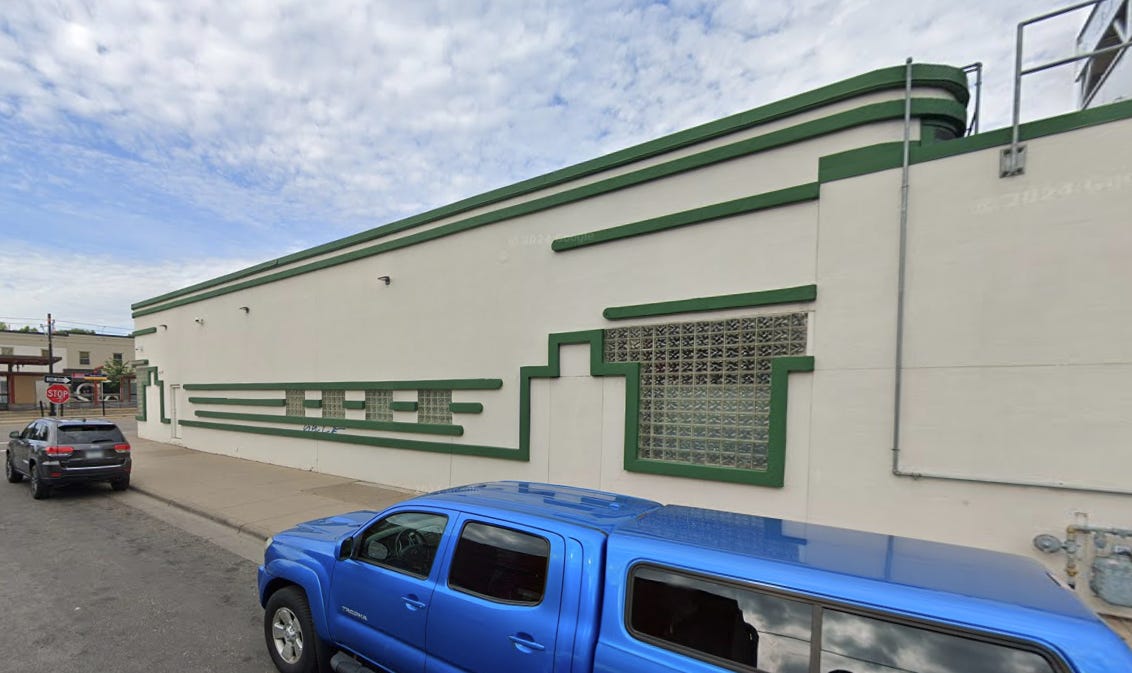
That’s fitting, in a way. The individual buildings aren’t what make a neighborhood like this. The whole thing is its own place, even as the particulars hop in and out of the picture.
Related Reading:
I’m Really Gino’s Underneath It All
English is listed second! The idea that immigrants or immigrant communities today are resistant to learning English, or whatever, doesn’t seem accurate to me.
“Young man, you can work in a store, I said
Young man, come on in through my door, I said
Young man, do I need to say more?
But you need to be bilingual….”