
I Know I Am, But What Are You?
Snarkiness is a kind of vice

I saw this sign by the door of a restaurant the other day, and it annoyed me, probably more than it should have. I wasn’t even trying to eat there; I was doing an errand run and noticed it while stopped at a red light, so I snapped a quick photo:
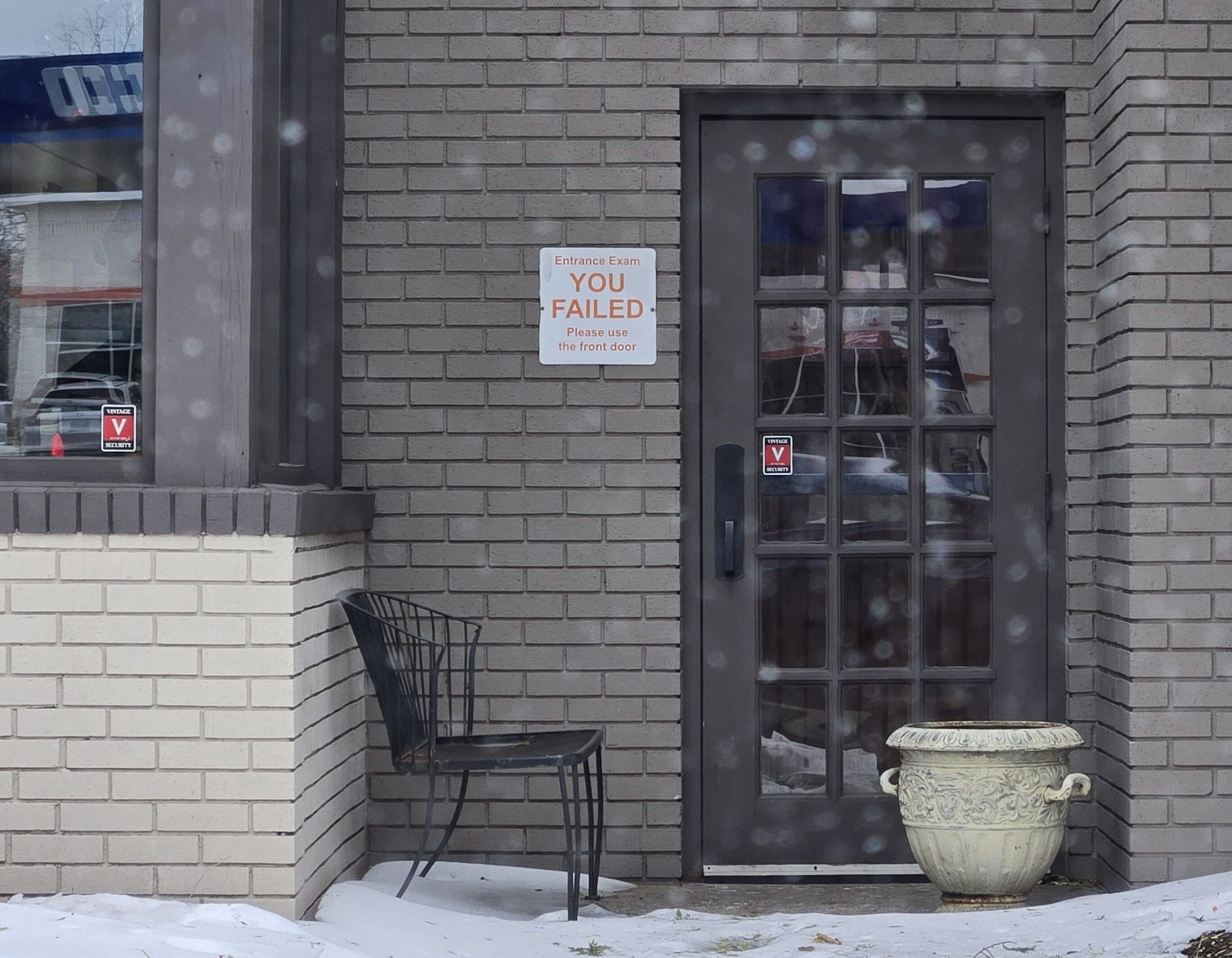
I suppose they think it’s cute or cheeky, but I find it…civically distasteful? This is not a particularly dense area—this is western Fairfax County, Virginia suburbia—but this reminds me of something that (often) more conservative-leaning urbanists point out. With greater density—greater concentrations of people, more everyday, unchosen human contact—comes a greater need for patience, kindness, courtesy, and situational awareness.
Often by this they are referring to nuisance behavior like being disruptive on trains, busking with amplified sound, etc. Sometimes people read into this—or there is—a class snobbery going on. But I would expand the observation to something like this.
“Haha, we have a door that isn’t really a door, but it’s your fault, stupid customer, now give us your money!” isn’t really funny. It reminds me of some electronic game I found in Walmart when I was a kid, and wanted my mother to buy for me. But the toy said “Try again, little baby” when you lost, and my mother thought that was too rude. I agree with her now.
I was slightly ticked off for about five minutes after seeing that restaurant sign: long enough to storm into the post office (where I was actually going) in a pleasantly annoyed state, like Scrooge after he tells off the fellows collecting Christmastime donations for the poor, instead of looking around for anyone to hold the door for or smile at.
And it made me wonder how much rude/annoying/snarky behavior taxes us, socially and psychologically. What percent happier would we be if we all—I include myself as well as the snarky restaurant—really, genuinely reminded ourselves that we live in a society, that we owe something to it, that we’re not all the main characters in a little self-satisfying story?
This makes me think about Japan, which, based on what I’ve read about its culture, and backed up my experience visiting for vacation, has a much more rule-bound and generally polite atmosphere. Business owners and staff seem buttoned-up by American standards, but extremely hospitable and considerate in their way.
I don’t get the sense that a Japanese business would make a joke at its customers’ expense, for example, and thereby put the customer in the position of having to decide whether to stand up for himself and walk out, or whether he’s overreacting, etc. It can be difficult to discern the difference between conformism and politeness, but I think America could use more of at least one of those things.
Now I want to note, I can imagine the business owner’s side. Maybe the door is kind of obviously not the main entrance, yet people keep yanking at it, knocking, acting put out that it isn’t the entrance, etc. So the owner tacks that sign up to emphasize the point while having a little humor about it. Maybe it was once an entrance for a former occupant and the new interior no longer works with it being an entrance. Who knows. It’s not a big deal. It’s silly of me to pledge that I would never spend a penny there because I won’t pay for the privilege of being insulted. And perhaps this is exactly the kind of attitude the restaurant owners want to keep out.
But…how hard would it be to tack up a sign that instead says “This door is an exit only—please use main entrance at the front. Thank you!” How hard are pleases and thank-yous? Really.
I’m not just being a curmudgeon. (Not just.) My point is that if the expectation you start to derive from being out in public doing things is that nobody is going to be particularly nice or accommodating, then you might as well be around as few people as possible. Rudeness drives a desire for a larger private sphere. For less spending on communal assets or on businesses. And the less we all are out spending time with each other, the less attuned we are to social skills.
I quite dislike unprofessional or insincere behavior. It’s one reason I don’t like “takes” or memes, and the whole “I’m saying this but I might not really mean it, so if you challenge my stated view I can say ‘it’s just a meme’” thing. It feels like the same category as the annoying door sign: using humor to disguise a motive, kind of. Not being brief and plainspoken.
And I think that, specifically with regard to urbanism, with the desire for more connected, dense, walkable communities needs to come a higher standard of conduct.
Related Reading:
Why Does The Bad Guy Feel Like The Victim?
Whose Leftovers Are They Anyway?
Thank you for reading! Please consider upgrading to a paid subscription to help support this newsletter. You’ll get a weekly subscribers-only piece, plus full access to the archive: over 1,500 pieces and growing. And you’ll help ensure more like this!
Agree 1000%. Same with people who walk around wearing rude or vulgar tshirts, billboards using euphemisms and double entendres (no, I don’t want to explain to my 7 year old what the local semi-pro hockey team means by “PUCK THAT”), and so on. Bottom line, I’m really just over the coarsening of society.
I'm aware this might sound a little snarky itself, but I can't help finding it a strange mix of amusing and confusing that conservatives could be offended by an innocuous joke like this but will then turn around and call liberals/lefties "snowflakes" when they're offended by actual bigotry and hate. I'm not saying you do this personally, or that some lefties don't also overreact to innocuous jokes, but as someone who's been trying for a while to understand conservatives better and take them in good faith, I gotta say, things like this make it a little harder.
This probably speaks to a larger issue - different people are offended by different things, and one of the challenges inherent in a pluralistic society is that individuals need to be mature enough to take humor for what it is ("sure that offends me, but I'm not the main character here, so whatever" is the healthy adult reaction). But something that's been clearly revealed in the Information Age is that a great many people can't do that. Many people across the political continuum clearly place their own delicate sensibilities above all else, creating needless friction. Strange reality we live in.