
I Went To Europe And Now I'm Not So Sure About Urbanism
Great cities need air conditioning, and much more

A European vacation is supposed to underscore, for an American, the poverty of our built environment, if not our lifestyle. We sit in soul-crushing traffic, alone in oversized gas-guzzling cars, while the Europeans stroll down to the piazza for a pre-dinner spritz. We lock ourselves in comfortable air-conditioned homes, with postage-stamp yards, privatizing the public realm. We drive everywhere, for everything, and when we experience a landscape in which walkability and proximity reign, we go, “Well, that’s fine enough to do on vacation,” as if nobody lives in the places we’re visiting.
There is some truth to this critique of American life, and there really is something almost otherworldly and yet déjà-vu familiar about life in beautiful, walkable, pleasantly crowded cities. Now, maybe I just really shouldn’t have been in Europe in one of the hottest weeks of the year, during one of those heat waves that never happens that happens at least once a year now. But our recent vacation spanning Italy, Austria, and the Czech Republic felt less like an aching whisper of what could be, and more like a confirmation of the oversized, air-conditioned American way of life.
TLDR: the intense heat, from which you can’t escape all day and maybe not even at night, makes you a little goofy, in a laugh-so-you-don’t-cry sort of way, and a heat wave is a good time for a roast, isn’t it?
What you imagine when you go to Europe is fairytale sightseeing followed by a lazy evening on a town square sipping an aperitif. The hardest question you’re supposed to wrestle with is, Aperol or Campari? What they don’t tell you is you sit outside and nurse a drink because you work four days a week, your apartment makes a shoebox look like Versailles, and it’s too damn hot to do anything else. It’s too damn hot to do that too, but at least you have a drink. And France even tried to ban that!
Some say Europe is just poor. I don’t think that’s quite right; they’re rich enough to choose to live like they’re in the third world. During the height of the heat wave, the French were chalking over their windows to deflect heat, like cavemen scratching at a wall. The difference is, the cavemen didn’t have beautiful churches.
Speaking of beautiful churches, we went to Mass at one of them. If not for a couple of stragglers and a few nuns padding the stats, you could’ve mistaken it for the Last Supper itself; 12 people showed up.
Beautiful architecture only gets you so far. There’s certainly some very nice new construction in Europe, and some modernism which does not appear designed to offend the sensibilities of normal people. But most of the beautiful buildings are just…old. Even the beer is old. I saw a brewery founded in 1861; we were abolishing slavery while they were drinking lager.
And the thing is, they’re not really building these things anymore. If America had an extra 1,000 years, we’d be Europe. We’d have houses and cathedrals from the dark ages too. Europe isn’t better at this; they’ve just been around so long, they’ve stopped doing it for longer than we’ve even been around.
And those picturesque cathedral squares that anchor every city and draw so many people into the old cities (where most people don’t live anyway)? They’re the product of a state of affairs that very few modern Europeans, probably rightly, would return to. There was no separation of church and state, no negotiation over whose denomination got to have the most centrally located church. You can have communion in any church, as long as it’s Catholic. How many Europeans these days even know exactly what a cathedral is? How many of them appreciate that these majestic structures that define so much of the look and feel of their cities were built by a religion they don’t believe in, and whose preeminence they would not return to?
Europe is very secular these days; it’s Portland and Seattle with history. Most of what people think of as “Europe,” and what Europe sells as “Europe,” is old and obsolete. The world that built it now resides firmly in the past, and this is considered a triumph of liberalism, democracy, and human rights. So it may be, but there’s a certain irony in this. The line goes that Americans love Disneyland but don’t realize it’s basically just a walkable car-free city; I felt the creeping suspicion that walkable car-free Europe is basically Disneyland.
And in any case, most of Europe isn’t car-free anyway, and the drivers on old European streets are crazier than the drivers in a Costco parking lot. It does make you appreciate the safety factor—for pedestrians—of smaller vehicles. I’ve never been so grateful for a tin can with a manual transmission.
I shouldn’t be too negative. Italy was very nice, especially the Alpine regions. Certainly, we enjoyed it more than Sicily. The Czech Republic was alright too. The people were wonderful. In particular, the Czech women are supposed to be very beautiful. I guess they were all out of town. The food is tasty, but it has no green. It makes British pub fare look like a garden salad. The beer is cheap, though, and goes well with the food. It’s almost like reverse razors-and-razor-blades.
Austria did not wow us quite so much (and it was what made me think of Seattle). Some even say schnitzel was invented in Italy, so Austria hasn’t done much of anything. They do make a good schnitzel, though, and a schnitzel—that is, one schnitzel—is enough. The Austrians think they’re good at fighting wars and frying meat, and they’re good at one of those things.
Well, they’ve done one other thing: Mozart was Austrian. (So was someone else.) Mozart was from Salzburg. Salzburg is very lucky; if Mozart had been from Albany or St. Louis, Albany and St. Louis would be international tourist attractions. Salzburg is also famous for salt, which it’s actually named after. They might even like salt more than Mozart. At least they’re still making salt.
Salzburg also has a castle—the imposing Fortress Hohensalzburg—yet another reminder that most of the reasons anyone goes here are hundreds of years old. In the middle of the castle’s museum, in between tidbits of medieval history, is a display about the persistence of poverty and inequality, complete with a little poor box if you should be so moved.
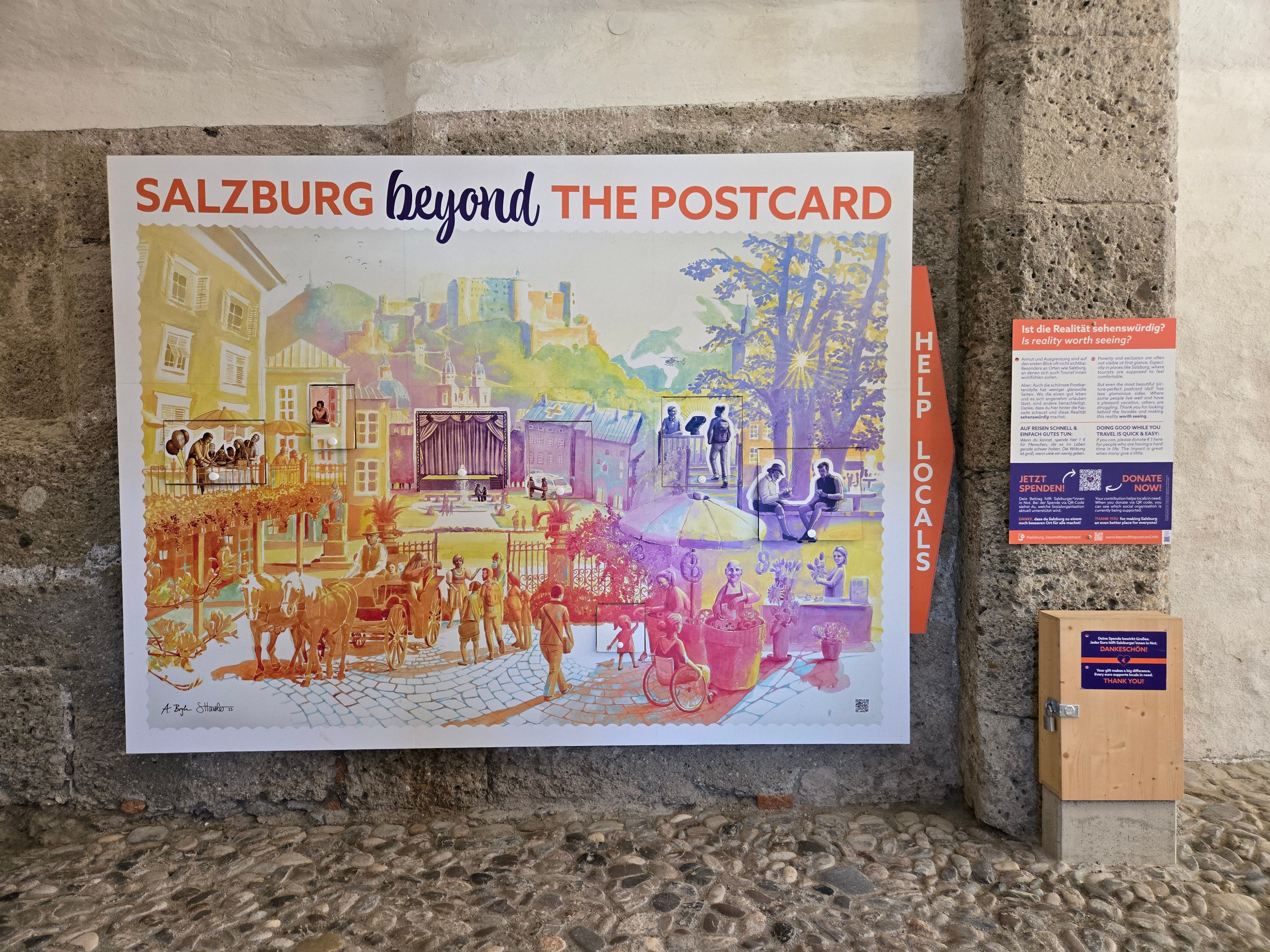
I mean, look at this. What are you doing, thinking you should feel nice on vacation?
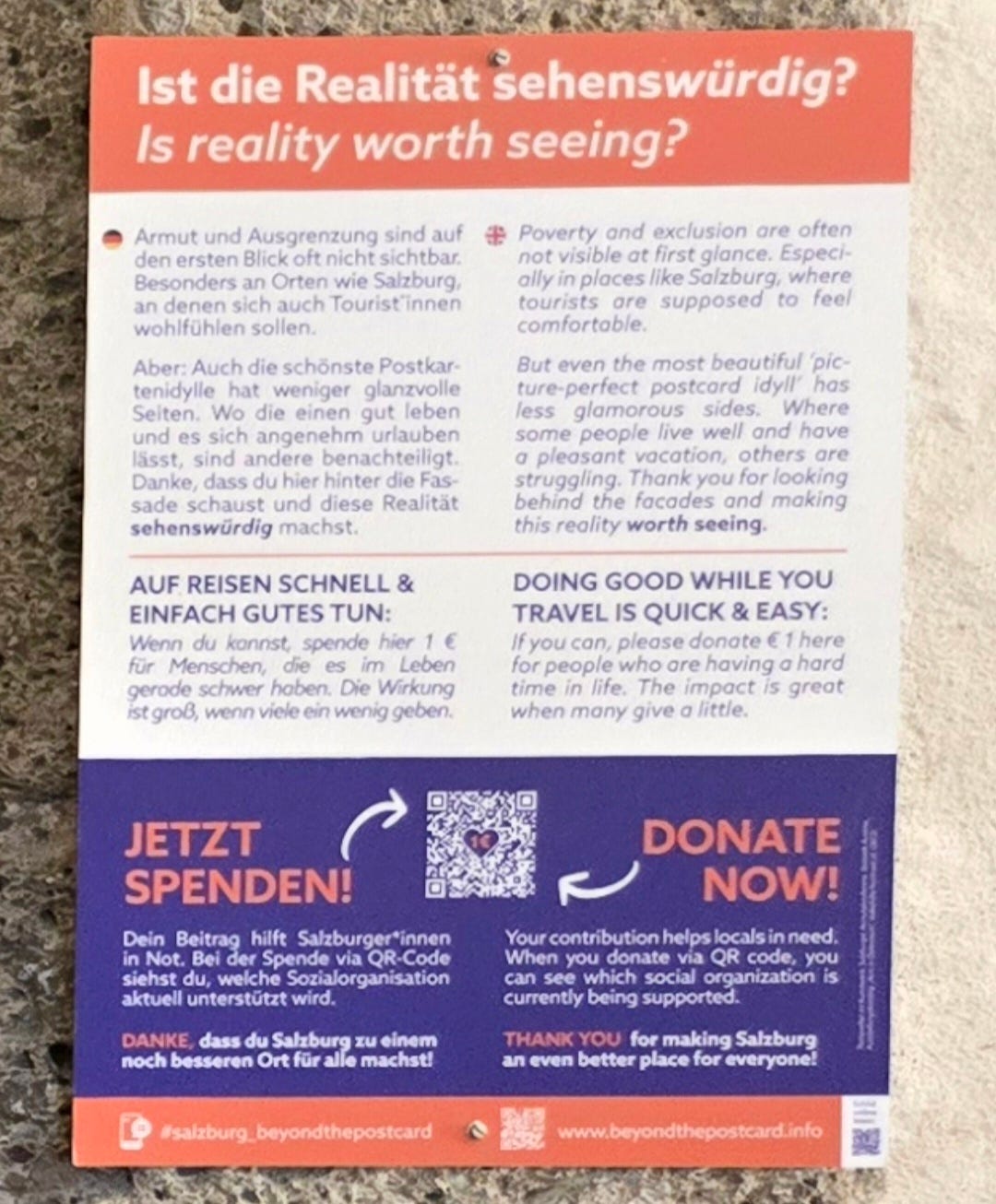
And now for a break in our scheduled programming, we would like to remind you that we haven’t beaten poverty, even in our high-tax paradise, but your stray coins might do the trick. Remember, making our visitors, who are just trying to learn about our history, feel bad about the problems we can’t solve is how we achieve economic equality!
The museum also has a section with “accessible language.” If you’ve ever taught a toddler to read, it will be familiar. This is a castle. A castle is very big. A person called a king lives in the castle. He is very important. Oh, and maybe he rules an independent ecclesiastical principality:

Why, a four-year-old child could understand this exhibit! Run out and find me a four-year-old child, I can’t make head or tail of it.
Personally, I find this not so much “accessible” as condescending. And I’d like to know how many people who read at a kindergarten level are visiting a museum of cultural history. Maybe I’d be surprised. But it’s worth noting all the rest of the exhibits are explained in normal language. The poor peasants only get one accessible section. They should be thankful they get that much, I suppose. The more things change, the more they stay the same.
Maybe it’s the secularized echo of Catholic guilt or Calvinism, but these Europeans really do seem to like taking a swipe at their own beautiful history, and impose just a little guilt on the tourists substantially keeping their economies afloat.
Over in Vienna, they thought a sculpture depicting plastic garbage would be a fine addition to a major historical street which is now a luxury shopping district.
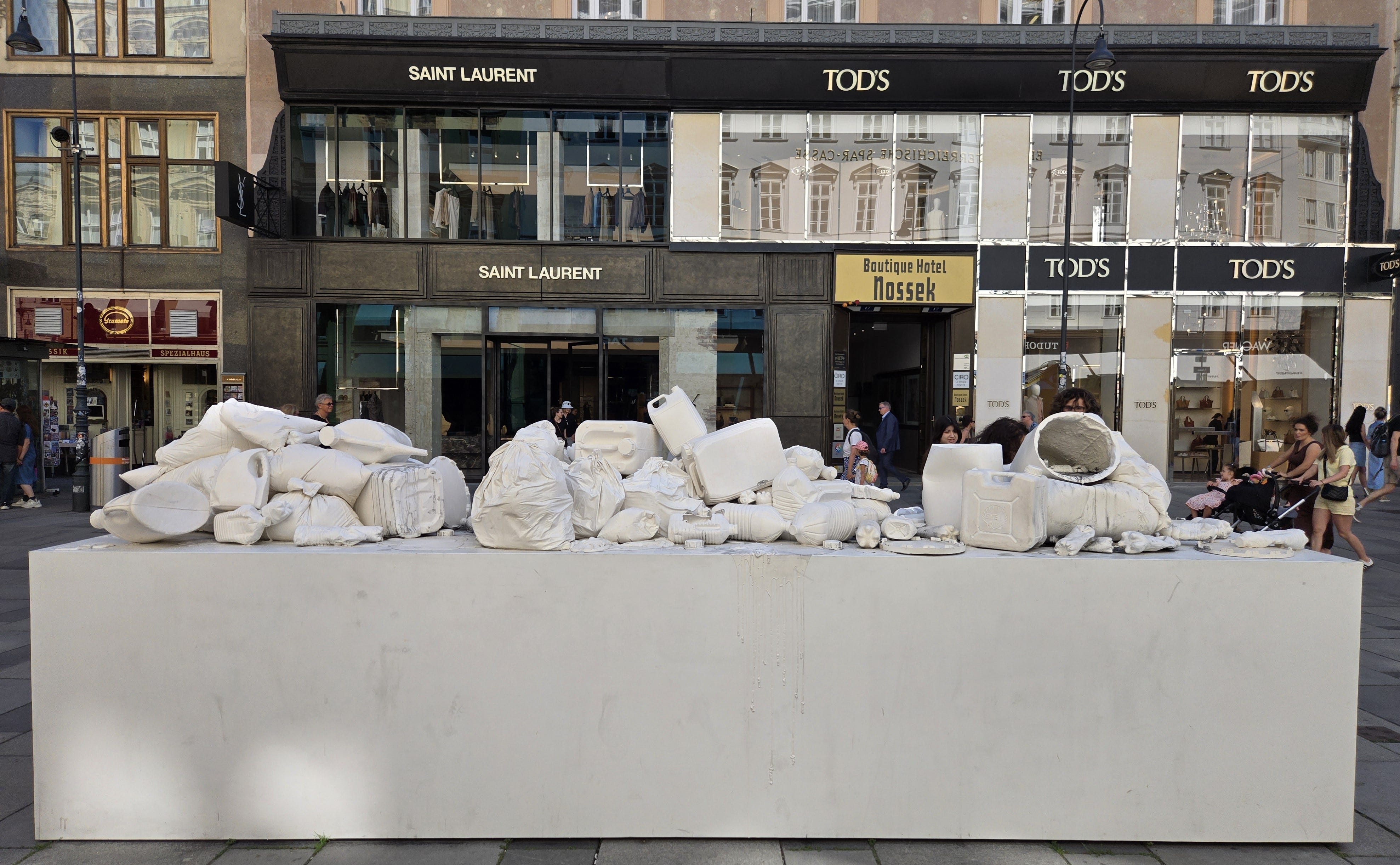
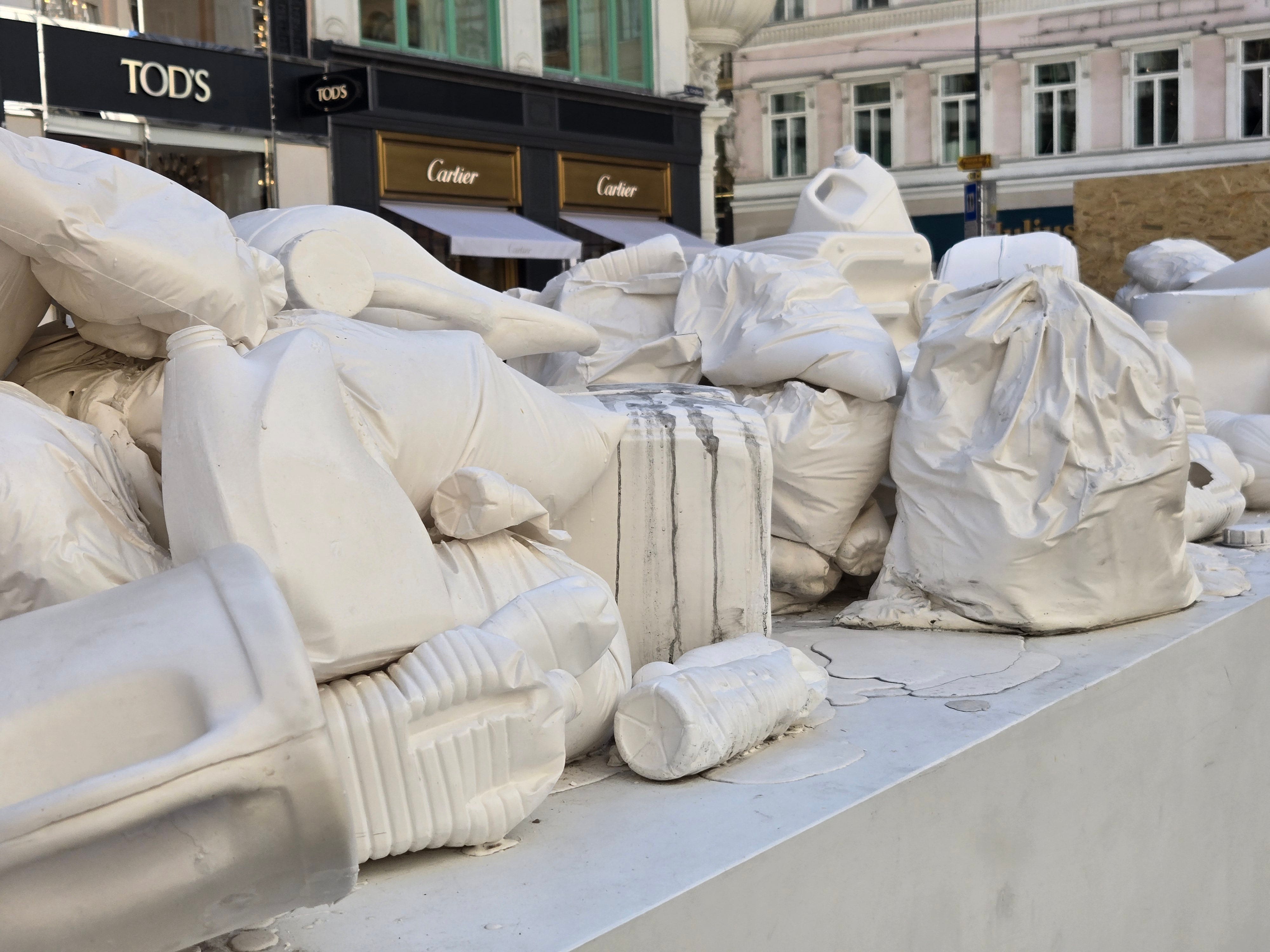
Oh, sorry, it’s not a pile of garbage, it’s a baroque-inspired “still life.”

Look on my works, ye mighty, and perspire.
Plastic is killing our environment, you see. Don’t forget about that just because you’re on vacation. International air travel and luxury shopping, on the other hand, might be the key to solving global warming.
Looking at this stuff in the sweltering heat, the right-wing jingoistic Euro-bashing felt like it might have a grain of truth. This is a civilization that euthanatizes its depressed people and leaves its elderly to die in heat waves, and then pats itself on the back for riding bikes and drinking from paper straws and having refrigerators the size of Rubik’s cubes.
In Europe, it’s easier to end your life with a doctor’s prescription than to install air conditioning. It’s easier to buy a gun in America than install air conditioning in Europe; you don’t need a doctor’s note, after all, to buy a gun.
This contrast does make you question the rationality and morality of anything else they do over there. Europe today coasts on the things it didn’t build, and which its ossified bureaucracy would not allow to be built again. What could such a decadent, exhausted, civilizational dead end possibly have to teach us?
Well, now that I’ve cooled off, of course I understand that this doesn’t say anything about urbanism or principles of good land use, and whether or not we can take examples of those things from other places. But it does say something about the near worship of “Europe” as an idea among a certain set of professionally ashamed Americans.
The question that Europe makes me wonder—in all seriousness—is whether private discomfort or at least simplicity is, in fact, a sort of requirement for, or flipside of, great public spaces and cities. I’m kind of kidding when I say you sit on a piazza with a spritz because your apartment is tiny and it’s too hot to go indoors, but not completely kidding. And yet the observation that American suburbia is a privatization of what should ideally be public—the yard for the park, the large comfortable home for the public gathering space—is also in some sense true.
But Europe exists on a kind of path dependency, where there’s much less land to sprawl, a longer history of tight, dense urban living, and—importantly—less toleration of antisocial behavior than in the United States. Americans might at one time have ended up like Europe, and in many ways we were like Europe (in terms of having great cities), but American life diverged from that common origin so long ago that to go back is really to become something that we no longer are. Europe flirted with car dominance and turned back, but it never had the system of complete car dependence and suburban sprawl that most Americans are now quite used to.
In other words, does urbanism in America necessarily mean a tradeoff between expected and familiar private comforts and a speculative, hoped-for beautiful public realm? And if it does—and I think it probably does to some extent—is this a tradeoff more than a small minority of Americans are really willing to make? The problem of disorder and antisocial behavior, and the homelessness crisis, and the conflicts over race and policing and much ugly history there, also create a lot of thorny issues.
That’s what I think when I visit Europe: this is very beautiful, but so much would have to change for anything like it to be daily life for most Americans, in most of America. And I’m not sure how much of that change I would really be willing to take, and how much of it most people outside of the urbanist coalition would be willing to take.
Related Reading:
First, European countries (and even Canada to some extent) have to take a serious look at modern air conditioning systems... but so does the United States. The US already has AC prevalent, but it's paying too much for the AC that it is getting while lagging regulation permission for the modern systems that would cut energy costs a lot. It's only midlly reassuring that "regulation is a problem everywhere".
Two, just like you can't visit Times Square only and say that New York is a failure of urbanism, the tourist traps in European cities are very much not representative of the lifestyles of most residents... possibly any residents in a lot of cases. (Paris perhaps being an exception). It's quite funny that architecturally-notable urban residences - sorry to only come up with two Brutalist examples, but Habitat 67 and The Barbican - are not free-to-roam places to outsiders. As far as where-the-tourists-go, there are deep similarities between US cities and European cities in these regards. Even a lot of newly-developed US towns have included at least one mall-like area that may be situated and decorated, for its visitors, like an ancient city. And the modern strip mall is basically a one-sided version of this.
Three, urbanists aren't a monolith, and the vast majority of them do not want to remake 90% of America to be like medieval cathedral squares (although, hey, I noticed a lot of town squares like that in Iowa during RAGBRAI - we don't have to tell anyone to do anything, apparently). What I think is agreed broadly is that people should have the option to not need a car every day, or to need one minimally, by way of creating new places (when it is fit to do so) that include walkability with all the other concerns. We point out that people like visiting places that are walkable - Disneyland, Vienna's tourist traps, Times Square - and that people aren't happy with shopping centers that take up 100 acres and have completely detached, distant buildings for sundry items, and that such designs have repeatedly failed and been demolished.
Finally, Europe's attachment to "old buildings" is not quite the superiority talking point for Americans that they think it is. Frankly, it's a lesson in how we must deal with people who want to preserve everything here in the US, including buildings that are barely older than 50. Some of that preservation is a worthy and sensible pursuit! But a lot of it very clearly isn't, and we're getting manipulated by people who argue in bad faith or are slightly deranged about nostalgia. Preservation must be done with a lot more purpose than what we see from selfish attempts to sabotage redevelopment.
European cities really do give off the same feeling I sometimes get from San Francisco or New York: their ancestors built great cities, but had the people currently in charge been running things back then they would never, ever have allowed that to happen.