When God Closes A Dor-Ne
What Do You Think You're Looking At? #246
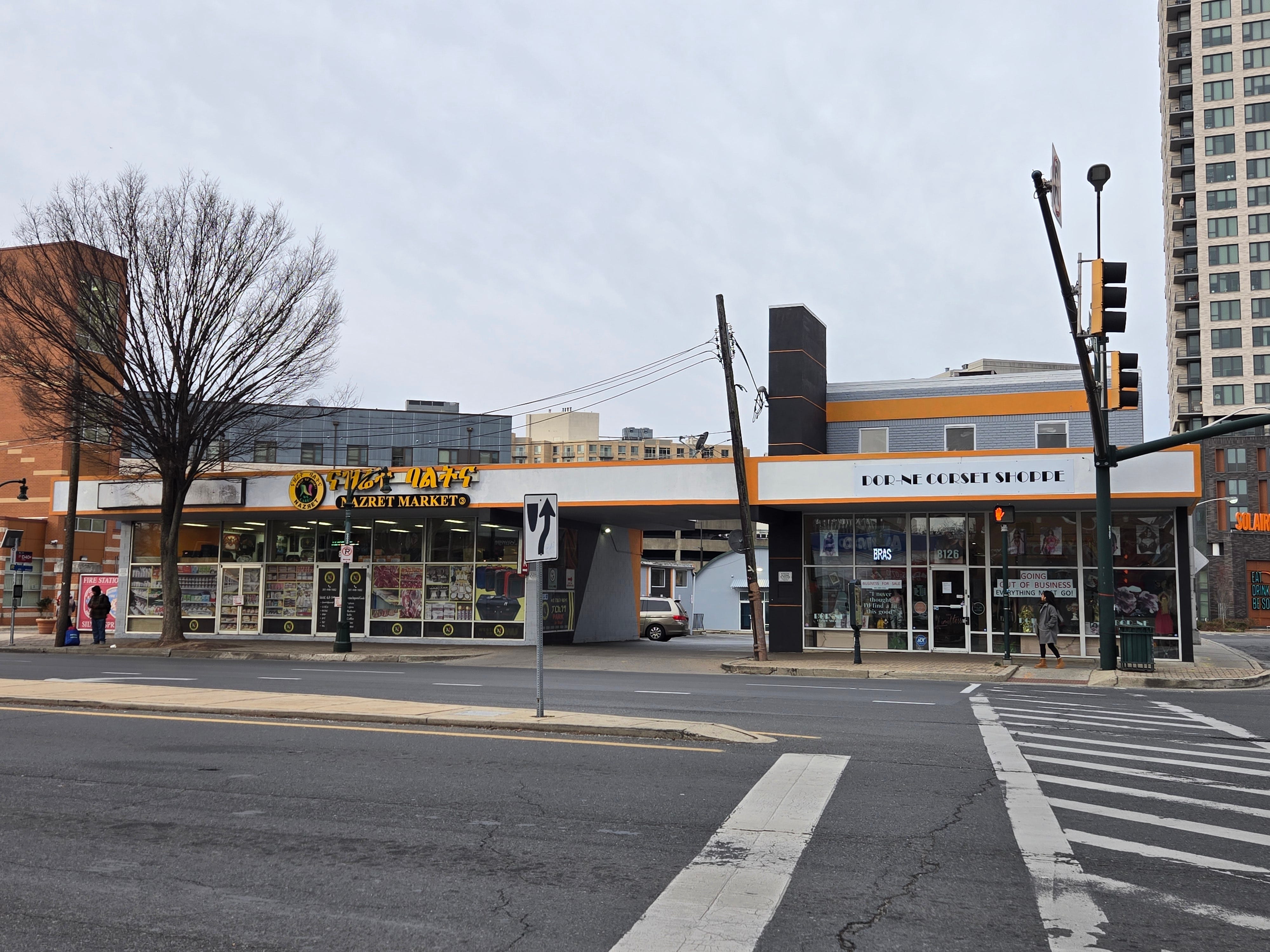
Take a look at this women’s corset and lingerie shop in downtown Silver Spring, Maryland:
It’s a bit of an old-fashioned type of store. Unfortunately, it is going out of business, which means one fewer small, locally owned store.
The building it’s in is interesting too; more on that another week! This time, we’re actually looking at the business itself, not the building it’s in.
Here’s a bit from an old 2001 Washington Post story, the year Dor-Ne arrived at this specific location:
Dor-Ne sits in a shopping center at 8126 Georgia Ave. that is being renovated. Workers are tearing down walls and putting in electricity to turn other empty storefronts into rentable space for new restaurants, a cleaners and boutiques. A few doors down is a music shop. Across the street, mechanics fix transmissions and firefighters hang out in front of their station, next to a well-established flower shop.
Earlier, the Post story refers to the shopping center as having been “nearly empty” when Dor-Ne first moved in.
But Dor-Ne isn’t from Silver Spring, it isn’t from 2001, and it nearly predates the 1920s two-story structure itself.
More from the Post story:
The shop, which had been in the District since 1932, is a one of only a few in the Washington area that offers custom fitting and ordering for hard-to-find bras, panties, bathing suits, fluffy robes, lingerie and, yes, corsets.
“We’re an old-fashioned business,” Leshchiner said. “You just don’t find places that do custom fittings for ladies’ undergarments anymore.”
A Russian immigrant, Leshchiner bought the shop in 1995 after the previous owner retired. Leshchiner, who was a frequent customer, switched from painting women’s faces with makeup and their toenails with polish at a Chevy Chase shop to fitting bust lines. She and her husband, Igor, who works for Metro, took out a second mortgage on their house to buy the business. When they moved to Silver Spring, they turned what was once a rundown space into a dainty store with light gray carpet, a restored, romantic archway and Italian pink and gray marble counters.
Since 1932! Nearly a century ago.
What I find fascinating about that isn’t just that it’s older than almost all the stores you probably shop at or pass by. In other words, not just “Wow, that’s old!” It’s also the trajectory the store made, and the story it tells.
1932 is just a few years into the Great Depression; it predates the postwar suburban boom, the invention of big-box retail, urban renewal, and the final dominance of the car over living and shopping patterns. 2001 is around the time that a whole lot of small stores were closing, as Walmart expanded.
This little store in an unassuming building in Silver Spring—which is kind of a dual small city/early D.C. suburb—traces its lineage back to an old urban core, in the days when cities were glamorous and when the city was where people went to do real shopping, even if they didn’t live there. And it survived the explosion of big-box retail and e-commerce, too.
A dwindling number of businesses currently operating in these older suburbs go back that far, but the fraction that do are the closest you can get to time travel. A whole vanished world is contained within them.
I wrote about something like this with regard to the supermarket(s) in my hometown. There used to be several downtown supermarkets, but over the years they migrated out of downtown, to the suburbanized edge of town and/or just outside the town limits. Only one still survives, now in its third location, and it’s quite a large store and is the area’s main supermarket. But it began life in the 1960s in a comparatively small building right on Main Street.
I find it fascinating that you can tell this entire story of the built environment in the 20th century—the story of suburbanization, the profusion of the automobile, and the migration of real everyday retail and commerce away from legacy urban areas—with businesses which are still operating today. Of course, when the stores close up, the stories can still be told. But there’s something special about the embodiment of it in a going concern.
It appears that Dor-Ne is closing because it failed to find a buyer: here is an October 2025 listing for the store. (It’s also possible it’s announced a closure but is still for sale; when I photographed it on December 12, it had, as you can see, both “Business for sale” and “Going out of business” signs in the window.) The listing calls it, correctly I’m sure, “one of the oldest bra stores in the United States.”
Unfortunately, the value of history is not always in money.
Related Reading:
How Many Nuts Do We Have In This House?
Three Cheers For The Blue & White
Thank you for reading! Please consider upgrading to a paid subscription to help support this newsletter. You’ll get a weekly subscribers-only piece, plus full access to the archive: over 1,400 pieces and growing. And you’ll help ensure more like this!


I am always sad to see such an old business close but sometimes there are reasons... I have lived in this neighborhood for decades and am a person who could definitely use a custom bra fitting. But I've never gone in because until extremely recently, I had no idea they sold bras. I just vaguely wondered how a corset shop stayed in business. It's on a block where there isn't much foot traffic so I'd never walked past it, just driven past, so never got to look in the window to see there was more to it.
So, I read elsewhere that the owners are retiring but if they can't find a buyer, I'm afraid maybe the business is not an attractive purchase because they don't have a big enough customer base. Because clearly they haven't done even the most minimal things to keep up with the times and attract new customers, like making sure their name/sign makes sure that people who've driven past thousands of times can tell exactly what they sell.
So yeah, it's a bummer to lose a piece of history but there's not much that can be done if the people who owned the history didn't, for whatever reasons, do the work to keep it alive and relevant.