

Is Japan vibrant because it’s poor?
Abi Olvera, who I follow and whose writing you should check out, offered on social media a list of specific things that might actually become possible if we enacted the zoning, permitting, and other reforms discussed under the “Abundance” umbrella.
Some of her examples drew on Japan, which prompted this response:
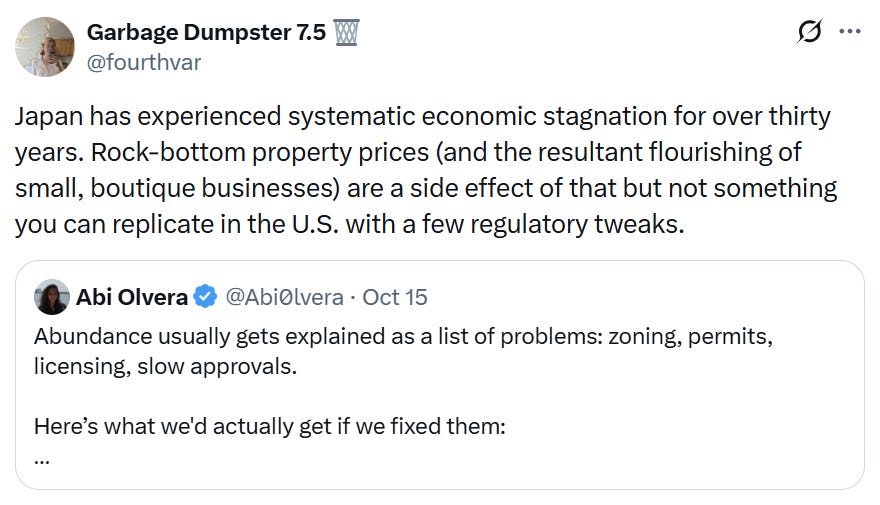
Later down in the back-and-forth, this “Garbage Dumpster” fellow added: “As for the small business thing, that’s what I meant by the economic stagnation argument - that’s the enabler of the funky businesses in Japan. You can make a living doing that because rents are dirt cheap and cost of living is stagnant, but that also stifles the overall economy.”
Now an account named Garbage Dumpster, with fewer than 50 followers, might not be an authority on the economics of small businesses, Japan, or anything.
But the questions this raises are interesting. First it brings to mind something I’ve thought before about Japan: it’s a rare developed country which has not undergone modernism, or an Enlightenment, or a Reformation. At least superficially, to an American, Japan looks like an actual example of a “traditionalist” society which is nonetheless modern in most important ways.
That’s to say that at least some of the “quirky tiny business” phenomenon in Japan is likely cultural, or a kind of cultural path dependency following from long-established habits or ideas. But some of it is economic, and some of it is regulatory.
But the argument being presented here is that what fundamentally underlies this climate of widespread microenterprises is not the regulatory regime which makes them legally feasible, but the depressed economy and real-estate market which makes them financially feasible.
He offers Singapore as a counterexample, which has much higher housing costs than Japan. (A quick Google search suggests roughly double, or more). From this, he draws the conclusion that Singapore’s relatively abundance-friendly regulatory regime hasn’t resulted in the same affordability as in Japan, because “abundance” policy has nothing to do with it. Japanese real estate is simply worth less, while Singaporean real estate is worth more.
I don’t think this is correct, but I do find it interesting enough to think through a little bit here, and ask anyone more familiar with Japan’s economic state or business climate to add anything in the comments.
There are a few points I want to draw out here, but the most important one is subtle, and is a pretty important but under-remarked-upon aspect of Japan’s tiny business phenomenon.