

I have driven past this bakery and restaurant on Annapolis Road in the Landover Hills area, in Prince George’s County, many times:
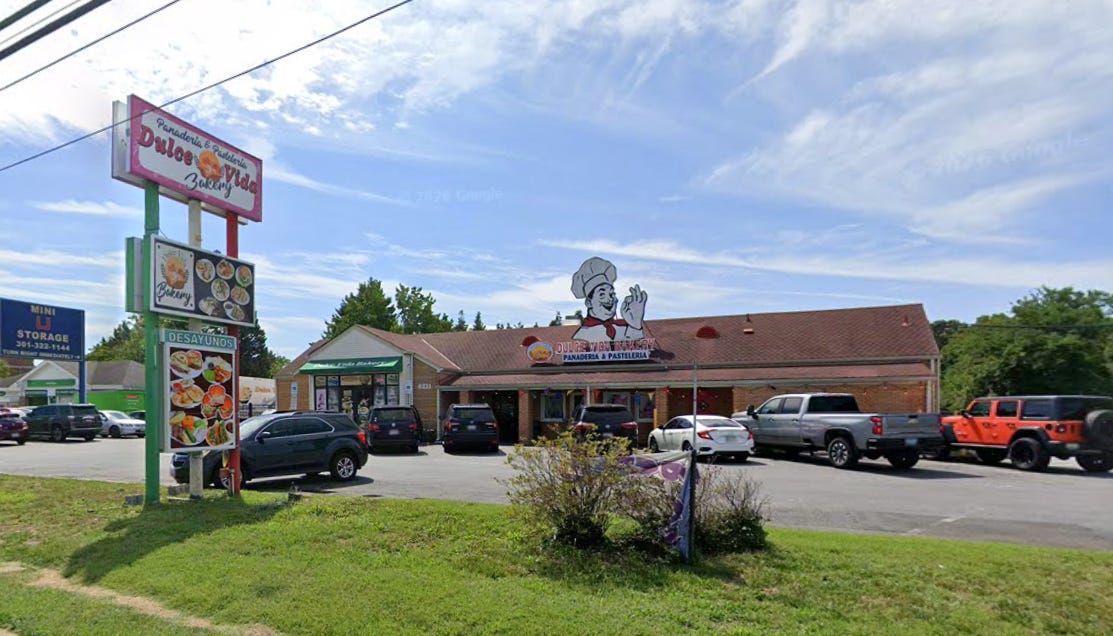
The bakery is fairly recent—the original business closed in 2016, and the bakery opened in late 2021 or early 2022—so I actually drove past it before it was converted, but I never took note of it. It was only after it became a Latin American bakery that I noticed that funny little chef on the roof. It almost fits, but it clearly predates the current establishment, and I always wondered what exactly the place used to be.
Since the conversion is recent, it was captured on the Google Maps historic imagery. Here is the oldest, from June 2008:
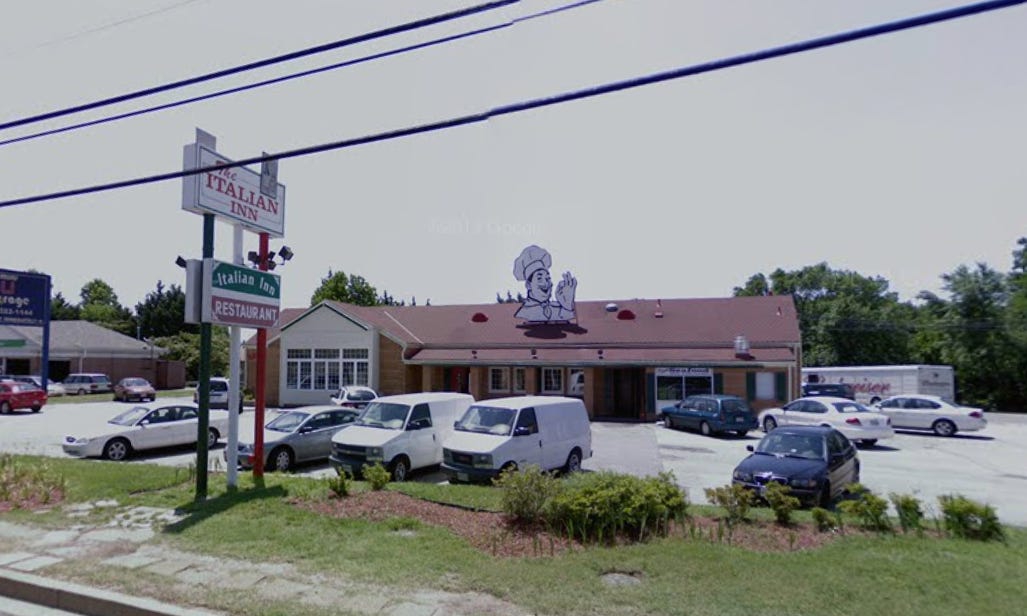
The Italian Inn! The chef makes perfect sense, as does the Italian-flag-painted signposts (though I suppose you could imagine they stand for Mexico now). From the look of it, you can tell this is an old-school place.
The Italian Inn was a local institution, and there’s lots of nostalgia for it online. The D.C.-area blog PoPville noted its closure; here’s a representative Facebook thread about the place; and its Yelp page is still up, with lots of reviews and photos of the old interior.
It opened in 1961, according to this nice Washington City Paper profile from 2008. On a bit of a tangent, this was, surprisingly to me, a time in which many communities were still getting their first pizza restaurants; I’ve gleaned that from reading old newspaper clips.
In a lot of ways, though it doesn’t feel like it now, Italian restaurants were the “ethnic cuisine” of their day, much as Chinese, Thai, or Indian food are today. A place like this was a living relic of an older moment in American history and culture. And every year, there are fewer and fewer of these places left.
And of course, “Italian cuisine” in America has itself evolved. From that profile:
The Italian Inn opened its doors in Hyattsville in 1961, seven years before de Assereto opened Cantina d’Italia, of which Robert Shoffner wrote in the March 2006 Washingtonian: “By 1974, the preponderance of dishes on Cantina’s menu were from northern regional cuisines, so Cantina d’Italia could claim to be our first authentic northern Italian restaurant.”
Regional Italian restaurants now, of course, dominate the landscape, from chef Enzo Livia’s Il Pizzico in Rockville to Pastan’s Obelisk near Dupont Circle to Donna’s Bebo Trattoria in Crystal City. But Donna, for one, can remember when places like the Italian Inn were the major players, not the marginal red-sauce houses that diners now frequent for a taste of nostalgia.
And then, it wasn’t even (entirely) opened by Italians!
If anything, the story of the Italian Inn combines two distinct chapters from America’s dining history. The first, naturally, concerns the southern Italian immigrants who created the red-sauce cuisine that defines the restaurant; the other concerns Greek entrepreneurs who have repeatedly shown a willingness to seek business opportunities beyond their ethnic neighborhoods in Chicago, New York, and elsewhere.
“Greeks spotted an opening in the Northeastern diner business in the mid-1950s,” writes D.C. food historian Joel Denker in his excellent book, The World on a Plate. “Irish, German, and Jewish owners, whose children had little appetite for the business, were selling out. Greeks began taking their places.”
Three partners, including at least one Greek, launched the Italian Inn in 1961; it was a late entry into the local Italian-American red-sauce scene, which had been around since at least the 1920s. The Gioni family eventually bought the aging restaurant in the early 1990s. The Gionis, despite the sound of their surname, are Greek.
The profile plaintively ends with, “We can’t afford to lose an institution like the Italian Inn.”
Well.
Now, to some, the replacement of an Italian institution with a Hispanic bakery would constitute the loss or erosion of culture. But that’s such a wrong way to look at it. Hispanics today occupy a similar place in American culture as Italians (or, I suppose, Greeks) did back in those days; and Latin food is somewhere between mainstream and ethnic, in the way Italian food was but isn’t really any more.
In this conversion from one immigration-driven business to another, we’re not seeing the loss of culture; we’re seeing the same dynamic process by which that old Italian restaurant came down to us, happening right now, using little bits and pieces of the inherited past but making something new with it. One day, maybe, that bakery will be a local institution of its own, with old folks remembering the warm scent of freshly baked cookies and pastries and breads, or a little meal at the lunch counter in the corner. One day it may feel as solid and immovable as the Italian Inn must have felt in the 1990s or 2000s—as if it had always been there.
Maybe, maybe not. But I’ll never stop feeling that living in this region of our country, I am lucky to see this organic, textured process of places and people making and remaking themselves.
Related Reading:
Brother, Can You Spare An Oyster?
Don’t Yell “Dinner!” In A Crowded Fire House
Archive Dive: Plant-Based Patties, Italian Peasant Style