

I’ve touched on the transformation of Napa Valley wine tourism here in a few different pieces over the years. I find it interesting 1) because I saw Napa as a kid on a family trip before it was completely unaffordable, 2) I like wine, and 3) I find it interesting how inflation in other kinds of experiences is and isn’t related to high housing costs or the general feeling that the middle is falling out of the American economy.
My wife also recently got to visit a few Napa Valley wineries on a work trip—the only way I’d do it nowadays—and I did a little reading on the state of tourism there now. One person said he spoke to one of the staff in a Napa tasting room, and the guy told him that the entire business model has changed. It isn’t just that tastings went from free or a small fee to $40, $50, $60. It’s that the tasting room as a low-key, casual thing to (hopefully) help sell bottles is over.
A lot of these wineries require reservations now. A lot of them try to sell you a tour and tasting, or a food and tasting combo, or some even more expensive “experience.” The tasting room is in and of itself a profit center now, not an appendage of the bottle sales operation. So in a sense, these wineries are now partially in the experiences, almost theme-park-adjacent industry rather than in the actual wine industry.
Here’s Grgich Hills, a historic Napa winery, with a puny three-wine walk-in tasting offered for $30, and going up to $250 for the “Private Library Tasting,” all the way to “if you have to ask how much it is, you can’t afford it” offerings like “bottle service.”
Just a little tangent, to make a comparison. This is sort of like if, say, an Italian deli, or a bakery, or something—where you’d go to browse and buy food and groceries, and maybe sample an olive or a slice of charcuterie before buying half a pound or whatever—started charging money to visit and look around, then a little more money to sample a handful of products, and then even more money for a bespoke tasting of the most expensive products with the founder/owner. I mean, not exactly, but sort of.
I guess another way of looking at is more like sandwich menu at the Italian deli—instead of buying raw groceries, you’re buying something sort of value-added. If you squint, these fancy wine experiences are maybe more like turning wineries into bars/restaurants than into theme parks. I understand, obviously, why they do it and I suppose it makes business sense. I just don’t personally care for it!
The same thing in a way (but to a lesser degree) has happened in Virginia, which has a pretty healthy wine industry. Some of the lesser wineries are derided as “wedderies”: wineries that meet the minimum legal definition of a farm winery (which has some tax benefits), but focus their core business on weddings and events. And of course there are a lot of passable but forgettable wines made by legitimate winemakers who are just not that experienced yet, or who are working with grapes that just aren’t quite good enough.
A Virginia wine blogger, who stopped publishing years ago and appears to have gotten tired of the large number of second-tier wineries in the state, wrote about that back in 2013:
So…another issue that I’m becoming more and more frustrated with are the “Wedderies.” These are the places that are a winery (or as I’m about to talk about – a cidery) but are really more about the events they can hold there than the adult beverages that are, in theory, the heart of the business. Don’t get me wrong – I’m not in the no events crowd. I get that wineries need to make money to stay in business and that events can help make this happen. That said, when events seem to be the core of the business plan, it feels like a misuse of a farm winery license, and it just frustrates me.
There’s also a big emphasis on selling wine club memberships, which is basically a subscription model. In all the wineries we’ve visited, we’ve only ever bought one wine club membership, which offers three bottles for $100 each quarter, including some smaller-production bottles and wines that are not for sale to non-members yet. What convinced us was that the reds were as good as the whites. (In most Virginia wineries, in my experience, the reds struggle while the whites are usually decent-to-good.)
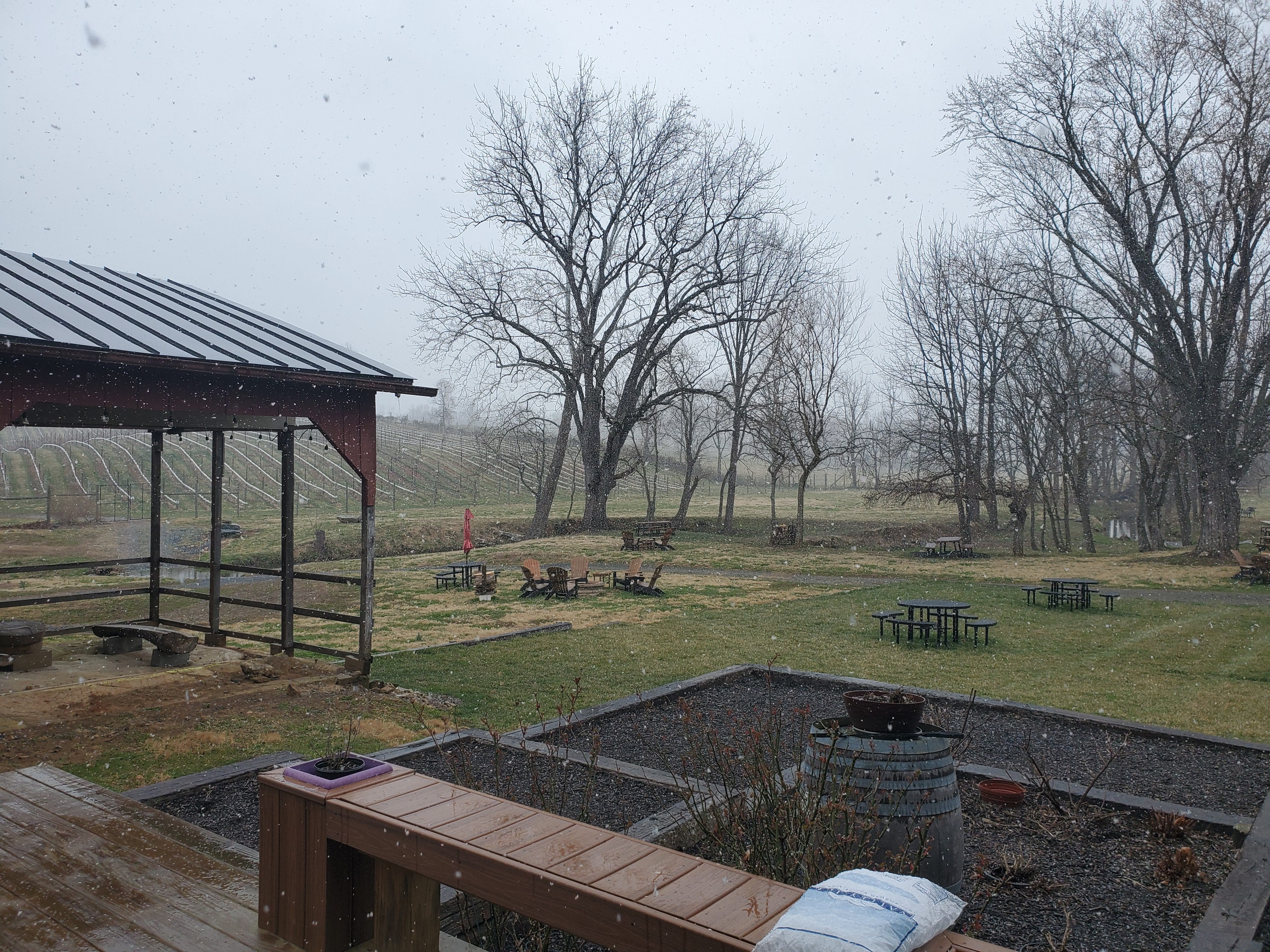
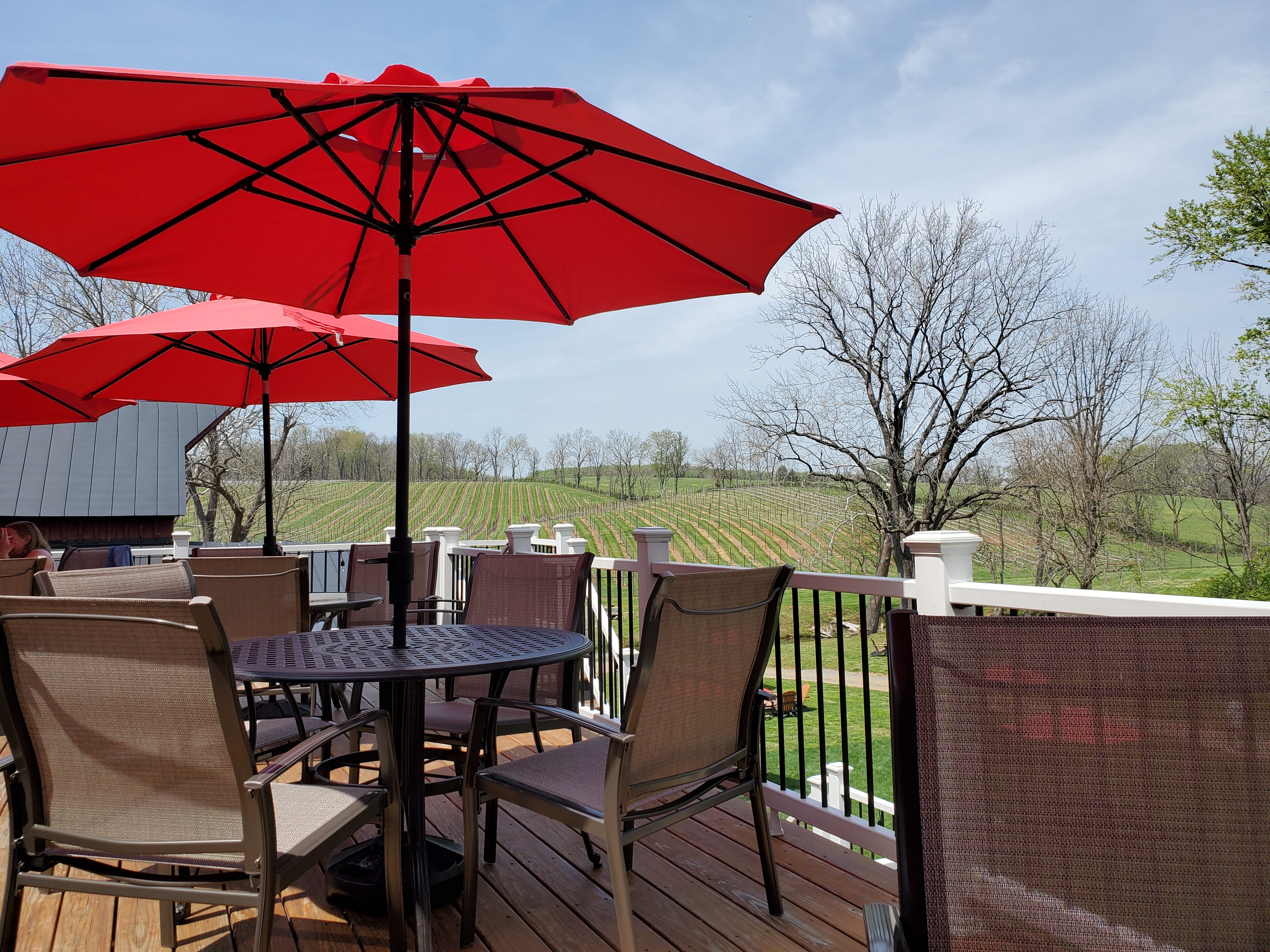
Those guys are called Three Creeks, out in Loudoun County west of Leesburg, which still is, or at least feels, like a real, unspoiled countryside. Their patio overlooks tables out by three creeks (hence the name) that run through part of the property, and also the vineyard planted into the hillside. It’s perfectly put together but still rustic, not slick. And I believe their tasting is six wines for $15, which is completely reasonable.
Here it is in the snow!
And the sun:
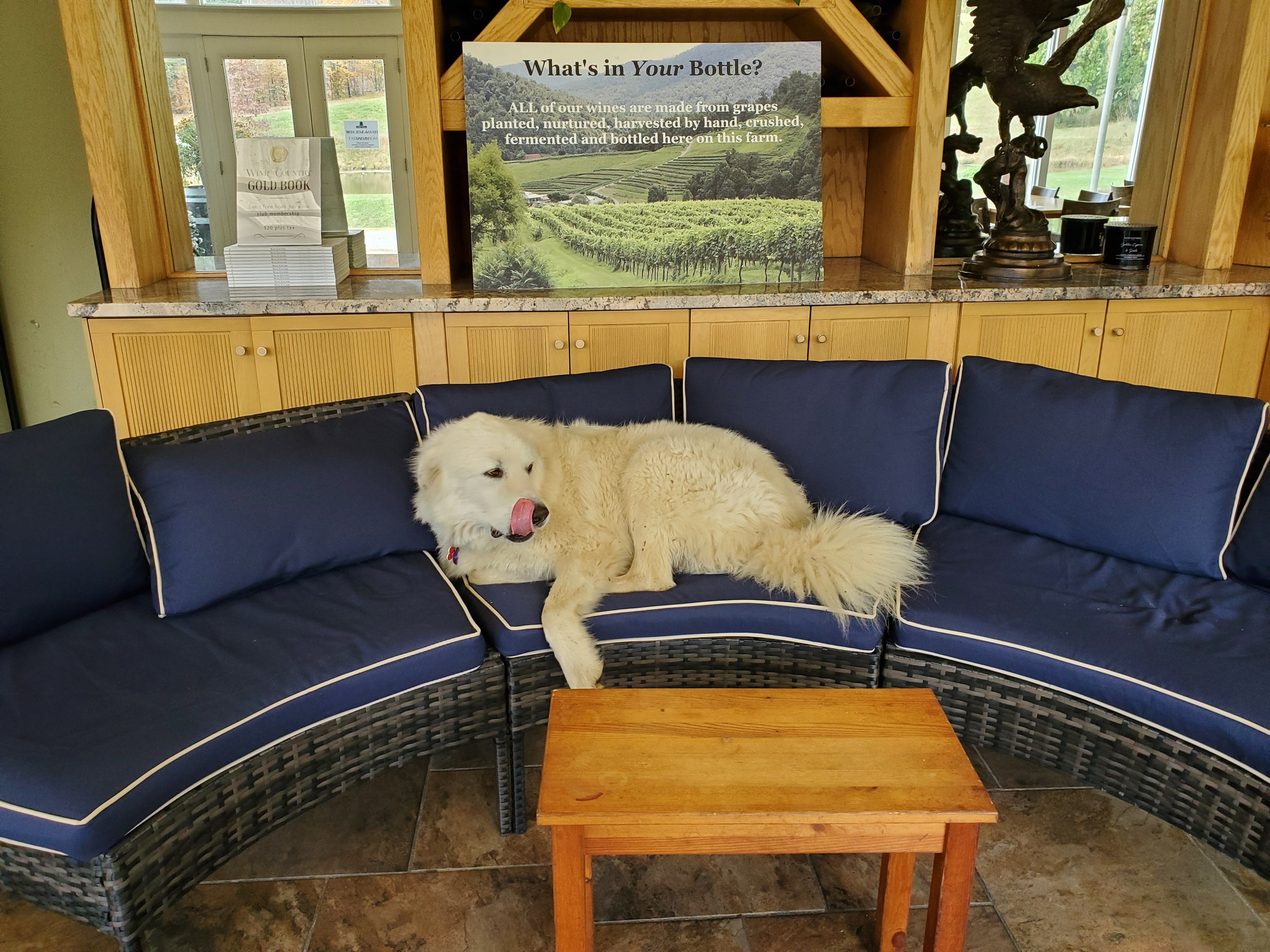
There’s one other winery I would join, if it weren’t nearly three hours away: the vineyard formerly known as Delfosse, now named Mountain and Vine. They similarly make some very nice reds, have a friendly resident dog…
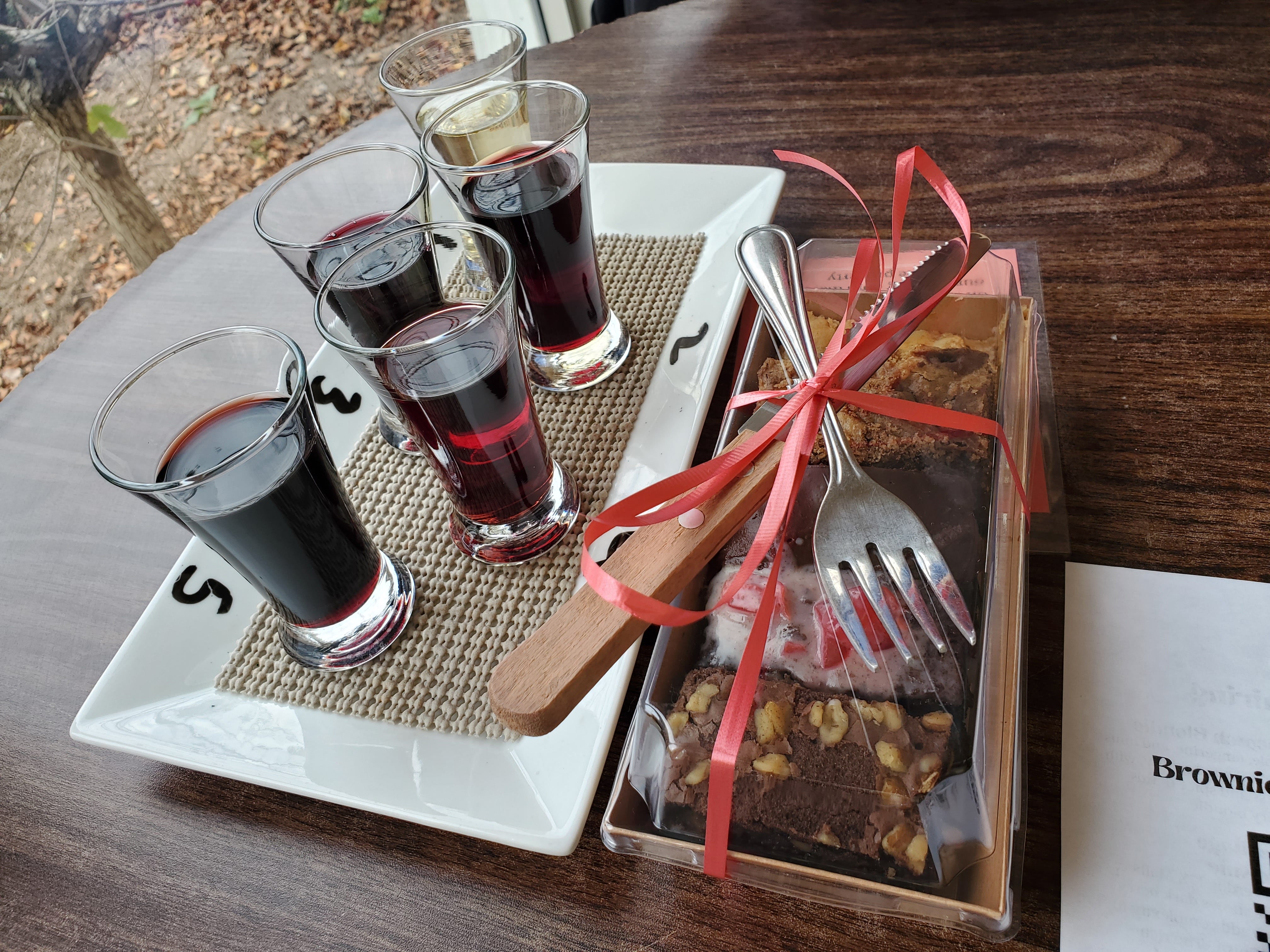
…and even offered this cool and reasonably priced self-guided brownie-and-wine tasting on our last visit, with homemade brownies in several varieties to pair with different wines. That was a neat idea and really nicely done. (The brownies were big and very rich, and we saved half of each one, too!) This was $30 or $35, for five bigger-than-a-tasting pours and four serious homemade brownies.
These better Virginia wineries still feel cozy and not commercialized in that impersonal, conveyor-belt sense, where the staff are practically saying “Come on in pigs, eat your slop, and buy stuff quick or get out!”