

I took this picture the other day, while I was testing out an old Nintendo Wii console I found at a thrift store.
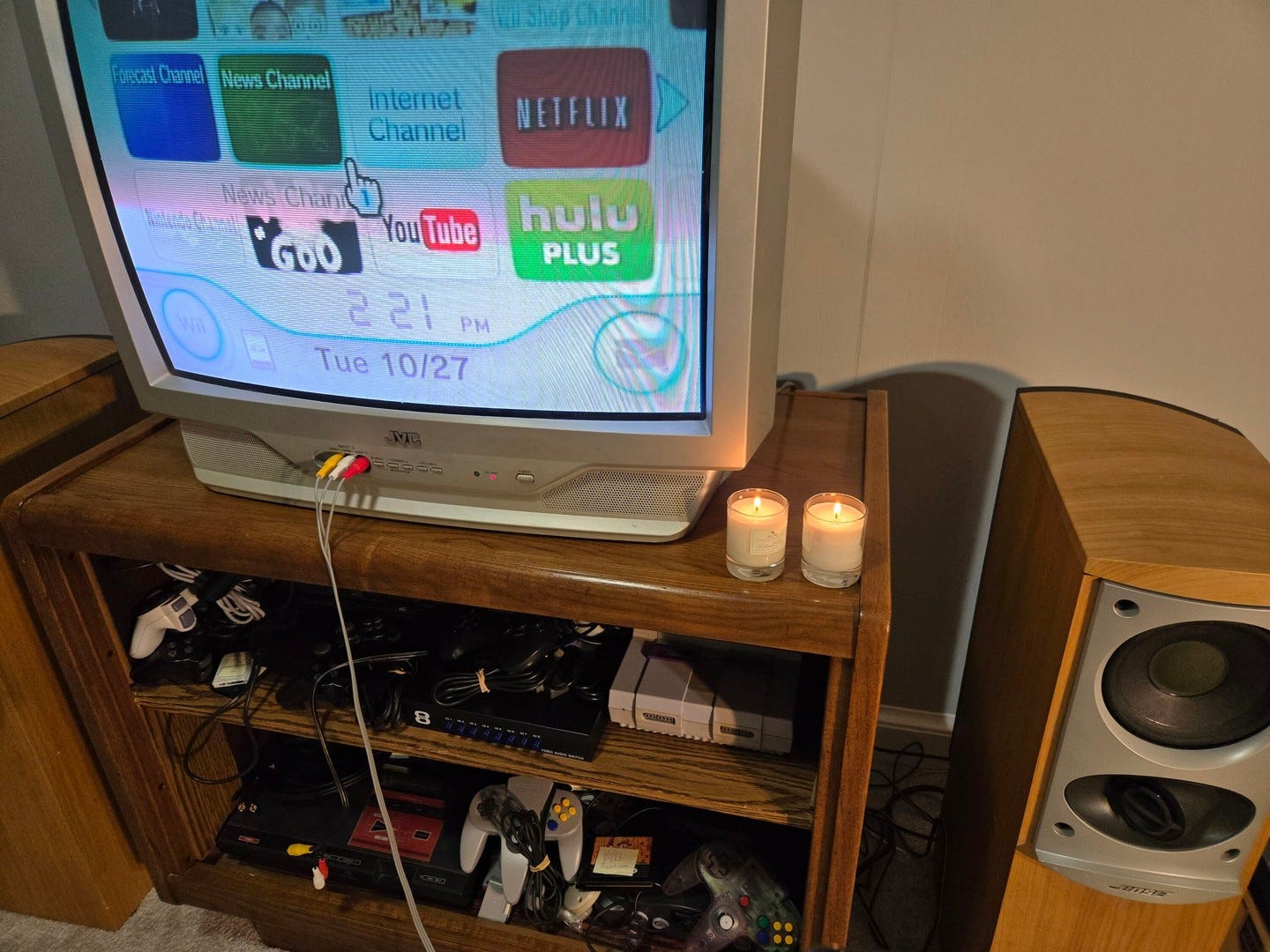
Apparently a lot of people, especially those who actually owned a Wii back in the 2000s1, already know this. I did not, and it blew my mind (and that of thousands of other people—a social media post I did about it went viral).
To start off, the candles are not just for mood lighting. The device that Nintendo called the “sensor bar”—the thing you put by the TV that made the motion control work—is actually not a sensor. It’s a infrared light emitter. The sensor is in the controller/Wii Remote itself.
I’d always assumed the remote had an infrared emitter in it, and the sensor bar was a remote eye—just like a TV remote sending a signal to a television. But it’s the opposite here: the sensor bar is generating a light signal, which the Wii Remote reads. This is how the system determines where the pointer for the motion control goes. The system uses the sensor bar’s light points, two of them, to triangulate the position of the controller, so the pointer displays correctly on the screen.
You don’t actually need Nintendo’s sensor bar, which I was missing. (It was a small, plasticky device, and a lot of them were lost or broken.) All you need is something which can emit two points of infrared light. And a flame does the trick. I couldn’t place the candles far enough apart to work really well, because of how my TV is sitting on the stand. But it was enough to determine that the controller and the console worked.
Now, the reason you need to do any of this to test a Wii is a little frustrating. Even though the Wii controller has a traditional directional pad and set of buttons, you can’t navigate the Wii’s main menu or launch a game without the motion controls. Nor can you use the D-pad or buttons on a GameCube controller—even though the Wii plays GameCube games. The GameCube controller only works once a GameCube game has been launched. With a Wii controller’s motion controls.
This is the kind of thing that makes me nostalgic for the barebones functionality of the old-school consoles. No operating system, no menu, no “launching” software. Just stick the game in, turn the thing on, and you’re playing. I don’t think this is just nostalgia, either. It’s a desire for a simpler and less bloated design philosophy, one that puts fewer steps and less friction between the user and the end goal.
But anyway, firing up a thrift-store Wii and playing it with two candles a few days before Halloween was pleasantly mysterious and spooky. There’s something so satisfying about understanding what’s happening as a complicated device works. You could call that applied physics or engineering, I guess.
I like to call it “mechanical literacy”—a familiarity with how physical things work, with how their seeming magic arises out of legible material processes. A way of seeing and making sense of the world. All that tech talk for two points of light that a flame can generate. All this accreted specialized industrial knowledge to re-engineer something primal.
You almost feel like a magician, resurrecting this brick of useless tech with candles, or bringing a radio back to life with a quarter-second spray of electronics cleaner, or getting an old fridge to seal tightly with a touch of silicone lubricant. Some people call these things, especially the jankier ones, “ghetto repair” or “redneck repair” (depending, I guess, on which group of poor people you prefer to punch down at). But I think of them as mechanical literacy. I think of them, really, almost liturgically, ritualistically. A participation in something ancient, carrying it forward.
Some of this stuff is pretty basic and general, and all you have to do is learn it. Electronic spray fixes dirty switches. It’s simple. But much of it, like the vast knowledge held by old repair technicians, is much more specialized. As devices become more disposable, repair becomes less common, and the old generation of technicians retires or dies, a lot of knowhow that we once took for granted will become scarcer and more expensive.
When I was a kid, I found an old stereo receiver out by a dumpster that looked really cool—one of those old 1970s wood-and-chrome models. My dad took it home and fired it up, and it worked, except that the sound in one channel was out. A relative’s neighbor who’d once worked as a repair tech for an electronics company took a look at it, knew exactly what part was at fault, and fixed it for a couple hundred bucks. That’s not nothing, but it’s a fair price for a piece of scarce knowledge that restored a product that will never be made again. It still sits in my dad’s stereo cabinet.
Preserving the body of accumulated human wisdom is a hallowed effort. When we do this, we are stepping into time, becoming custodians in a little way of our collective progress. I think, in fact, many of us understand this on some level, but we don’t really have a language for it. Nostalgia doesn’t capture it. Nerdiness doesn’t capture it. It may be those things, but it’s much more, too.
Related Reading:
The Pancake House And Tacit Knowledge
Technology, Delayed Gratification, And Cities
I almost wrote “back in the day” but…no.