
New and Old #259
Housing in Singapore, the end (?) of cheap restaurants, a crazy chef, and a possible backstory on a video game feature

Singapore: Where your home loses value & everyone’s better off, Elysian, Elle Griffin, March 5, 2026
When the lease ends, the unit and building revert to state ownership, which usually tears down the building to build another one, selling 99-year leases once again.
This system is unlike any other in the world. Housing is not an investment or a retirement plan—buying and holding real estate means holding something that ultimately goes down in value. The only reason to purchase a lease in Singapore is because residents want to live there at an affordable “set-by-the-government-not-the-market” rate. The government, meanwhile, uses that rental income to build more housing and earn more revenue.
And:
That all leases end and the land and buildings revert back to government ownership is vital. In the 1990s, a population boom meant the city needed more high-rise buildings, so Singapore pulled down a bunch of low-rise buildings and built more high-density ones instead. The city wouldn’t have been able to do this if property were privately owned. Private owners would have held onto their condos, even in aging buildings, and units would have become exorbitantly expensive as more people crammed into small buildings. Instead, the city is constantly under construction, pulling down old buildings that have come back into state ownership, and building new ones that can meet growth as it happens.
This is a very interesting piece and the housing/land policy described here is unique and apparently successful.
Singapore strikes me as the absolute best possible real-world example of authoritarianism working. It’s a kind of efficient, technocratic, rule-bound authoritarianism, not personalist tin-pot dictator authoritarianism. But even if it works, as it seems to, I don’t know that it would or should play in America.
Where Did All the Cheap Restaurants Go?, Wall Street Journal, Chris Kornelis, February 6, 2026
I’ve had it with trying to find cheap places to eat.
There used to be places where burgers, salads and draft beers, the midbrow fare that’s in my sweet spot, could seem like a pretty good deal. Now, no matter where I’m eating, I’m paying pretty much the same price. When I get barbecue at a food truck—eaten outside, off a falling-over picnic table—it’s the same price I pay sitting at the marble bar at a downtown restaurant that also provides water refills, clean bathrooms, table service and silverware.
He goes on to mention that he usually goes for food like burgers. Yes, this is my general impression of restaurants these days too. But also, the real deals are to be found in “ethnic” restaurants nowadays. They have not been bougie-fied and Instagram-ified to hell. A friend and I have a joke about people who complain that they want “normal food,” (pizza/burgers/American) because there’s so much great dining out you miss if you stick to those familiar options.
I do think he’s right, as he goes on to say, that the best values are often now at pricier places that deliver, rather than average places that have become pricey:
On the menu at the bar: a Kobe beef burger (with fries) topped with bacon and avocado for $25. It turns out that this fancy burger cost just a few dollars more than the one at Five Guys. I ended up ordering a Caesar salad for $14. And that option was a little cheaper than the sandwich I purchased from the food truck earlier in the week.
But the game-changer for me was what I got beyond the food. My meal came with metal utensils and a cloth napkin. My seat at the bar had a view of the water, the Olympic Mountains and the Mariners baseball game. The bartender even poured me a glass of ice water to go with my $8 beer.
If I can get an arguably better burger and all those extras for just a few dollars more, not to mention a beer for the same price, isn’t it worth it?
Thomas Keller asked me to leave the French Laundry. It turned into my most extraordinary night as a critic, San Francisco Chronicle, MacKenzie Chung Fegan, May 19, 2025
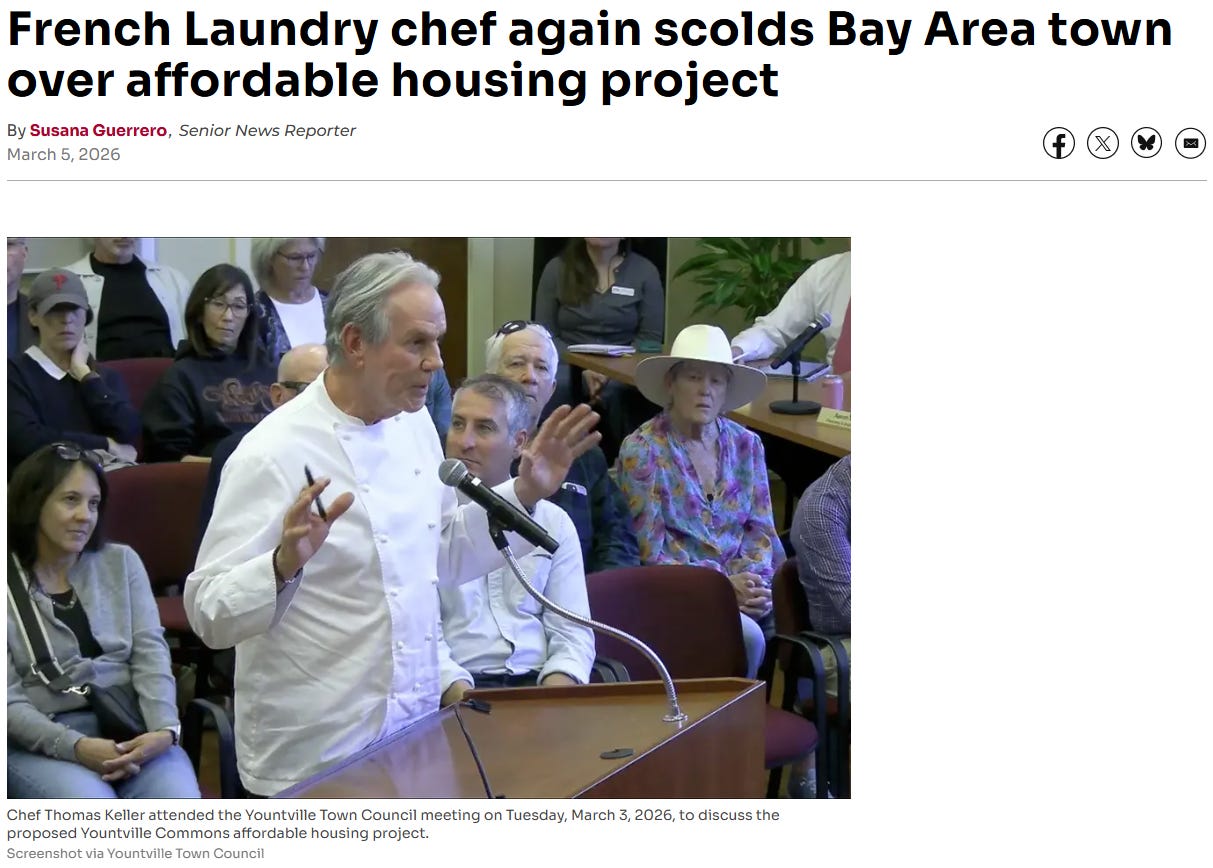
This is some deeply insane behavior from the entitled, whiny, wannabe-French authoritarian chef who shows up to complain about affordable housing at public input meetings in his chef suit, like how Mario is always dressed as Mario:
Thomas Keller is fidgeting on the bench next to mine in the empty courtyard of the French Laundry. There’s a slight quaver in the chef’s voice, and he tells me he is nervous. This is not something he is accustomed to doing, he says — asking a critic to leave.
He’s sure I’m a nice person, he tells me, but he doesn’t know my intentions, and he doesn’t want me in his restaurant.
The story is long, because the chef tries to kick the critic out, then softens, then subjects her an hour of cajoling/lecturing, then tells her it would be rude, after all, to kick her out and serves her (and her group of friends—this was not a dinner she was having in her capacity as a reviewer!) very late. You really have to read it to grasp how nuts it is.
Then the cherry on top:
We retake our seats for duck, beef and cheese courses and so, so much dessert. Finally, at 12:30 a.m., our server hands over a check presenter. “Dinner is compliments of Chef Keller,” the bill reads, with a big fat zero perching on the “total” line. It’s the ultimate display of power, Keller’s refunding of our prepayment of $1,831.75, tip included, and I drop my head into my hands. This is bad. Chronicle journalists are prohibited from accepting free meals from people we cover, but our server insists the refund has already gone through, there’s nothing to be done, you’re very welcome! I confer with my companions, and when our server returns, humble myself. Please, I say to him, you have to help me. I’m going to get in a lot of trouble.
I guess he makes good food, but with this kind of domineering, arrogant behavior, I guess he’s mastered more than one thing about the old-school French restaurant routine.
Apparently, over at Reddit’s fine dining sub, the consensus was that the chef’s behavior was perfectly fine, while the critic was the unprofessional one. On the one hand, you think, what does it matter what people on the internet think about a thing? On the other hand, it’s useful when people discredit themselves by voicing bad opinions, which leaves you free to presumptively ignore them.
If I’m ever kidnapped and need rescuing, ask me about this article and I will say, very slowly and deliberately, “Thomas Keller sounds like a very good, professional, mature, and well-adjusted person, and nothing whatsoever in this article comes across as a dime-store Henri Soulé impression. I believe this very deeply. Very.”
Rewind - It’s not for what we think, Reddit
Reddit appears again, but this time it’s a useful and interesting thread on a feature in Nintendo’s new Mario Kart game, which lets you rewind gameplay a few seconds to correct a mistake (more for kids or newbies than seasoned players). Or is it?
The original poster guesses that this feature may have been left in and retroactively marketed as a new-player assist, but that its function may have been to bypass potential bugs the player can run into in an open world game:
Put it all together and it’ll be a common occurrence that we get lost, we fall off cliffs and take ages to get back where we wanted and we end up with really, really boring ‘busy work’. We might even (and this is very unlike Nintendo) encounter a load of bugs. And none of this is fun.
Now the designers could attempt to solve for all those cases or they could add a band aid - a rewind feature. Frankly it’s a necessity. Then once it’s in place they can advertise it as a way to respond to race events or time trials - great, but that’s (probably) not why they developed it.
(As an aside, the character swap in GTA5 solves the same problem - players running out of fun in an open world).
A commenter adds that it even have helped the actual developers work on the game: “So basically the same reason Nintendo included Ascend in Tears of the Kingdom (it was originally a dev tool to quickly exit caves and buildings).”
It’s a funny thing when a thing exists for some unstated reason, and then gets marketed as something else later on. Can you think of any other examples of this phenomenon?
Related Reading:
Thank you for reading! Please consider upgrading to a paid subscription to help support this newsletter. You’ll get a weekly subscribers-only piece, plus full access to the archive: over 1,500 pieces and growing. And you’ll help ensure more like this!
* So regarding Singapore, it's actually an interesting example of Land Value Tax (or at least, something very similar to it) working spectacularly. And in all honesty, I think the government goes too far by also owning and building the buildings themselves. Put another way, I think you can achieve the same outcomes without authoritarianism (at least, to anywhere near the same degree) through just the straight land value tax. The market can still build and own the buildings. It just pays for the privilege of location.
* For cheap restaurants, I think a lot of it is part of the cost of living crisis. The most expensive part of running a restaurant is the labor, so there's incentive to make food bougier and with fancier ingredients while still paying the same labor cost. In other words, it creates a hard floor, not unlike we also see with new housing construction. Cost of living can really kill a country by making otherwise lower cost stuff too expensive to make, and I think this is another case of that.
* I think the real trick with Rewind is that it simply removes tedium. And that wades into the whole debate of whether video games should be purely fun or not. Like whether tedium can make a game more rewarding, for instance (like grinding levels in Runescape). Interesting to think about. For a game like Mario Kart, though, I don't think tedium ever improves the experience, so it's a good addition in my mind.
* "shows up to complain about affordable housing at public input meetings in his chef suit, like how Mario is always dressed as Mario"
Brutal.