New Wal, Old Wall
What Do You Think You're Looking At? #253
Today we’re in Rockville, Maryland again, just one lot down from where we were last week, in fact.
This is a Walgreens in Rockville, along Rockville Pike, the main road through the area (the local name here is Hungerford Drive):
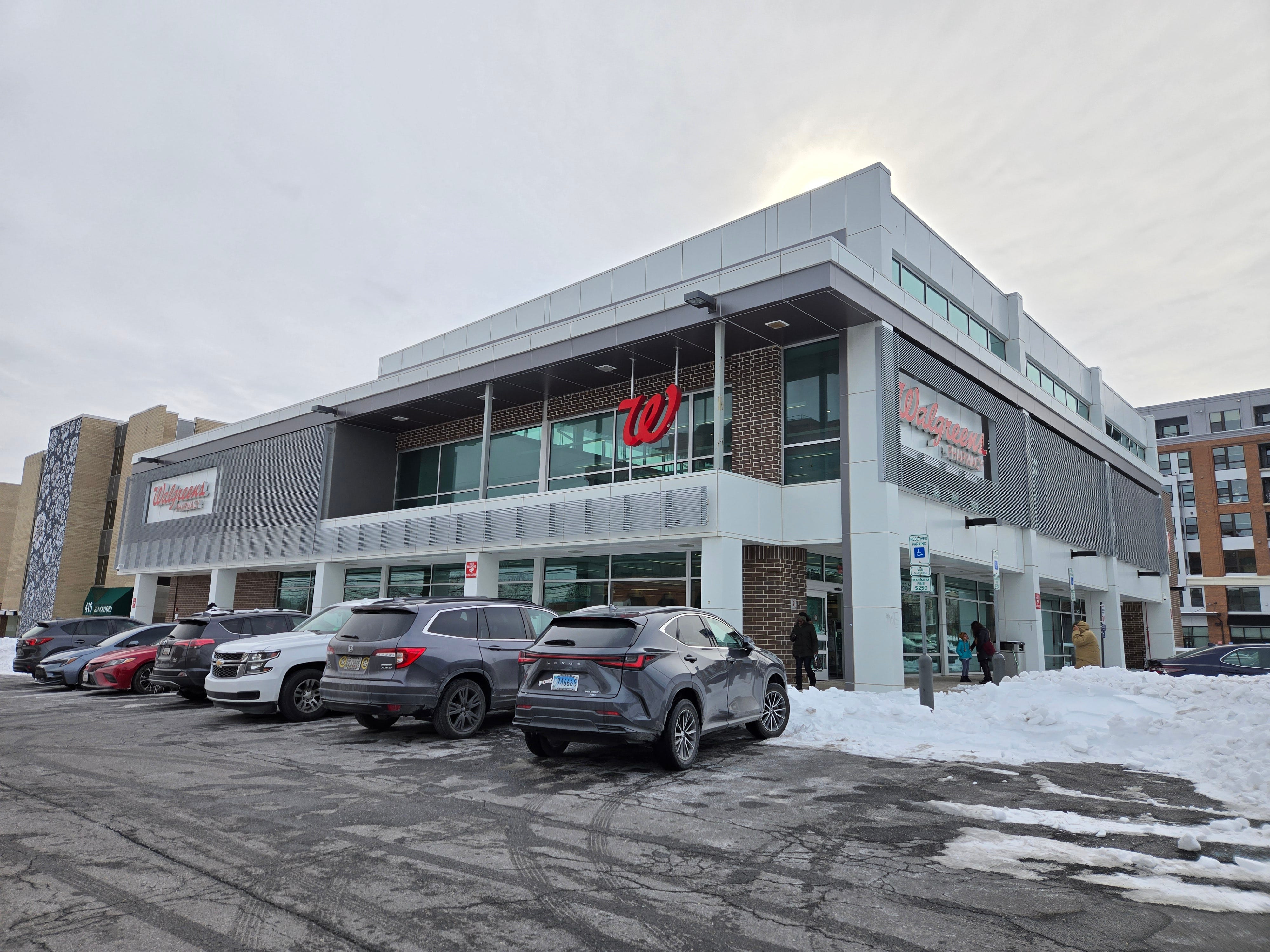
This is a sort of flagship building, designed in 2013 as part of the ongoing modernization of the Hungerford Drive strip. It’s considered a “marquee” store, and was designed by a local architecture firm:
The design of the 13,300 SF marquee store included the elimination of the 2nd floor, which allowed for enhanced ceiling height and clerestory windows on all sides of the extension. Additionally, 8 feet by 1 foot slot windows allowed for light to radiate out at night, linear design motifs provided views of the atrium. In keeping in compliance with the city of Rockville lighting limitations, site lighting was incorporated on the building and in the design. As well as fulfilling the City of Rockville’s art in Public Places requirement, a prominent 37 foot long niche hovering over the main store area featured local artist Greg Braun’s sculptural installation of a sequence of flowing drywall panels.
Nothing says “art” like “flowing drywall panels,” I guess, but that’s not important.
You would think such a notable drug store building would be new construction, wouldn’t you? But I said “designed,” not “built.” Because this building was actually built in the late 1960s!
Before Walgreens, it was a billiards hall and cafe, and looked like this:
The basic structure and those white columns were retained, but the inside was completely redone and the ceiling/roof were altered. So while the renovation was pretty comprehensive, it is clearly the same structure.
For whatever reason, however, the property’s build date in the official digital records from the state of Maryland is 2013—the renovation year—which means the only way to dig up the real, specific build date is to find someone who knows it, or go to the building where the records are stored and find the full paper trail. Some people do know; it was built in 1967.
Here it is seen on Historic Aerials, in 1970; it’s the gray-roofed building, just left of the middle of the frame:
At that time, it was the recently built showroom for Stern’s Furniture, a local furniture retailer, for which, unfortunately, I can’t find any vintage photographs.
This Hungerford Drive store was not the first showroom for Stern’s Furniture, however. Which brings us to the ignominious history of Rockville’s urban renewal project. The original Stern’s showroom was located in Rockville’s old downtown, which can be seen in the middle here, on Historic Aerials, as late as 1964:
Photos of that original store can be found. Here’s one from a Rockville Facebook group:
Here is that same downtown area, with the downtown basically gone, in 1970:
In the 1964 set of imagery, the immediate strip of Hungerford Drive where the Walgreens sits today was forested; in 1970, as I showed you above, it was developed, with the Stern’s showroom and some other buildings. So that’s consistent with 1967 as the build date.
Rockville’s urban renewal was, as these projects were at the time, considered forward-looking, and the aging downtown struggled to accommodate the city’s growth in the postwar era. Nonetheless, it’s such a shame to think how valuable that handful of downtown blocks would be today if it had been just made it through the couple of decades when we destructively turned against our built heritage.
I’ve made a point about Rockville before which I’ve made about other places, and want to note here again. I’m going to quote from a piece I wrote a few years ago for Vox on the phenomenon of iterative densification in suburbia, where I used Rockville as a prime example:
Rockville, Maryland, a suburban community about half an hour from DC by car, didn’t always look like standard suburban sprawl. In the early 20th century, it had trolley service into the urban core. The trolleys completed “24 trips a day between 6:30 a.m. and 12:30 a.m.,” not unlike the region’s subway service today. The trolleys were scrapped in 1935, and it was not until 1984 that the Metro system was extended out to Rockville.
Looking back, scrapping the trolleys wasn’t Rockville’s only mistake. In 1962, the town embraced urban renewal and leveled nearly all of its original downtown, wiping not only the buildings but even the street grid off the map. In its place, they built a mall and office complex. That period, from 1935 to 1984, and especially from 1962 to 1984 — no rail, no downtown — typifies what we often mean by “suburban.”
Today, Rockville is very different, and in some ways it resembles its original state more than its “suburban interlude.” Rockville is widely considered to be the region’s main Chinatown, with a population that is about 20 percent Asian American, and an array of restaurants, Chinese newspapers, and other businesses that serve a predominantly Chinese customer base. In the 2000s, the mall that stood atop the old “downtown” was demolished, and a “town center” with gridded streets was built in its place. For curmudgeons or NIMBYs who think these trends are altering Rockville’s character, they just need to look further back for their baseline. The changes in Rockville aren’t turning it into something it isn’t; they’re turning it into something it used to be, and continuing a process artificially arrested by the suburban era.
This “marquee” Walgreens, the Rockville Town Center, the attempt to bring back walkability, mixed use, and civically minded architecture which enhances the shared, public realm—we had it, we gave it up to chase a shiny object, and now, at long last, we’re understanding what we lost, and working to get it back.
Related Reading:
A Little More on Rockville Pike
Thank you for reading! Please consider upgrading to a paid subscription to help support this newsletter. You’ll get a weekly subscribers-only piece, plus full access to the archive: over 1,500 pieces and growing. And you’ll help ensure more like this!


Speaking of architectural snootery, check out "clerestory." It's a term from the Middle Ages. namely, the row of windows on the upper level of the nave of a church's nave.
https://en.wikipedia.org/wiki/Clerestory