Nicer Than The Average Strip Mall
What Do You Think You're Looking At? #258
Sometimes I come across a shopping center that seems interesting or unique, and I just like to capture them and write something down about them. This one in Gaithersburg, Maryland, Gaithersburg Square, is today’s entry:
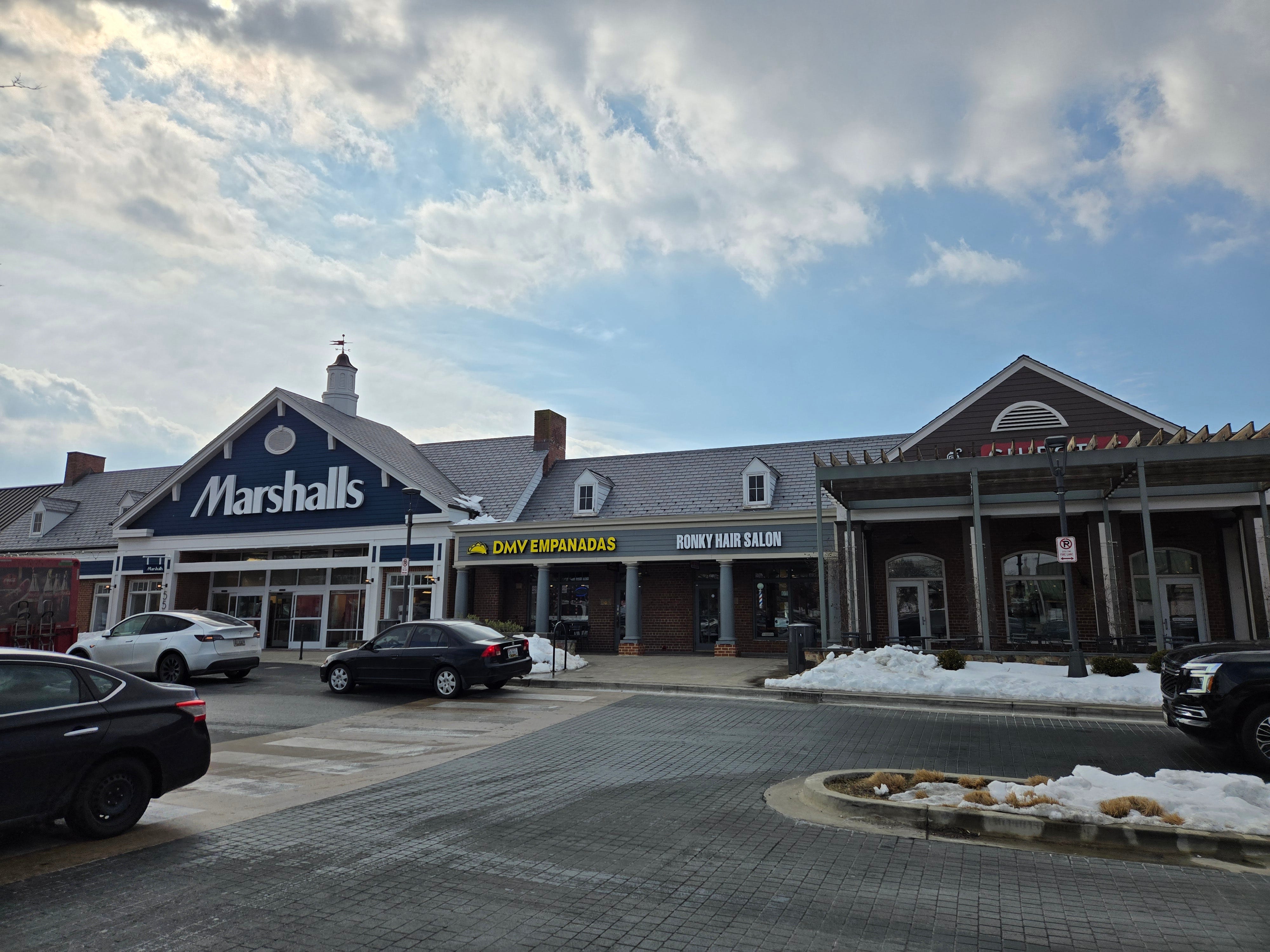
It has some little decorative features, and some outside seating for the restaurant, that makes it nicer than the average strip mall. That does little to change its function or land use, but it elevates a typically clinical and bland space and makes it a little cozier. There’s nothing wrong with that:
While it has a bit of a faux-Main Street look, which could be of recent vintage and a kind of watered-down New Urbanism or something, it actually looks pretty much exactly as it looked when it was first built, in 1967! From this photo shared by the MoCo Show’s Facebook page:
Obviously, the tenants have changed. As that image shows, the current Ross store was an A&P supermarket! (There is no supermarket in the strip now, at least partly because a modern supermarket is typically larger than these spaces.) There’s also a Marshall’s—an almost identical store—in here, which is curious, because often major tenants will have a clause in their lease saying that no direct competitors can lease in the same center. I suspect one reason they’re both here is because they’re the kind of awkward store size that doesn’t match many brick-and-mortar retail stores today.
The Five Below was a Chuck E. Cheese long ago, and the Panera, in an outparcel, was a McDonald’s sans drive through:
That was a real (gas) fireplace!
There was also once a movie theater in here—before the multiplex dominated, when theaters were scaled to fit into shopping centers or urban streets. That was nice, because it added a possible non-retail use to a shopping center. But that theater format doesn’t exist, so the shopping center form is deprived of a possible extra dimension of use.
For whatever reason—perhaps the same company developed them, or perhaps it was a common style and these were simply never facelifted—Montgomery County has several strip malls in this general style. Here, from Google Maps, are two more I can think of:
Beyond that, I don’t think there’s any particular reason these shopping centers were built, other than that this more outer portion of Montgomery County was developing at the time. And not just with bedroom communities; there are companies and government agencies with offices in Gaithersburg, too—for example, the National Institute of Standards & Technology has its office there.
And despite the suburban growth, Montgomery County remains somewhat more logically, intuitively planned, I think, largely because of the way development has been planned over the decades to hug I-270 and then more or less terminate with the Montgomery County Agricultural Reserve.
Here’s an aerial of the rough area of Fairfax and Loudoun County in Virginia, and Montgomery County in Maryland. The Leesburg/Ashburn/Sterling area of Loudoun County, which is heavily developed, is the same distance out as Montgomery County’s Agricultural Reserve, which is the patch of farmland above Ashburn/Sterling and left of I-270 here:
I found this really great history of suburban shopping centers in Montgomery County, and it also doubles as a history of the evolution of the form in general. Basically, as they evolved, they became less and less “urban” in form and character, mostly because the need for parking overwhelmed other considerations.
That article includes this photo and description, of a major shopping center in Rockville. It’s interesting that this picture of a quite plain-looking, low-slung strip mall with a huge parking lot was sort of self-evidently exciting and new and great at the time. Today this same photo reads as “depressing, bleak, blank sea of empty asphalt.” (At least it does to me.)
This shopping center is actually still there, though it has been facelifted probably more than once, and it looks nicer today than it did with its original exterior. Maybe that dull look is why the faux-Main Street look came into vogue in the 1960s, when the Gaithersburg Square Shopping Center went up.
The article doesn’t go into the 1960s, when those further-out communities in Montgomery County were starting to develop heavily. By that time, these suburban shopping centers were no longer remarkable or really notable. In their early days, though, they were very much an intentional, self-conscious idea. Often a lot of thought went into the design. The opening of a new shopping center was event; free, plentiful parking was a feature, not just the way retail and errand-running work.
I think it’s helpful—helpful in thinking through policy for the present day, helpful in being grateful for what we have, helpful in staying humble—to learn about the really not so distant past, and how subtly different it can seem.
Related Reading:
Thank you for reading! Please consider upgrading to a paid subscription to help support this newsletter. You’ll get a weekly subscribers-only piece, plus full access to the archive: over 1,500 pieces and growing. And you’ll help ensure more like this!


