

I have a new piece out, at The Freeman, on the persistence of the “category killer” retail format. These are product-area-specific superstores, combining the discounting and economies of scale of the discount department stores with the focus and selection of specialty stores.
This segment—including Borders, Toys ‘R’ Us, Sports Authority, Buy Buy Baby, Bed Bath & Beyond, Circuit City, and more—has taken a beating in the last couple of decades. Even though they grew alongside the discount department stores, especially Walmart, the rise of Amazon and other e-commerce sites probably took too much market share for so many of these chains to stay in business.
However, as I write, the retail apocalypse has really never quite come for this retail format overall:
The arrival of Doomsday may be slowing—or even reversing. First, it’s notable that despite the carnage in the category-killer segment, many broad product categories do still have at least one category-killer chain representing those products in the physical world, including books (Barnes & Noble), electronics (Best Buy), crafts (Michaels and Hobby Lobby), sporting goods (Dick’s), shoes (Famous Footwear and DSW), office supplies (Staples and Office Depot), and at least a subcategory of home goods (The Container Store).
So, while there may not have been room in a product category for two or three competing chains and Walmart and Amazon, the threat to specialist big-box stores has never quite been extinction-level.
There’s also Lowe’s and Home Depot, which are much larger than other category-killer stores, but function the same way. E-commerce has not yet replaced the ability to run to the home improvement store for a particular screw or nut or bolt or plumbing part, nor has it replaced the importance of being able to inspect things like lawnmowers or barbecue grills in person.
There are even some interesting new ideas going on in the world of category killers. AutoZone in 2014, in the thick of the retail apocalypse, introduced “Mega Hub” stores, which function as stores as well as warehouses to restock smaller typical AutoZone stores. The Mega Hubs are much larger than the typical auto-parts store, up to 50,000 square feet. Here’s one in Austin, Texas, in an old supermarket:
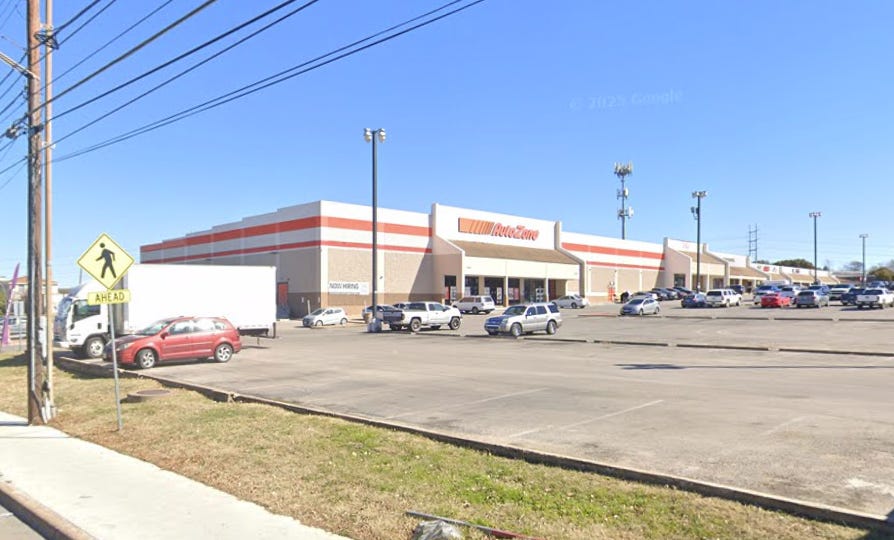
AutoZone has been building more of these lately; recently it was reported that they plan to about double the number of Mega Hubs, which would bring the total number to about 300. This doesn’t seem to have gotten much press outside of retail trade publications, but it’s fascinating. It is probably the most recent category-killer concept and pretty much a new one.
Here’s another interesting idea: DSW (Designer Shoe Warehouse) in 2022 introduced a revamped smaller and more experiential store concept. That’s fairly common, but notice this detail: the smaller store concept has the same amount of inventory!
DSW is reimagining its store design with a new, smaller-size concept that puts the spotlight on its owned brands.
Designer Brands Inc., parent of DSW Designer Shoe Warehouse, unveiled its “warehouse reimagined” store format at Hedwig Village in Houston. At about 15,000 sq. ft., the new format is smaller than a traditional DSW, which averages about 25,000 sq. ft., but offers the same amount of inventory due to design optimization.
There’s also the concept of “stores within stores,” which can be gimmicky or might be a genuinely good idea.
I saw this post at the Facebook page Retail Dead or Alive, bouncing off the recent Party-City-inside-Staples arrangement:
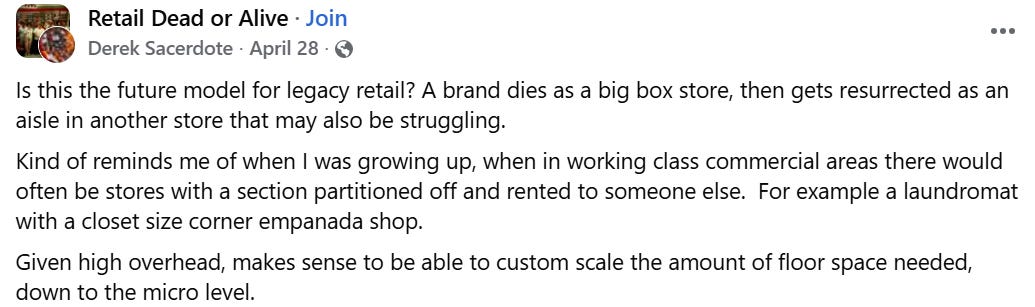
In addition to that deal, there is the new “Bed Bath and Beyond inside The Container Store” concept being rolled out now. Like the smaller DSW with the same inventory, it’s likely that a little bit of squeezing can fit these stores-within-stores without the primary store losing SKUs.
This is all very interesting because it means there are still new ideas in brick-and-mortar retail. The narrative that e-commerce would eat physical stores was not entirely wrong, but it was quite exaggerated.
Now here’s a little bit of retail history. In some ways the trajectory of the category-killer idea is even shorter than you might think. Discount and warehouse-type stores have existed in some form since at least the early postwar years, and Toys ‘R’ Us stands out as an early category-killer-type store. But the world of curated, broadly specialized 25,000-40,000 square foot superstore, with one or two or even three chains for every broad category, is a child of the 1980s.
And even in the mid-1990s, the idea of category-specific superstores was novel enough for the New York Times to publish an article on their appearance along a major New Jersey commercial corridor:
Along six major highways in the northern half of the state, retailers are moving in and getting bigger. “For Lease” signs in front of vacant stores have been replaced by signs that say “Opening Soon” on hangar-sized buildings.
Retail vacancies fell to 3.2 percent in 1995 from 5.3 percent the previous year, according to a recent survey conducted by R.J. Brunelli and Company, a retail leasing firm in Old Bridge.
Many analysts agree that the retail sector has rebounded somewhat after several years of sluggishness. But they point out that shoppers’ appetite for bargains has favored the proliferation of “big boxes,” giant stores of more than 15,000 square feet with no frills and discount prices….
On Route 22 between Union and Somerville, Tops Appliance City, Sneaker Stadium, Staples and Pet Food Giant are the newest tenants.
This is good news for shoppers who like one-stop bargain shopping and don’t miss the personal service that shops in small downtown areas often provide.
That is pretty wild to me, that “shoppers who like one-stop bargain shopping and don’t miss the personal service that shops in small downtown areas often provide” was not kind of an obsolete or old-hat idea in 1995. The end of the category killer’s big burst of expansion very nearly overlapped with the beginning of its demise.
Check out the piece over at The Freeman!
Related Reading:
For my own case, I find a lot of value in being able to see an item in person before I buy it, although I guess I'm a bit of an oddball in that regard. Of course, it depends on the item. Clothing definitely needs to be in-person, but consumer electronics much less so.
That being said, I think there's also something to be said for these superstores having the advantage of being able to use their stores both as showrooms and distribution hubs. Amazon definitely got the jump on a shipping-focused logistics network, but now a lot of larger format stores have gotten better at digitizing their inventories and using their stores as warehouses as well. Just warehouses that you can also walk around in and shop from directly. It may not be quite as efficient as Amazon and its giant robot warehouses, but I feel like that's more marginal than we give it credit for.
Also, I feel like Amazon has had more of a legitimacy crisis these days, with a lot of the stuff you can purchase on there being of questionable quality. It may be convenient up front, but having to return stuff all the time is such a drag. At least in-person shopping tends to be from established brands and you can get a better feel for the quality, at least sometimes.
And as a final note, we've been here before. Shipping-focused shopping existed already with the old Sears catalog, which dominated once upon a time before fading as well. I always wondered why that was, and if there are any parallels to today. Or if maybe the advances in modern telecommunications make for a completely different ballgame.