

I’m heading home from the YIMBYtown conference in Raleigh, North Carolina.
YIMBYtown is the largest pro-housing conference in America, and it’s my first time at one of these. I’ve been to smaller gatherings and many of the folks involved overlap, but this was a difference in scale. (“Too many people,” one conversation mate said, “we need a density limit on YIMBYtown attendance.”)
While it’s all fresh in my mind, I wanted to send a little roundup of ideas and moments that particularly stood out to me.
These three days felt uncannily like the beginning of college. It’s strange but familiar, that feeling of being slightly alone but excited. Vulnerable, even. There’s something special about the brief but sometimes surprisingly intense connections that can arise from that mix of excitement and vulnerability. The way someone’s energy can be infectious and make you feel different but more like yourself. And how being alone with strangers is somehow itself the precondition for community. There’s something very deep there.
It makes me think of this sweet little essay I came across on the way platonic friendships in adulthood can feel almost like childhood crushes. It’s strange to feel this at my age, to remember that it is still possible, and to wonder why it is so rare.
And part of all of that is that the YIMBY movement, and the pro-housing movement in general, is positive. I don’t think that we want to become an entrenched interest group that exists in a symbiotic relationship with the problem we want to solve. We want to solve the problem. We would like to not have to exist. This may not be true of everyone, but it’s very much the vibe here. We would love to get housing right and make “housing advocacy” or the “housing movement” obsolete. I encounter very little cynicism in this movement. It’s earnest. And we could use more earnestness.
Raleigh is interesting. Like a lot of newer American cities, it has a downtown core, but the overall city is quite large and sprawling. Most of Raleigh would probably count as “suburban” in form. The downtown is growing as a residential district, but it’s largely offices, restaurants, and hotels. The streets were uncannily empty and quiet at night.
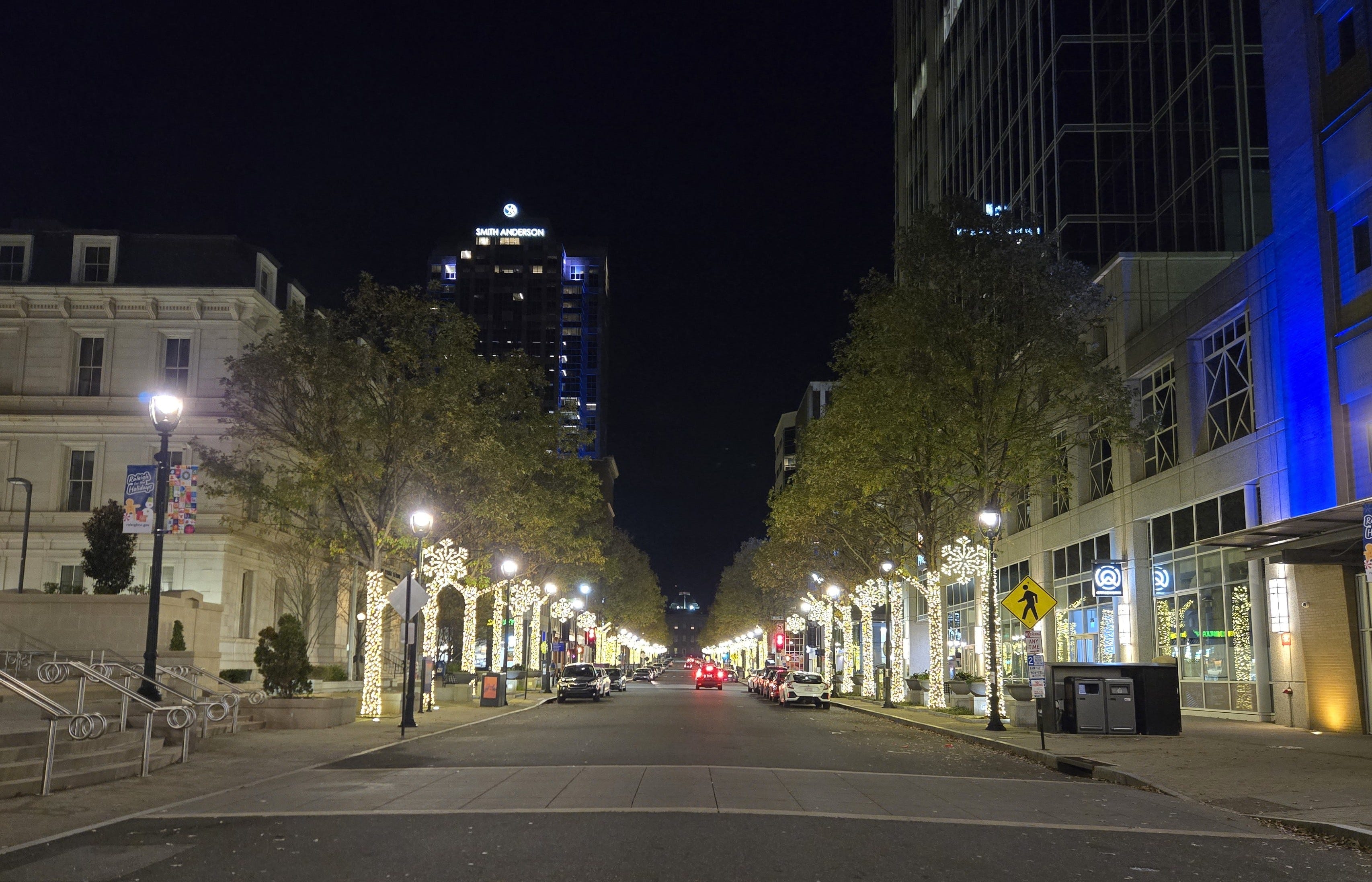
It’s almost like you have the city to yourself to just explore, like a map in a video game or a movie set. One of my friends wanted to run to a drugstore, and the hotel staff told her the nearest one was way too far to walk—about half a mile.
I don’t know how generalizable that is, but I suspect a lot of the words we housing people use don’t resonate. What does resonate is actually experiencing it. During a city tour, we drove around some neighborhoods adjacent to downtown and took a walk through a large park. We also saw some recently built and under-construction apartment buildings which connect to a trail network and are eventually meant to connect downtown to the nearby neighborhoods.
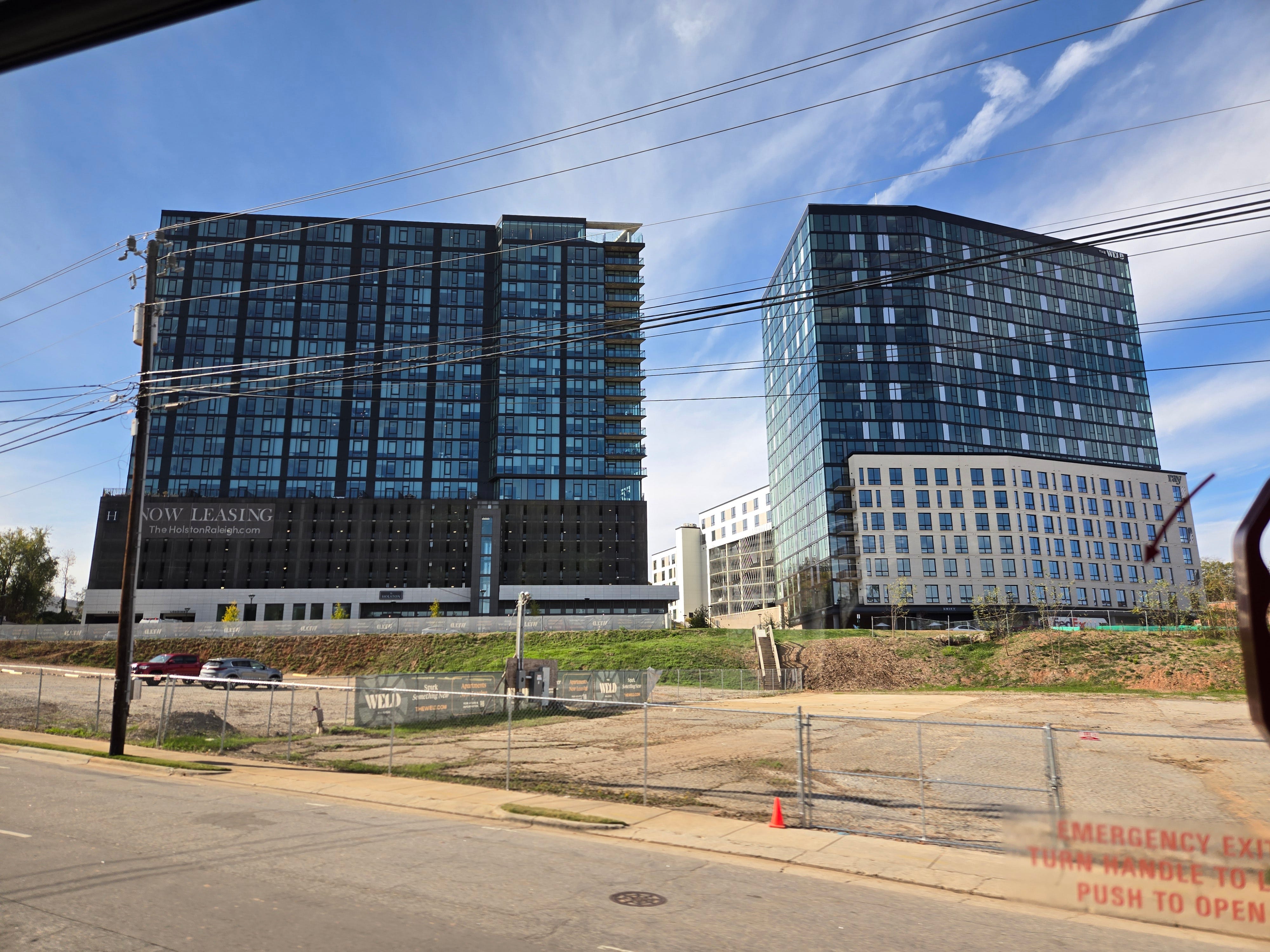
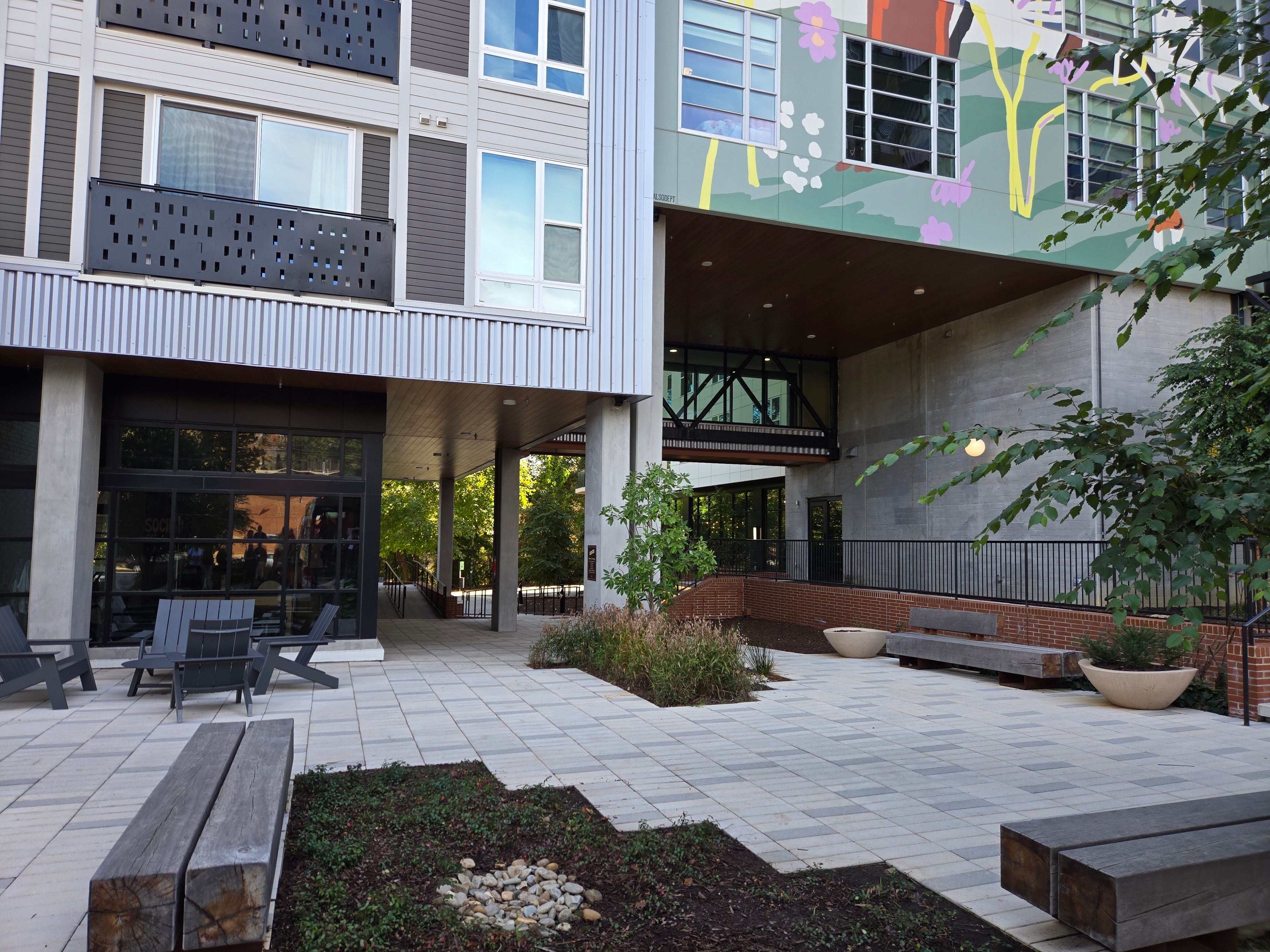
I asked our tour guide if she thought there was a cultural aversion to walkability or the idea of “urban living.” She said that when stuff gets built that makes that intuitive and seamless, people do it. And they like it. But they have to experience it.
The night before the programming began, I met up with another guy from the D.C. area. We got a couple of drinks at an upstairs bar in an old building, where we were almost the only customers.
We were chatting with the bartender and mentioned we were with a pro-housing conference, and he said something like, “So cutting down more trees?” And he explained how much land was being developed for housing and basically how suburban sprawl was proliferating everywhere. “If we’d had a few more minutes, we would’ve gotten into infill and densification,” I said to my drinking mate.
But “infill” and “densification” are not familiar ways of talking about development; traffic and cutting down trees are. And this region of North Carolina, the Triangle, really is traffic-choked and centerless, outside of its relatively small urban cores. If that’s what “growth” means to the average person, of course the YIMBYs sound weird when they talk about wanting more of it. But the whole point is that if we grow better, we can avoid that spread-out, overcrowded feeling. My wife, who’s not a land-use nerd to any extent at all, put it perfectly, on a previous visit to the Triangle: “It feels crowded for no reason.”
But to make that point land, you need trust and relatability, and you also need examples to point to. This is why housing becomes about “advocacy” even though the ultimate goal of the movement is so simple and intuitive.
A conservative from Montana gave a presentation on talking to conservatives about housing. “Speak American,” he said: faith, family, home, tradition, rootedness. Even though liberal and conservative housing advocates mostly agree on policy, the way YIMBYs talk about it often conveys to rural America that this isn’t for or about them. It’s an elitist, big-city issue and it can stay there.
I also went to a session on building trust in Latino communities. Like many communities that skew working-class, Latinos are often skeptical of this stuff because it can sound like a bunch of euphemisms for urban renewal or displacement or big developers building for rich people. The panelists were very careful to convey that while these criticisms are not really accurate, as far as describing YIMBYs and modern housing advocates, the distrust is real. And more than that, the distrust is legitimate.
It’s easy to recognize that when you sympathize with or come from the community in question. I suspect it’s harder for some YIMBYs to do the same with the rural conservatives. I don’t mean that everyone’s skepticism is equally valid; I mean that it’s equally real, and that breaking through it requires empathy. As an advocate, your job isn’t to win over a person’s whole worldview. It’s to build enough trust to maybe win them over on your concern. Or even better, help them find a way there from within their own view of the world. That’s politics. But it’s also being human.
At dinner I ended up at a table with some fellow Substackers, helmed by Strong Towns founder Charles Marohn. There have been some social media squabbles between Strong Towns and the YIMBY movement, which is a bit of inside baseball. The fact that Marohn was there is the result of a lot of online and offline dialogue. In some of my work, I’ve been in a small way part of that dialogue.
You never know how an idea, a phrase, a meeting, an encounter will reverberate and grow and amount to more than you could have guessed. While I was here at the conference, I got a message from a reader that my work helped inspire a public comment he made in favor of a housing proposal. It’s amazing to hear something like that.
I suppose every movement and every cause thinks it’s going to win, talks about its momentum, feels the energy in the room when they all get together like this. But I think it’s really true of the pro-housing movement. I’ve watched it just in my six or so years as a writer grow from something of a niche cause to a mainstream political issue. A lot of that is just because the housing crunch is real, and severe. But some of it is because of the work we’ve done as policymakers and advocates and communicators.
I’ll leave you with what might be my most important takeaway: this work can be professionally useful, fun, inspiring, even emotional. But above all, it’s a responsibility. It’s a responsibility to have a position of influence, however narrow it might be in the scheme of things. These moments remind me of that, and I hope remind all of us.
Till next time.
You might also like
A Little More On Zoning Preemption
Back To Basics On Towns And Urbanity
Energy is a necessary but insufficient condition for the long-term prospects of a movement. Our adversary is the Ideology of the Home and we will need to offer a more compelling alternative. We have not achieved that yet. OTOH, the progress is real.
The tree thing definitely drives me up a wall.
From an environmental standpoint, you need like 400 trees to offset the emissions from just a single car. If you can save just a single car trip a year by cutting down a tree, you're coming out ahead. It's madness.
To say nothing of sprawl. Of course. Or the ability for trees to easily integrate in an urban neighborhood. Or the fact that a small group of trees in the middle of a city don't exactly constitute an ecosystem (especially compared to the real forests outside of town that are being suburbanized).
But your point definitely stands. In a world were development really just means suburbs, it's easy to assume that there is no other way. I think that's our real work to be done.
Same thing with talking to rural folks. The main tricks is two-fold. Focusing on the fact that the government is preventing folks from doing basic simple things with their own land, and also pointing out that good urbanism keeps the city in the city, rather than letting the sprawl invade the countryside. I'm not sure if that will work, but it's better than a lot of tut-tut messaging out there.