Old Store, Not Anymore
What Do You Think You're Looking At? #275
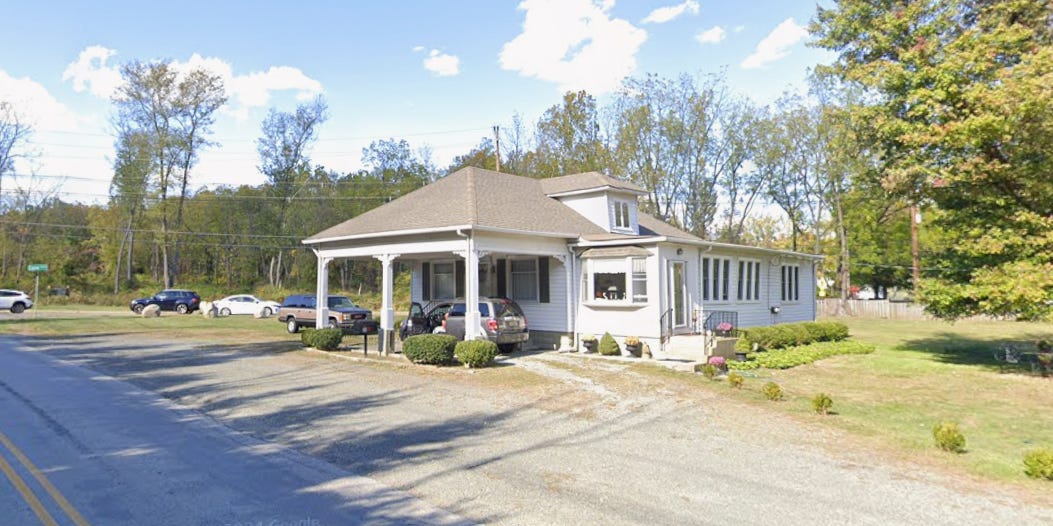
We’re taking a look at this house outside my hometown of Flemington, New Jersey:
I found this post on a local Facebook group about it:
The commenters mostly think it was never a gas station, though these recollections are often incomplete or mistaken. It does look like a gas station. But most of them remember it being a general store or small grocery store, with milk, bread, candy, ice cream, and other such things for sale. It apparently used to back directly onto a dairy farm.
Take a look at the front, too. Someone points out this two-way step to the front door is unusual for a house. But it does resemble the entrance to a diner or restaurant. Maybe this was used because the front was a store?
Now a general store in a house is cool, and this kind of thing, which modern zoning largely stamped out, should be allowed. But that’s not really remarkable or anything. What’s most interesting to me about this is where it’s located. It’s not on a residential street of the town of Flemington; it’s a fair bit outside of the town and its grid.
It’s at the red marker towards the left here:
This makes it something like a corner store for the people living in the “country” part of the area, which in the decades when this store was operating would probably have been mostly farms. But based on the comments, it also sounds like some of the people living nearby were probably suburbanites of a sort as well.
“We walked there all the time. It was only 2 doors down,” one commenter notes. “In early summer of 1964, my friend’s father piled us all in his Studebaker Hawk to search for cigarettes one Sunday morning. Here’s where we ended up,” says another. One more: “Spent many summer days hanging out with my cousins at their summer cottage close by and then stopping by for sodas there on the way home. Classic kid memories for those days.”
This is pretty striking. Almost all of the talk about “walkability” or “mixed use” has to do with urban areas or small towns, or at least fairly densely populated areas. Yet many decades ago, a sparsely populated area outside a town of about 3,000 people had, basically, a corner store.
You see these sorts of stores, or the remains of them, in a lot of outlying areas, near or beyond the exurban fringe. There are a lot of gas stations with some kind of old building and store, often long predating the current pumps and canopy. Sometimes you’ll also pass an empty one. Usually, they’re two stories, either homes with first-floor businesses or very basic commercial buildings, more “urban” than the ones we’re likely to see in today’s suburbs.
This flexibility—both of what a building could be used for, and how easy it was for people to use them that way—is striking, and is something we have lost. For the most part, modern suburban neighborhoods and even a lot of urban neighborhoods have no commercial uses at all, except illicit ones or grandfathered ones. The strict separation of uses is one of the most damaging aspects of modern zoning.
And, counterintuitively, rural and small-town areas may have retained the old approach to unselfconsciously mixing residential and low-impact commercial uses longer than cities did, because zoning was often adopted on a delay in these areas further from the big population centers.
That’s why this interests me. Partly because of what it meant, specifically, for the people who lived near it (there are so many fond memories in those Facebook comments.) But also because of what it tells us generally about the subtly different world we used to live in.
Related Reading:
Have You Ever Lived in a Strip Mall?


