Out Of One, Many
What Do You Think You're Looking At? #257
During my drive down the Route 1 corridor in Northern Virginia, which I wrote about here, I mentioned one interesting store to which I was going to devote a full piece. It’s this large thrift store in an old 1960s strip mall, at a major corner in Woodbridge, Virginia.
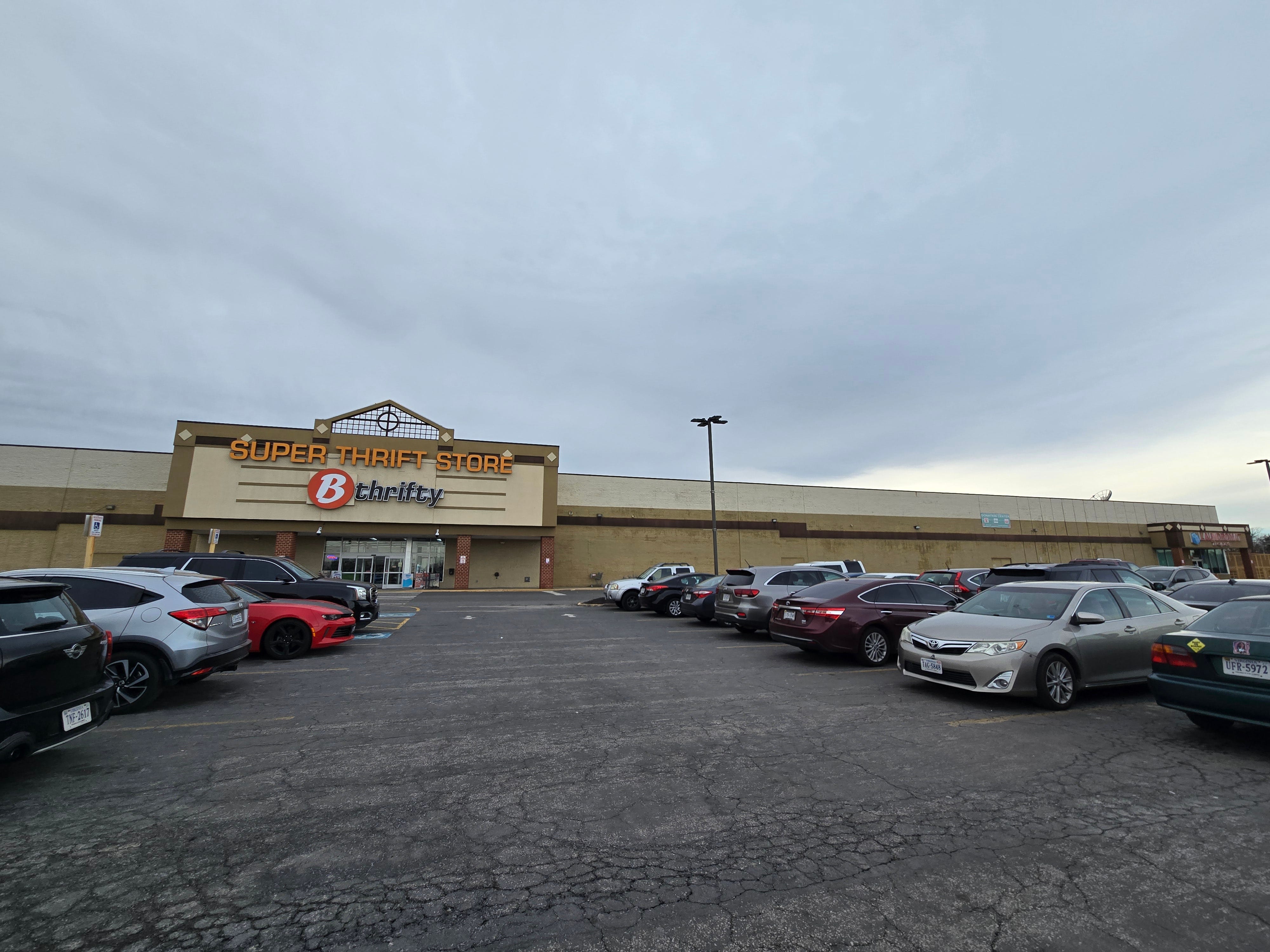
The shopping center has this kind of bleak, windswept look that vast suburban properties tend to develop, although it’s well occupied and not in bad shape:
There’s a large vacant lot adjacent to this shopping center, where there used to be car dealer, which is slated to become a mixed-use development. And there’s an empty lot across the road where there used to be a semi-abandoned strip mall; I’m not sure what that’s going to become.
The Virginia Railway Express station, which you can use to commute into D.C., is just across Route 1. It’s really something that we put heavy rail down here and almost no supporting density. But that will come, it seems. Everything is a work in progress.
What I’m focusing on in this piece is this thrift store, how it uses its space, and what it used to be. First of all, it’s huge. Obviously it was something else at one time, if only because these large thrift stores are virtually never new builds. But this one is really cavernous inside.
I neglected to snap a photo of the thrift store portion of the space, though it looks pretty much like the photos below. (The thrift area was well organized and pretty nice, although unfortunately I didn’t find anything I wanted to buy.) A narrow portion of the original store’s footprint has become an indoor playground space for kids, but there’s a more interesting division of the original space, which is still connected to the thrift store.
Divided among themselves with partitions and freestanding walls is this whole back area, full of spaces for small businesses:
One of them is a grocery store!
Most of them are clothing, knick-knacks, things like that:
I even found these old arcade machines in a space that was vacant. I wonder what will become of them?
This is really neat. The spaces are larger than flea market stalls, and I’m sure they’re fairly cheap to rent. I don’t know what sort of profit there could be in it—I guess it depends on what a given vendor is selling—but most of them were occupied, and staffed, so they must generate worthwhile money.
It’s essentially the same thing you see with this old shopping-arcade concept in an early shopping center in Glenmont, Maryland, or this much more recent subdivision of old strip-mall space in Fall’s Church, Virginia’s Eden Center. The basic idea is making commercial spaces small enough so that a single proprietor can afford the rent, make money, and provide some good or service that wouldn’t quite get done with chains or big-boxes. But it’s even more interesting here, because of its informality, and the fact that it has been added by tenants and not by the original developers.
This is a good time to tell you what this space used to be. It was a Kmart, from the mid-1990s until 2003, when it was closed in a wave of store closures.
Before that, it was a Woolco, going back to the 1960s when the shopping center was built. Woolco was a big-box concept from the Woolworth’s company, their attempt to compete with stores like Kmart and other emerging big-box discount department stores. The Woolco venture was not successful, and by 1983 they had all been closed.
Here are some photos, from the great retail blog Pleasant Family Shopping, of an old Woolco store. They looked nice, but they must have been expensive to maintain, and logistically complex.
A curious little sidenote here is that this shopping center, which is in fine shape but kind of showing its age, was actually renovated in the 1990s, when the Kmart was secured as a tenant for the old Woolco building. Apparently it was severely decayed and semi-abandoned at that time. For whatever reason, there has been a lot of visible boom and bust along this Route 1 corridor. From an October 1994 Washington Post piece:
Graffiti covered the exterior. Weeds grew three feet tall in the parking lot. Walls had holes big enough to stick your head through. Only four businesses remained open. The other 95 percent of the space was boarded up.
And the inside was worse. Lavinia Sherman, a vice president at the New Jersey real estate company that now owns the center on U.S. Route 1 in Woodbridge, said that at some point ponies had lived in the biggest store space. “We found that out from what was left,” she said.
“I had never seen a center so dilapidated. You can’t imagine what it was like,” said Sherman, who has spent the past year as Lamar Cos.’ project manager at the strip mall. “The ceiling was caving in ... buildings were inhabited by pigeons.”
So it’s with understandable pride that Sherman gives a tour now. The walls gleam white; the red-and-blue trim looks modern. New Kmart and Food Lion stores opened this summer. The smaller spaces are almost all rented -- the 174,000-square-foot center should be 98 percent leased by the end of the year. The parking lot is neat and clean. Big planters will be installed soon.
Even the name has changed -- it’s now called Station Plaza, after the Virginia Railway Express station across the highway….
The transformation of Station Plaza is a small but dramatic example of a national phenomenon. Thousands of aging strip malls line America’s older commercial highways. Fixing these centers not only removes a visual blight, but also offers a chance for developers to profit handsomely.
So that worked. But the boom and bust of the big-box discount department store segment itself pulled down a lot of these shopping centers, which ended up with anchor spaces too small or numerous for Walmart and Target, but too large for almost any other type of store. (The article says that Ames occupied the Woolco post briefly before moving across the street, to the since-demolished strip mall. Ames is gone, and Kmart, of course, is virtually gone.)
That’s part of what’s so interesting to me about this informal repurposing of the awkward big-box space. Suburbia has a dearth of truly small commercial spaces, while it often has too many of these larger spaces stranded by e-commerce and the “retail apocalypse.” It seems completely logical that these spaces would get carved up in some way to fix this imbalance. But it rarely seems to happen. And when it does, it tends to be in somewhat poorer areas.
That’s one of the puzzles of all of this for me. Why is it like that? This is excellent, entrepreneurial stuff. It’s not wholesale redevelopment, but the adaptation of a thing for new uses. It’s the magic of incrementalism. It’s how you build a real place, and the local relationships on which a sense of place rests.
One more thing. Over around the corner, there’s a little auto shop.
It was the auto service department of the old Woolco (and probably the Kmart) and is now an independent business. Here’s another Pleasant Family Shopping entry, with a vintage photograph of a Woolco auto shop. It looks exactly the same: six garage bays in the back corner of a massive store.
The box-store structure itself has been only minimally modified since it was built. But the number of individual proprietors that it now serves is fascinating and hopeful. It’s a kind of messy, hyperlocal vitality that is so easy to miss. Most of those small businesses inside the thrift store space aren’t on Google Maps, meaning there’s a whole layer of commercial activity which has not been captured by the internet. I find that fascinating. There must be a lot of this.
If these things aren’t “for you”—if they’re not in the places you frequent, or if you’re not the target customer—you might never notice them. And you might wonder, why is anybody here? What does anybody do here? There is so much more going on in most places than meets the eye.
This is why it’s these suburban areas in transition, deeply lived in, yet in some ways forgotten by time and by whoever first constructed them, which I find to be some of the most interesting places in America, and some of the places which best display an “urbanist” approach to living and doing business.
Related Reading:
Archive Dive: The Taco Truck And The Thrift Store
Thank you for reading! Please consider upgrading to a paid subscription to help support this newsletter. You’ll get a weekly subscribers-only piece, plus full access to the archive: over 1,500 pieces and growing. And you’ll help ensure more like this!


