
Silver Spring Forward
The suburbia we almost had, and could still have

My latest piece over at Greater Greater Washington is on the history of a couple of curious, seemingly out-of-place buildings along a commercial strip outside of downtown Silver Spring, Maryland.
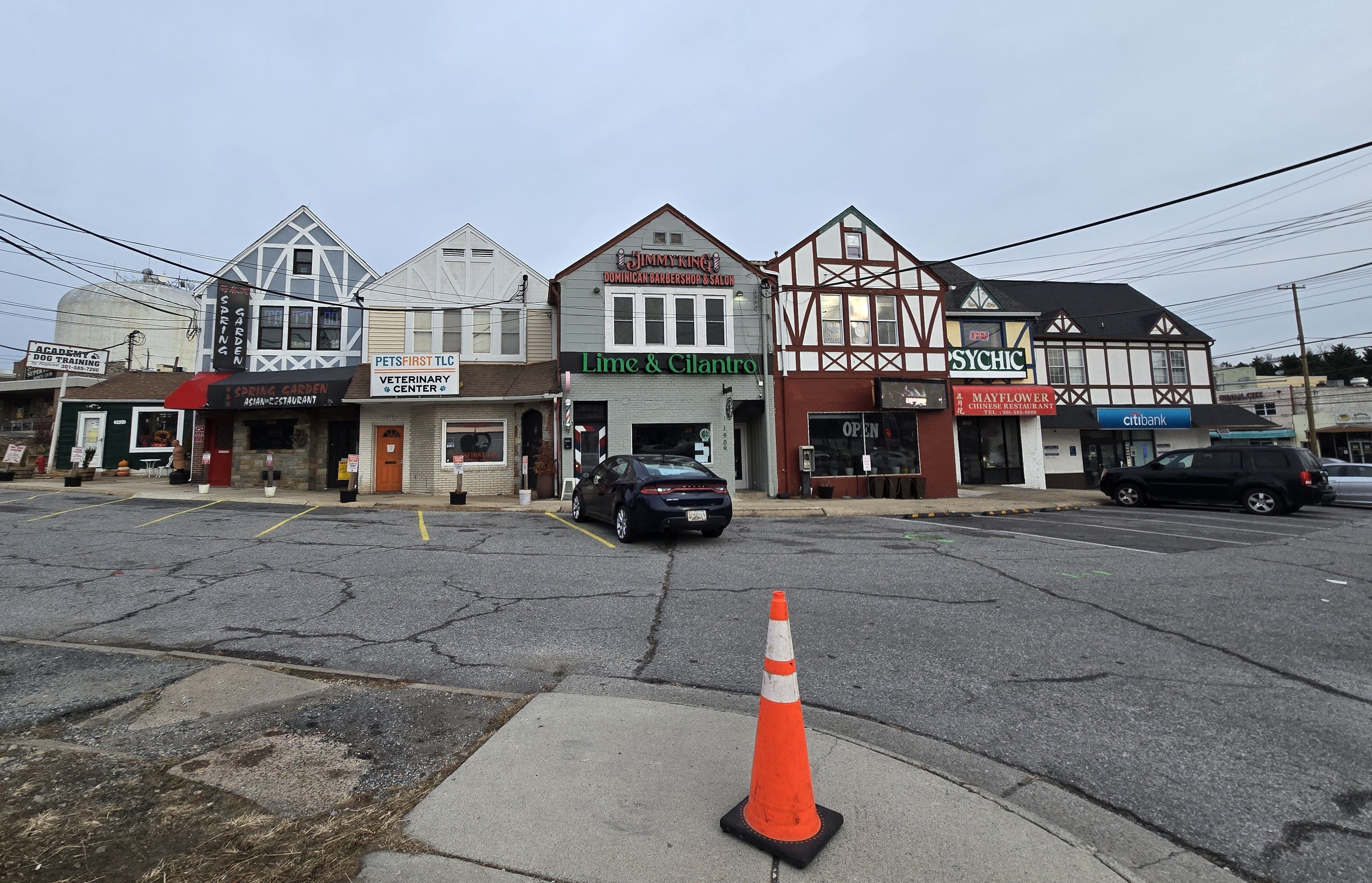
These buildings have fascinated me for awhile, and I finally decided to spend some time looking into their origins. The first is this, the Tudor-style Montgomery Hills Shopping Center, from 1929:
And the second is this block across the street, built during the 1940s:
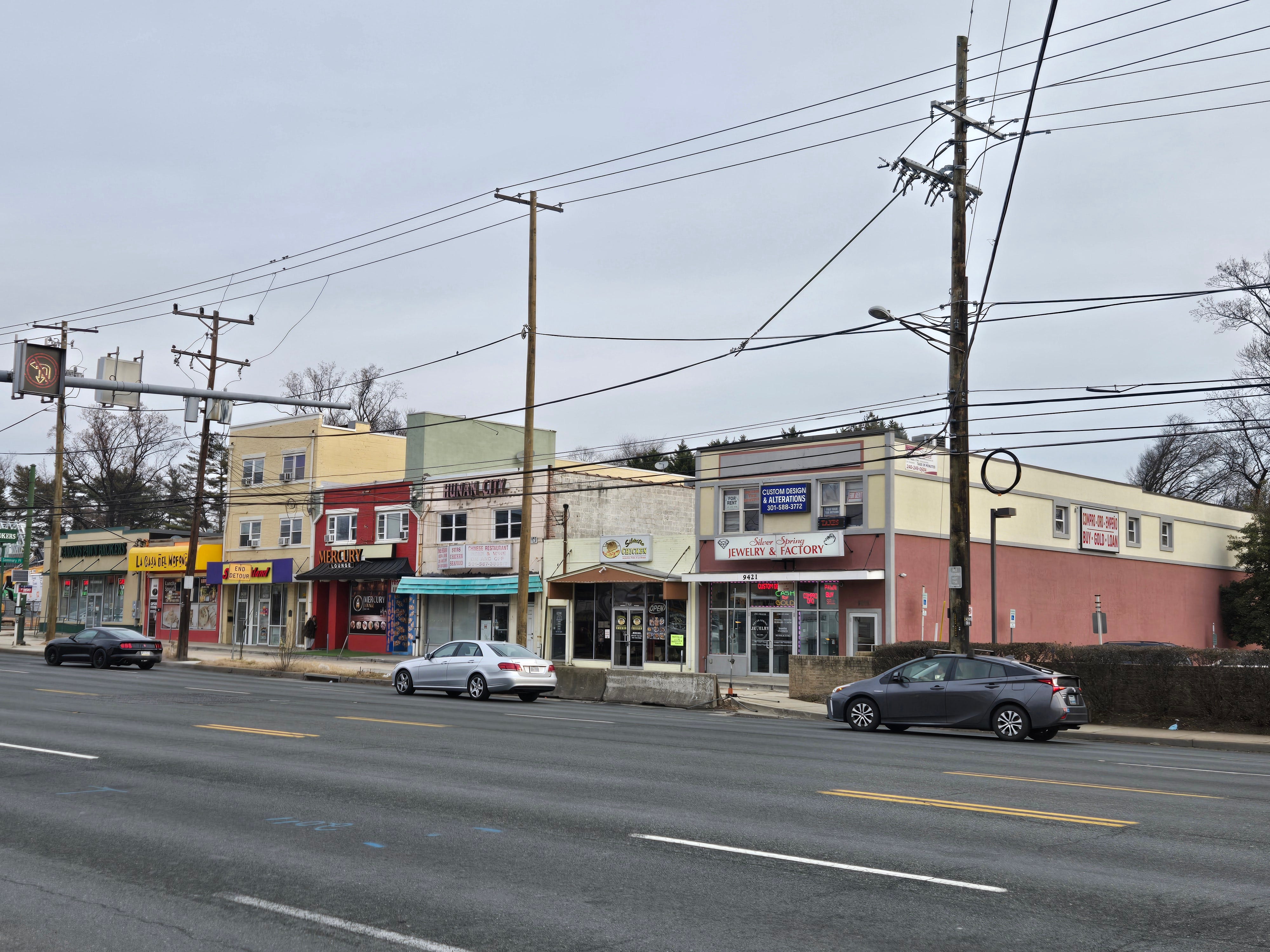
They form, along with a couple of other buildings, a little commercial node by what was once a streetcar stop, though the streetcar was gone before the first of these buildings went up.
Here’s the satellite view of the intersection today. The buildings right in the middle, on either side of the wide road (Georgia Avenue) are the ones pictured above:
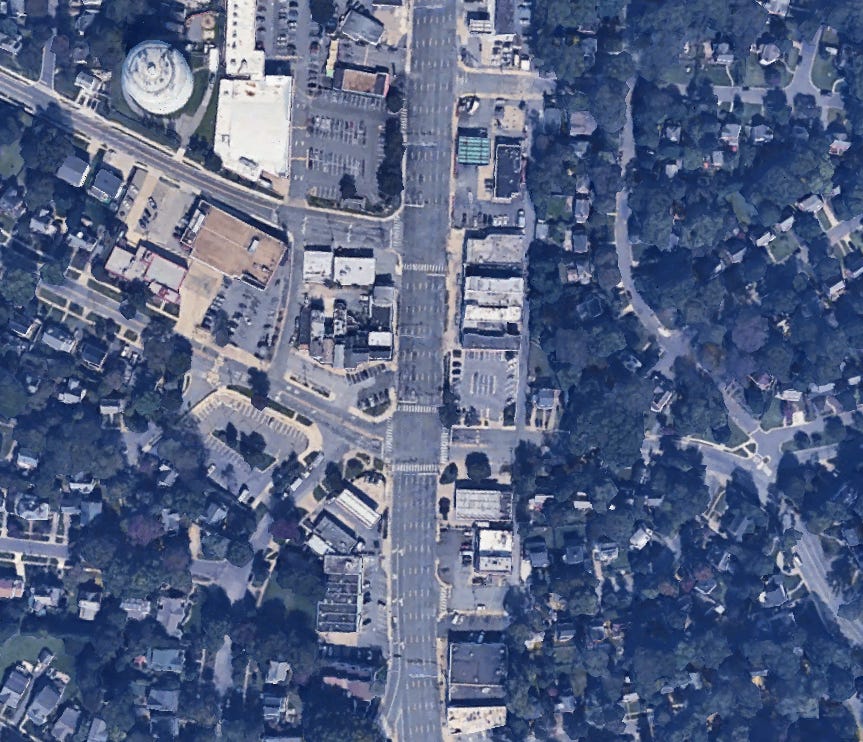
What strikes me about these buildings and this intersection is that it looks like an embryonic downtown: the beginning of an urban area that never “grew up,” because it started to get built right at the tail end of the old urban era, and right at the beginning of the period when cars began to dictate development patterns.
The actual history, however, is even more interesting than that! The residential subdivisions around this intersection actually predate the buildings a little bit, and the Tudor-style Montgomery Hills Shopping Center was not a last-gasp urban building, but a neighborhood shopping center designed to serve the surrounding subdivisions, and save residents trips into Silver Spring proper.
What’s really important, though, is this, from a Maryland Historical Trust determination of eligibility form:
Primarily constructed between 1929 and 1931, the Montgomery Hills Shopping Center consists of seven attached commercial buildings with residential units above and to the rear of a number of the businesses….
Largely completed by 1959, the rear additions on the buildings at 1901-1919 Seminary Road reflect the residential use and lack of an individual owner with a singular development plan….
The developers, however, lacked the foresight of the planners of a 1930s neighborhood shopping center. Benner and Good planned the shopping center to serve the immediate members of Montgomery Hills and neighboring subdivisions. As a result, the current parking lot was designated as a landscaped area/park with curbside parking serving the businesses….This use, however, may have never come to fruition as parking would have been essential for automobiles, especially along the highly traveled Georgia Avenue. Further, the staggered setback of the buildings from the street reflects the pedestrian-minded orientation of the commercial development, rather than one devoted to the automobile-owning customer.
This is all rather remarkable, given that this was a shopping center on a major road in the middle of essentially modern residential subdivisions. Though initially constructed by a single developer all at once, this “shopping center” was 1) made of attached, distinct buildings which were sold to different owners; 2) included residences above the storefronts; 3) partially fronted the street directly; and 4) was intended mostly for pedestrian access.
The Montgomery Hills Shopping Center, therefore, in every respect but its location, is far closer to a traditional urban mixed-use block than to what we would call a “neighborhood shopping center” today, which would be just a small strip mall.
This is on one level mundane—of course the strip-mall form evolved alongside the automobile, and of course earlier iterations of shopping centers were more “urban” in some respects.
But it’s also a transformative way of thinking about suburbia, because it demonstrates that suburbia does not have to mean stripping away almost all of the pre-automobile features of towns and cities, because it did not always mean that. The Montgomery Hills Shopping Center is urbanism in suburbia, before anyone would think to call it anything, or do it any differently. That is astounding.
This is not just a historical curiosity. What it means is that urbanists are not proposing anything new, or foreign, in suburbia. What we are proposing—when we talk about small, dense homes or mixed uses or walkability or opening up opportunity-rich areas to people of less means—is essentially exactly what we built, without even thinking much about it, in the earliest iterations of suburbia. Urbanists, housing advocates, transit advocates, and pedestrian advocates are seeking to restore a broken continuity, even in the suburbs.
From my piece, on this point:
It makes sense that aspects of this old way of building would have a long tail, even as they were being rapidly outmoded. These buildings are obviously “transitional species” of a sort. It would be easy to view, or dismiss, them as a last gasp of old urbanism. Maybe they say no more about our built environment than the handful of typewriters still produced in the 1990s said about word processing technology.
But on another level, these buildings are a glimpse of a past that actually existed, and therefore of a possible future. They are so interesting because in them, you can see how the timeline split right around this period. These buildings, despite their suburban elements and placement, clearly still preceded the final break with old urbanism that occurred later in the 20th century.
The stock plan for a neighborhood shopping center to serve a suburban subdivision — a new idea in 1929 — was still, essentially, an urban block. A barber shop with living quarters in the back is not just a historical curiosity. It is an ordinary thing, yet deeply symbolic of an entire approach to, and understanding of, how commerce, urban space, access, and density work.
Silver Spring in this period, it should be noted, was closed to minorities, due to racial covenants. But exclusion had not yet been engineered on so granular a level as banning small living spaces in commercial areas. Single-use zoning and the innovation of minimum building or lot sizes had the effect of preventing poorer people from buying a little slice of very valuable, proximate land.
Yet here, in the genesis of the DC suburbs, are an unassuming series of buildings that could have been the beginning of a different and more open, welcoming, and accessible kind of suburbia.
Nobody had to derive or understand or apply the insight that tiny business or residential units created opportunities for working-class people; that was just part of how we built places back then. On the other hand, it was exclusion which had to be invented and applied and enforced via zoning.
What urbanists want to do is peel back this accretion of regulation and social engineering from the 20th century, and restore the world in which free enterprise and good urbanism were simply what we did.
And so this little island of anachronistic, faded urbanism along Georgia Avenue is not just a relic, but a symbol of a future we could have had, and still could have. It must have been one of the last unselfconscious urban streets ever built in this country, until the housing crisis and the urbanist movement brought these questions back to the fore.
Like much of the D.C. area and the nation, today Silver Spring—after its origins as a white bedroom community, its slump in the 1970s, and its comeback as a lively, diverse city in its own right—is rediscovering walkability and mixed-use urbanism.
Yet as much as this may feel like change or departure, it is in its way, except for a few decades in between, what we have been doing all along.
There’s another thing I saved for this follow-up. I want to pull up another bit from that document I drew on for the history of the Montgomery Hills Shopping Center, the Maryland Historical Trust determination of eligibility form:
The context of Montgomery Hills Shopping Center as a small collection of businesses serving its immediate residential neighborhood no longer exists. Montgomery Hills Shopping Center has low integrity of design, workmanship, and materials. While the design intent of the developers is still largely visible despite additions, the loss of workmanship and materials diminishes the building's integrity. The main block of the shopping center remains generally intact and identifiable as the original structure. Yet, the one-story addition at 190 I Seminary Road was completed by 1941, connecting the development to the two-story building at 9416 Georgia A venue and enlarging the structure. Lot number 7 of Montgomery Hills Shopping Center, comprised of the one-story building at 1921 Seminary Road, was constructed circa 1950, likely outside of the purview of the original developers….
The site is not eligible for listing in the National Register of Historic Places as it fails to represent the property's 1929-1941 period of development….
Montgomery Hills Shopping Center fails to adequately represent the early suburban shopping centers from the 1920s or the neighborhood shopping centers from the 1930s on the periphery of Washington, D.C.
What all of this essentially means is that because of the alterations of the original style and additions to the building, and the evolution of the surrounding landscape, the shopping center was deemed not eligible for historic status. This is interesting; it shows that historic preservation is a poor theory of how cities actually work. Or, to go further, is actually antithetical to how cities work.
A building untouched by time is deemed historic; a building adapted, used, inhabited, altered, and iterated upon is not. Historic preservation seeks museum pieces, not the actual components or building blocks of cities, as cities develop in the real world. This notion that changelessness in the built environment is itself a worthwhile goal is the same anti-urban assumption that underlies NIMBYism.
Contra that, I would say that a building like this—surviving in a recognizable way over nearly a century, yet serving many different purposes for many different people, with iterative changes to match—is the highest form of historic preservation: the preservation of both a static building and a dynamic place, all at once.
Related Reading:
A City’s a City No Matter How Small
What About “15-Minute Suburbs”?
Thank you for reading! Please consider upgrading to a paid subscription to help support this newsletter. You’ll get a weekly subscribers-only piece, plus full access to the archive: over 1,500 pieces and growing. And you’ll help ensure more like this!
Do you know if people are still living in the apartments? is that still allowed - is it grandfathered in, even though you couldn't build like this now?