

Today we’re in upstate New York in the town of Vestal, near Binghamton. And we’re looking at a really interesting property. I first found this because it’s near an abandoned Kmart that I initially thought I might write about (I still might). But this is more interesting.
It happens that there was once a Kmart here as well, but it’s long gone. It’s the Vestal Plaza, now known as University Plaza. Unlike many properties in parts of upstate New York, the Vestal/University Plaza is not abandoned or distressed. In fact, it’s thriving.
This what it looks like today:
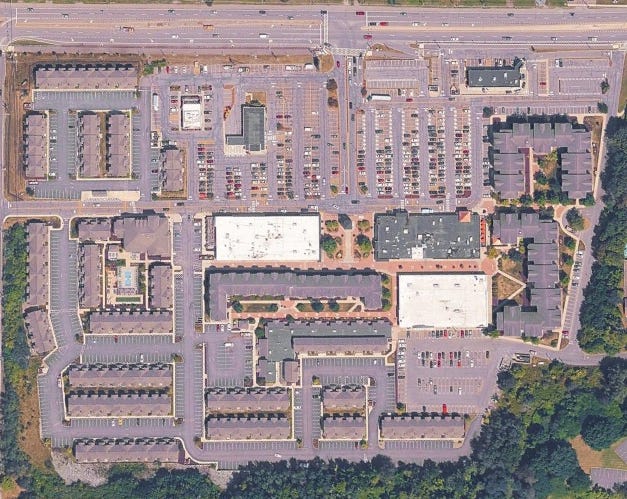
If you think it’s a bit…odd-looking, you’re right. That’s because it is, essentially, a combination of a fairly dense housing development built within the footprint of, and some of the remains of, an old strip plaza!
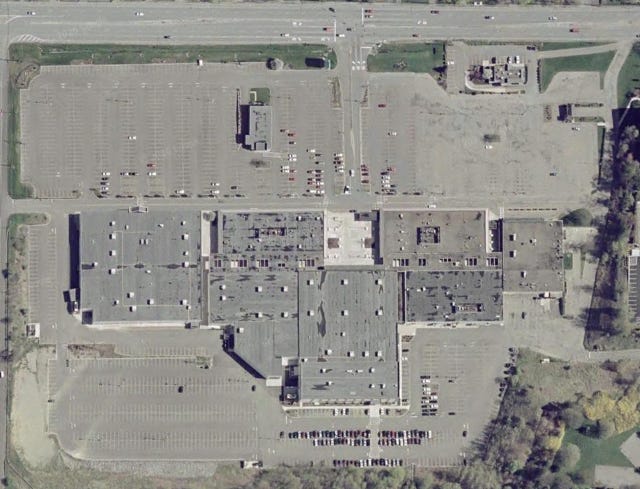
Here’s the property in 2002, looking pretty much how it looked when it was built decades ago, apparently in 1962, along what was at the time a growing suburban commercial strip.
At this point, before its redevelopment, it was in rough shape and suffered a high vacancy rate:
Here’s a nice blog post showing the history of the redevelopment.
This is a really fascinating example of what’s sometimes called “suburban retrofit”—that is, more or less, the incremental addition of urban design features to fundamentally suburban patterns.
It looks like the two outparcels, and only three segments of the original shopping center, still remain. Much of the old parking space and retail space has been replaced with housing. The housing is U Club, a student housing complex for Binghamton University students.
It places them fairly close to campus—a six-minute drive or a walk just under half an hour, with free shuttle service available. It also places them right near a number of restaurants, two banks, a gym, and a couple of stores. It is, now, a place. A place to live and a place to be, not just a place to park, run in, and go home—home being physically separated from everything else.
The view on the ground is a little uncanny:
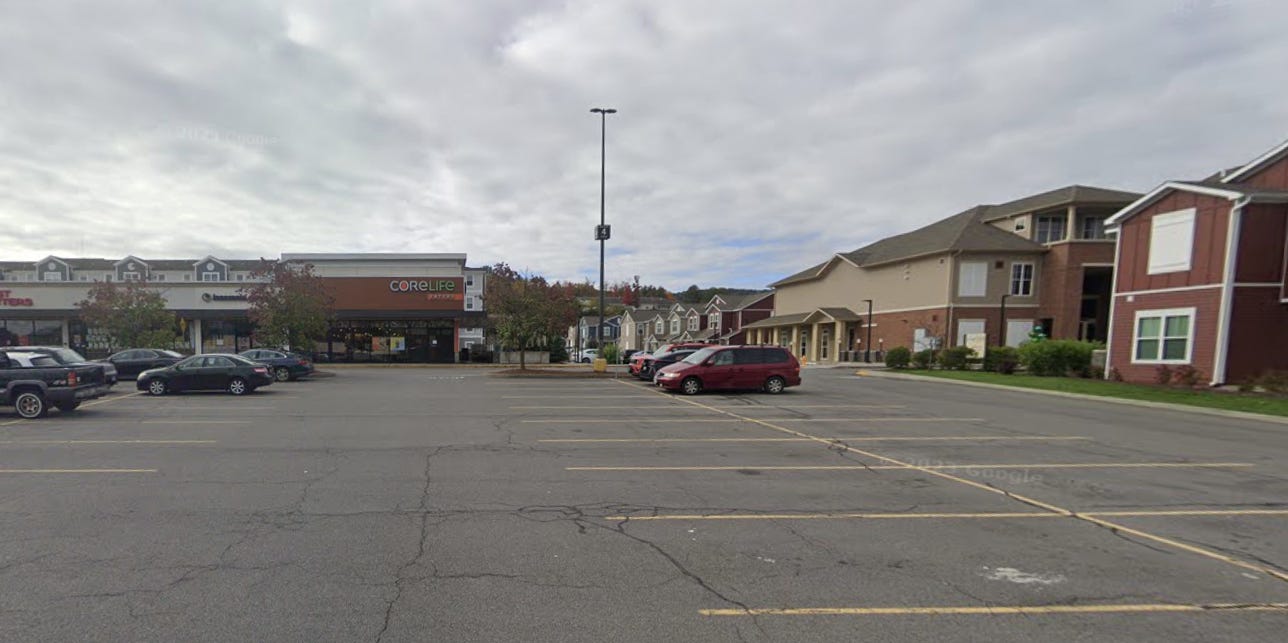
Or at least we tend to find it uncanny. Suburbia isn’t really designed to have its constituent parts altered and swapped out like this; this is how urban environments and city streetscapes grow, but it can be strange in this context. How much of that uncanniness is the perception of some real discordance, and how much of it is just a lack of familiarity with such mixed forms, I really don’t know.
But such concerns aside, ultimately this is a fine example of doing something, in an incremental way, with these large, faded commercial properties. Maybe all that parking made sense in the heyday of big suburban shopping centers. But the nature of retail has changed, university towns need housing, and cars are increasingly expensive.
A lot of what I mean when I talk about “urbanism,” and related themes of economic opportunity and lowering the barriers to doing things, is this. It’s not about wanting everyone to live in perfectly walkable cities, or hating suburbia or cars. It’s not an ideology or even a set of lifestyle or aesthetic preferences.
It’s more of an approach to the built environment in which gradual change is possible as conditions evolve, and in which the scale of change is low enough that small firms and even regular people can participate in building the place in which they live.
Suburban ruins are strange; how can entire once-thriving shopping centers just sit empty, slowly decaying, for decades? Not all of them can be saved or transformed; we probably did overbuild retail, now that we have e-commerce. Even housing doesn’t make sense everywhere. Lots of places have lost population and it isn’t just 1960s shopping centers that are distressed.
But much of this phenomenon is a symptom of an ossified land-use regime and commercial landscape, where building and adapting and tinkering are either impossible, or someone else’s job. So we would all do well to look at quasi-redevelopment projects like this as examples of a way that is just a little different, a little better, and a little more human.
Related Reading:
Not-Pennsylvania Amish Country
Parking As Access, Or Urbanist Ideals Meet Real Life
I lived in an apartment building that was connected to a shopping center in Maryland for a few months. I mostly moved there because I was able to get a short term lease and it was close to my job and I knew I was going to leave the region later that year. I will admit that it lacked a “neighborhood” feeling and I don’t think I would have stayed long term, but it worked well for the time I was there. The best part was that I could walk to a giant grocery store. I could see this type of setup being attractive to students who want to be near (but not on) campus and still want to have easy access to groceries and other retail.
A very similar thing is happening in Savannah around Oglethorpe Mall. They took down the old Sears buildings and put up apartment buildings. Interested to see if it helps revitalize the mall as well.