Taco The Town
Immigrants enliven tired suburbs and practice the entrepreneurialism we preach
Last summer, my wife and I wanted something tasty after an afternoon of yard work, and we decided to go looking for some good tacos. I’m not exactly a taco expert, but I assume you can’t go too wrong with a place like the one we drove about 20 minutes to try, Taqueria la Esperanza, along a faded commercial strip in Manassas Park, Virginia:
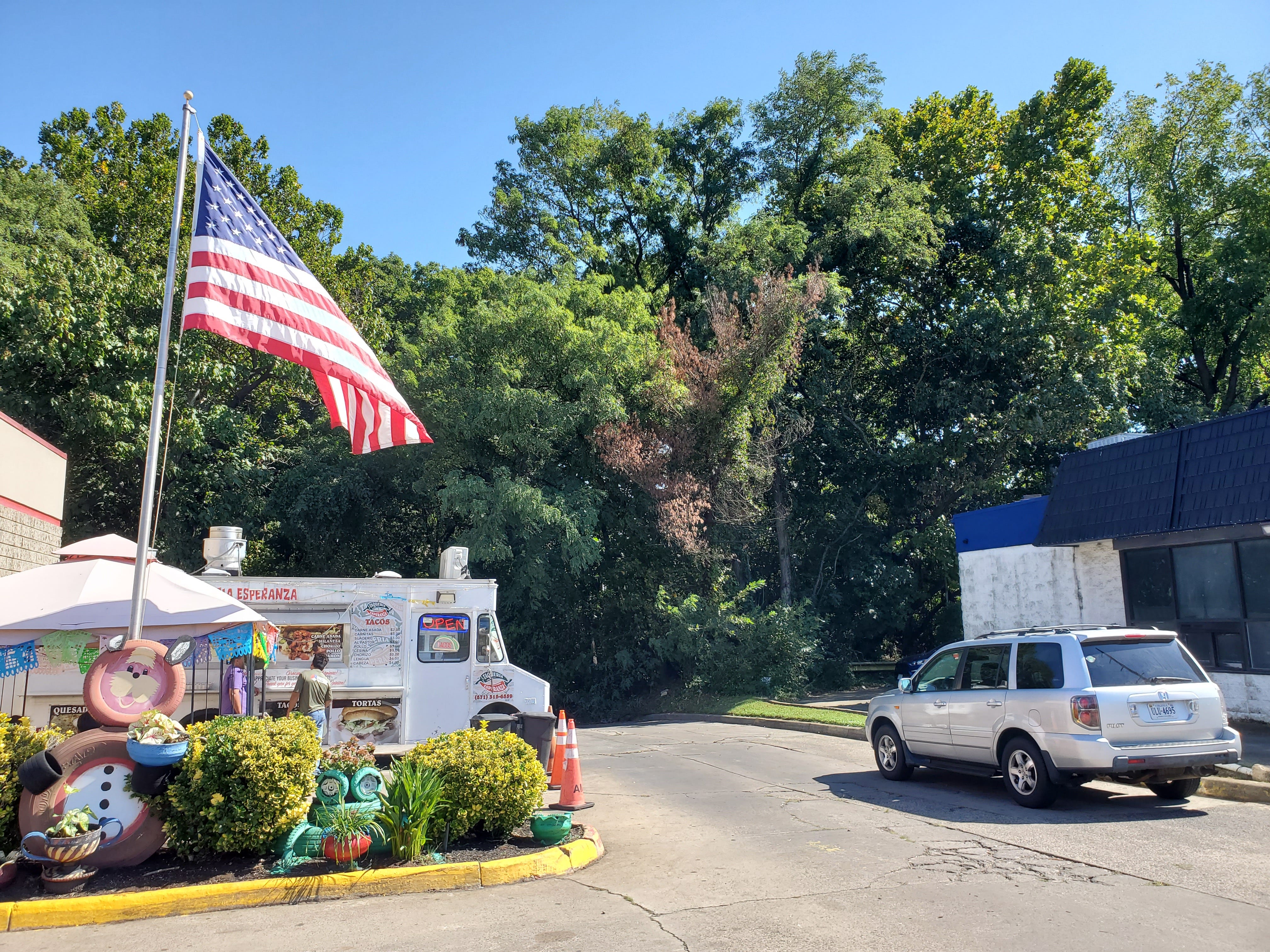
It’s a semi-permanently parked truck, sandwiched between an auto garage—it looks like it’s set up on part of their parking lot—and a convenience store that looks like an old Dunkin Donuts.
This is the view from the driveway/seating area:
This is the little seating area:
And here is one of many delicious tacos we ordered:
Taqueria la Esperanza is not too far from this former Pizza Hut, which is now a Mexican barbecue restaurant/tortilla market:
Or from this old Captain D’s restaurant—a seafood chain I’ve never heard of—which is now a Mexican ice cream and frozen drinks shop:
I said “faded.” By which I mean that everything along here looks old and a bit rundown. But as I’ve been writing on this week—here, and here—that may be a wrong impression of sorts.
Of course this physically deteriorated, heavily car-oriented landscape is not the most functional; it’s not fun to drive, let alone walk. Every business is islanded off by roadways and driveways and parking lots, and that spreads things out. And, of course, homes are separated from the commercial area, which itself is heavily interspersed with things that aren’t exactly customer-facing, like car dealers and low-rise office buildings. In terms of the built environment or the ease of getting around, this is pretty unremarkable from an urbanist perspective. Or any perspective.
And yet, while it is rundown and often traffic-choked, it is not blighted. This is a distinction with a difference. Most of the commercial space is leased. You see people around. This is a place that is old and a bit timeworn, but heavily lived in.
As you can guess from the businesses I pointed to, it’s a heavily Hispanic/Latino area. This full commercial strips runs partly through the city of Manassas Park, Virginia, which as of the 2020 census was about 45 percent Hispanic/Latino, and partly through the city of Manassas, about 43 percent Hispanic/Latino. There are a lot more Hispanic/Latino-owned restaurants and other businesses than the ones I mentioned. One review of another taqueria—I can’t find it again, but I wish I could—said it was just like Mexico.
As to the food truck format in particular, it’s worth pointing out explicitly that this is a way of multiplying effective commercial space without having to build anything at all. There are limits—for example, some of these trucks run off noisy and polluting generators, and a stationary truck is not the most comfortable site/space for a restaurant, either for the operators or the customers. But it’s a little way to wring some productivity out of the asphalt. It seems to be mostly immigrants, and mostly Hispanics, who run and staff these little parking-lot food trucks and carts, in my experience anyway. I suppose I would say that to view this as odd or wrong is a failure of imagination.
It requires a degree of abstraction, misanthropy, or, yes, racism, to look at a place like this and not see lots of regular people doing regular things, in a physical setting not particularly conducive to those things. At best, it is a failure to see what you’re looking at: allowing some narrative—about transportation or architecture or culture or class or race or immigration—to supersede what’s in front of your face.
Me, when I drive through a place like this, I see people. I see scrappy, productive enterprises. I see people working, frankly, in a way that I have probably never worked in my life. And I feel immense patriotism and pride that our country, even its neglected parts, is a launching pad for another generation of the American dream, another long climb up a ladder that sometimes, you think, no longer exists.
There it is, if you have eyes to see.
Related Reading:
Culture, Nostalgia, Cuisines as Living Things
Don’t Patch The Hole In The Wall
The Seafood Boil And The Buffet
Thank you for reading! Please consider upgrading to a paid subscription to help support this newsletter. You’ll get a weekly subscribers-only piece, plus full access to the archive: over 1,500 pieces and growing. And you’ll help ensure more like this!


I wish more people saw it this way, instead we have the current administration conducting military occupations and operations on American cities.