That Car-Free Dream
Most Americans are open to being less dependent on the automobile
They drive him here; they drive him there; those parents drive him everywhere.
What if they didn’t have to? What if they don’t want to?
In another piece, awhile ago, I shared this little graphic I’ve seen on social media:
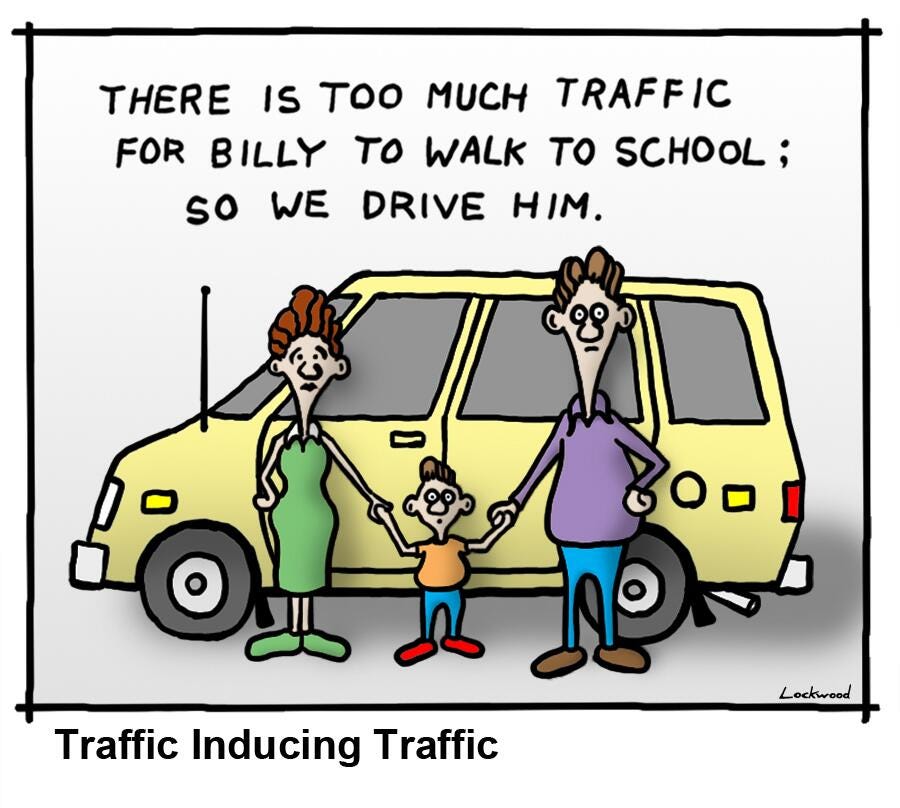
This makes a really important point: the mere wide use of the automobile cannot be taken as an expression of an affirmative preference. It may be a sort of anti-preference—we drive because we’d prefer to walk but there’s too much traffic—a grudging acceptance, or a lack of a sense that it could be different.
I’m not leaving out that some people simply prefer driving, but not everybody in a car wants to be in there, doing their errand that way. And that’s the important point, and the potential audience for urbanism/walkability/etc.
Now I want to show you something else I saw that is pretty incredible:
Almost one in five car owners are open to the idea of living without a car, even some suburban car owners. Look, it’s not like that’s a secret urbanist majority, but that is a lot of people. Those are not niche, weird, politically irrelevant lifestyle preference numbers.
And those are the people who can imagine enough what car-free living might be that they say yes on a survey. I’m willing to bet that quite a few more would say yes if they had a mental picture of what it could be. I think we urbanists have to remember that a lot of people have never heard a case for any of the things we want—and therefore really can’t be said to have rejected it, even if they answer “no” in a poll.
There are people who would find they enjoy many aspects of urban living, but don’t have a relatable image for it or reference point for it. And there are many people who merely mistake liking what they know for knowing what they like. What people need is a real example and alternative, or their preference is untested. It may hold up, but it should be tested.
To me, this is very hopeful. It means there is a very large untapped audience for what we care about. It also means that talking about suburbs or suburbanites as a blob, as a “they,” or as an antagonist, is not helpful and not even accurate.
Here’s a fuller article about the survey, which includes this important bit:
We should not be making demographic or political assumptions about who potential non-drivers are. They are everyone, rich and poor, old and young, and of various races and political opinions.
Anecdotally, I do think this is correct: that there’s a much larger audience for urbanism broadly than a lot of us think. What do you think? How does your experience tilt in terms of confirming this or making you skeptical of it?
Related Reading:
That Damned Elusive Parking Spot
Cities Aren’t Loud, Cars Are Loud
Don’t Patch The Hole In The Wall
Thank you for reading! Please consider upgrading to a paid subscription to help support this newsletter. You’ll get a weekly subscribers-only piece, plus full access to the archive: over 1,400 pieces and growing. And you’ll help ensure more like this!


It is *so much easier* with my two-year-old when we go somewhere that is a convenient transit trip instead of having to go in the car and has been her whole life. Of course, I was already a committed urbanist long before she was born but having a child did not change my beliefs the way many people insisted it would.
I had a chance to live in a small city in Italy for half a year when I was in college. I don’t think that very many Americans could even imagine what that daily life was like, and I feel pretty confident that if they were able to experience it, more than one and five would prefer it.