

One of the places I keep coming back to, in real life and in my work, is the early suburban landscape of the D.C. suburbs in Prince George’s County and eastern Montgomery County, Maryland.
The first thing someone from my background—upper-middle-class rural-exurban New Jersey—might notice is the sense of grayness and crowdedness, the general rundown look. You might wonder about crime (the crime numbers in these communities are exaggerated, I think, but not great). What I’ve increasingly appreciated about the older D.C. suburbs in Maryland—and wish I had appreciated when I actually lived here, in College Park—is their small-scale built form and their cultural and commercial dynamism.
This is a certain kind of density which I find really fascinating, and which, I think, probably inspired my interest both in urbanism in general and in particular the issue of what “urbanism” looks like in the suburbs, which, of course, is most of America.
There’s an ordinariness to American suburbia. Very little of it is artistic or bespoke. Mostly it’s just houses, garden apartments and 5-over-1s, interchangeable commercial buildings and strip malls, the same over-wide commercial corridors cluttered with stoplights and intersections and driveways. I understand why “sprawl” is used dismissively. I understand why this pattern of development is not good planning. And yet for all its ordinariness and ugliness, what comes through for me, the more I explore places like this with an “urbanist consciousness,” is that they’re often the raw material of opportunity, entrepreneurship, and uniqueness.
So take at this cluster of development along Georgia Avenue, in Montgomery County. This is the heart of Wheaton, Maryland:
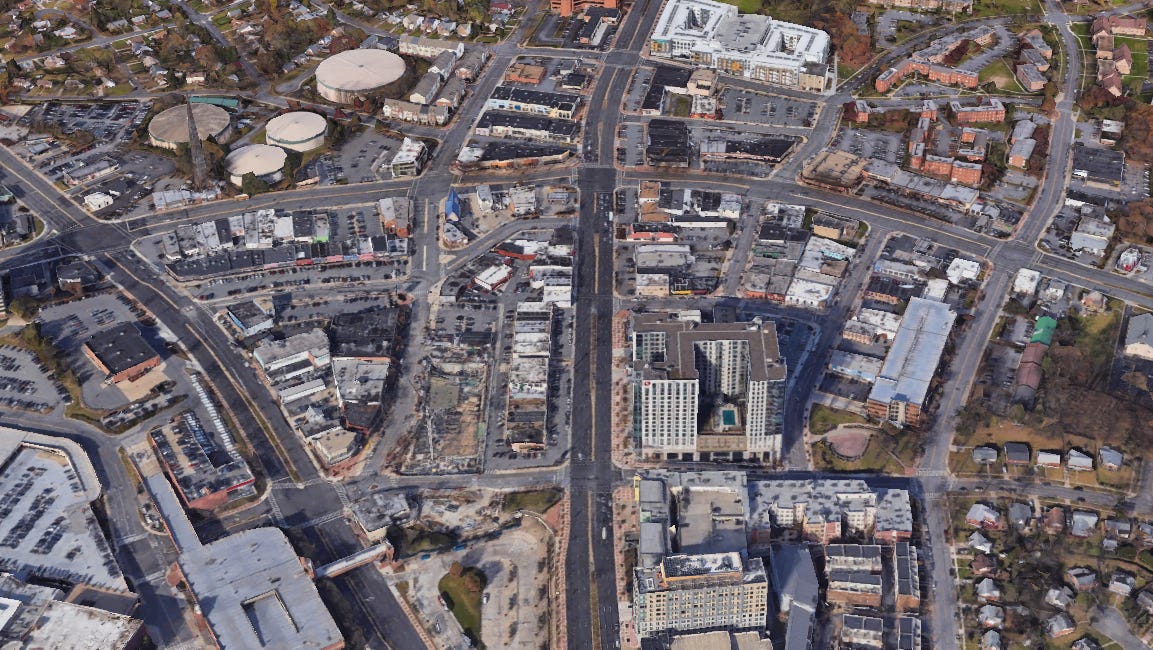
Here’s one block, with a bunch of little old shopping centers:
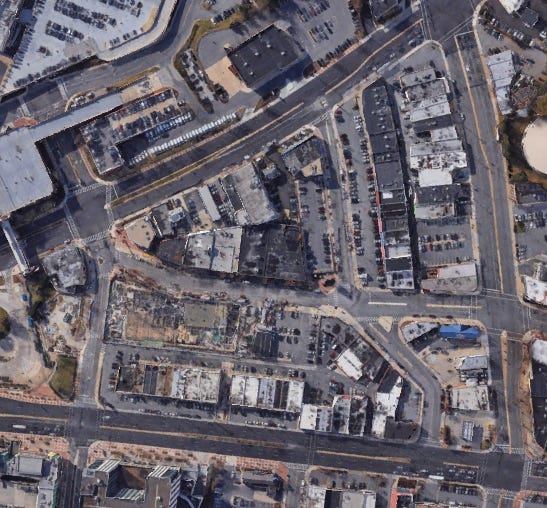
Here’s another zoomed-in block. This is two blocks of businesses, facing the street, meeting at the back, basically no parking:
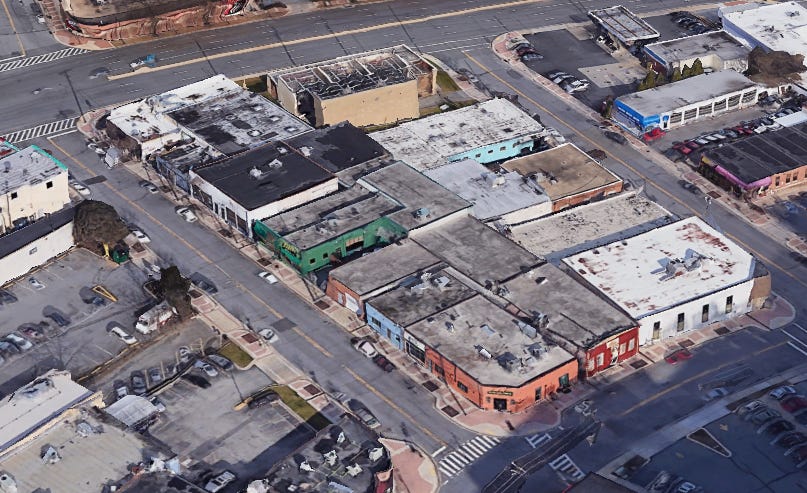
You can see from the roofs how small the spaces are, and how long the strips of stores are. They don’t have that much parking, and they really aren’t quite what we’d call strip malls or shopping centers today. In a lot of ways, this is a transitional form of development, very much resembling streetcar suburbs, despite being built after the end of streetcars, or at least after streetcar lines were chiefly determining development patterns.
But a lot of old streetcar nodes persisted as commercial areas after the demise of the streetcars, like this one not far from here.
Here are a few views on the ground in Wheaton: