
The D.C. Metro's Big 50
(Some of) the people who make things work

Last Friday marked the 50th anniversary of the D.C. Metro. It began in the city of Washington, D.C.:
It all began on March 27, 1976, with the first Metro Rail trips carrying customers on the 4.6 miles of Red Line between Rhode Island Avenue and Farragut North.
Those stations are both in D.C. proper. But the system now extends far out into suburbia. In Virginia, with the opening of a second extension on the system’s Silver Line, it now goes all the way to Ashburn, which is in Loudoun County. Loudoun is the third county out from D.C. That is a pretty big map.
The Metro is fairly unique for being a relatively small system tied to a city rather than a state (like NJ Transit, for example) but also operating in multiple states, plus Washington, D.C. It really is both the D.C. subway and the whole region’s rail (and bus) system. It would kind of be like if the New York subway went out to Connecticut and New Jersey. It’s really a neat thing, and I think the Metro map imposes a certain order on the D.C. suburban sprawl that stops if from feeling completely “centerless.”
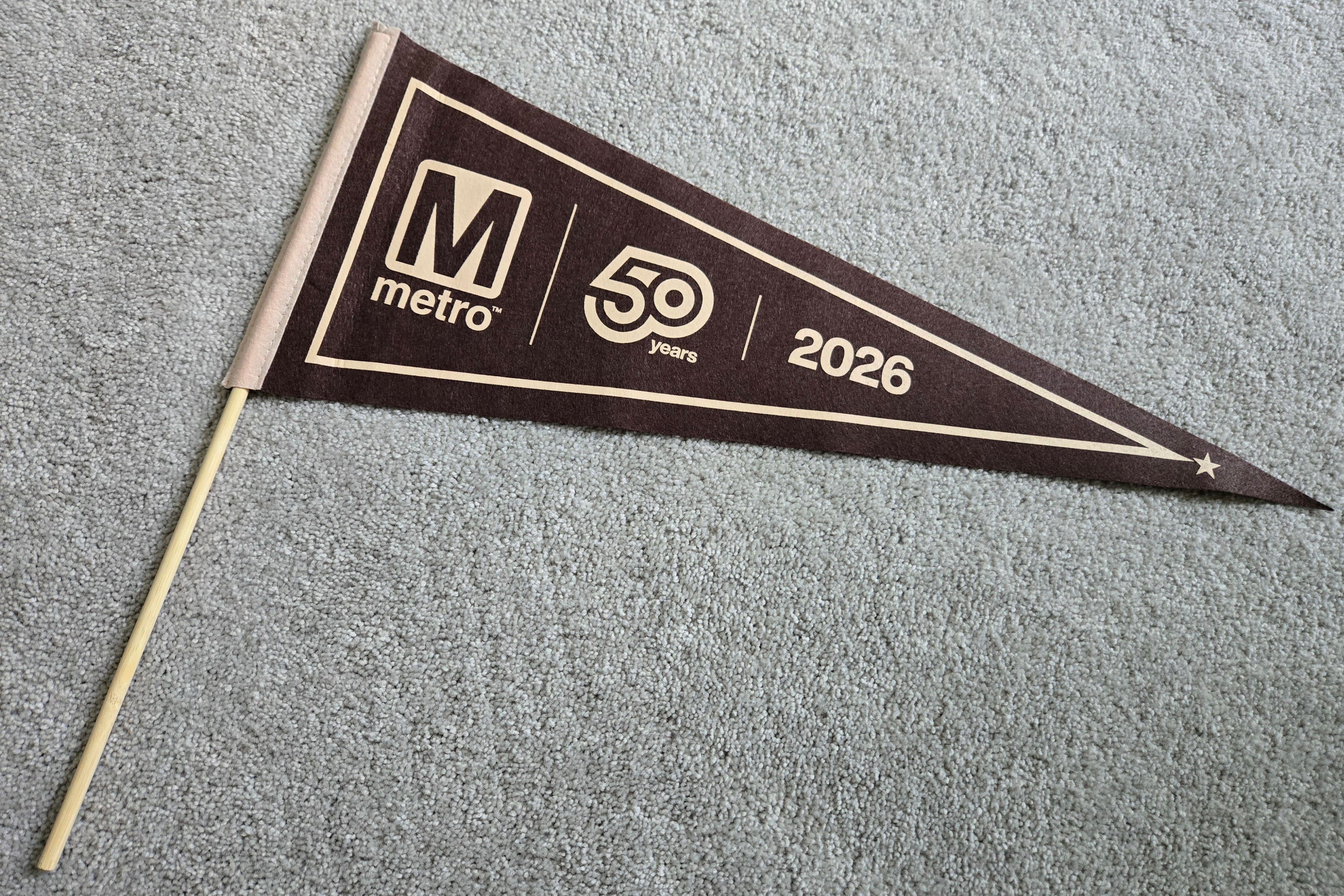
I went to a happy hour at D.C.’s Metrobar, fittingly, for the 50h anniversary. Outside the Metro station, some folks were giving away these flags:
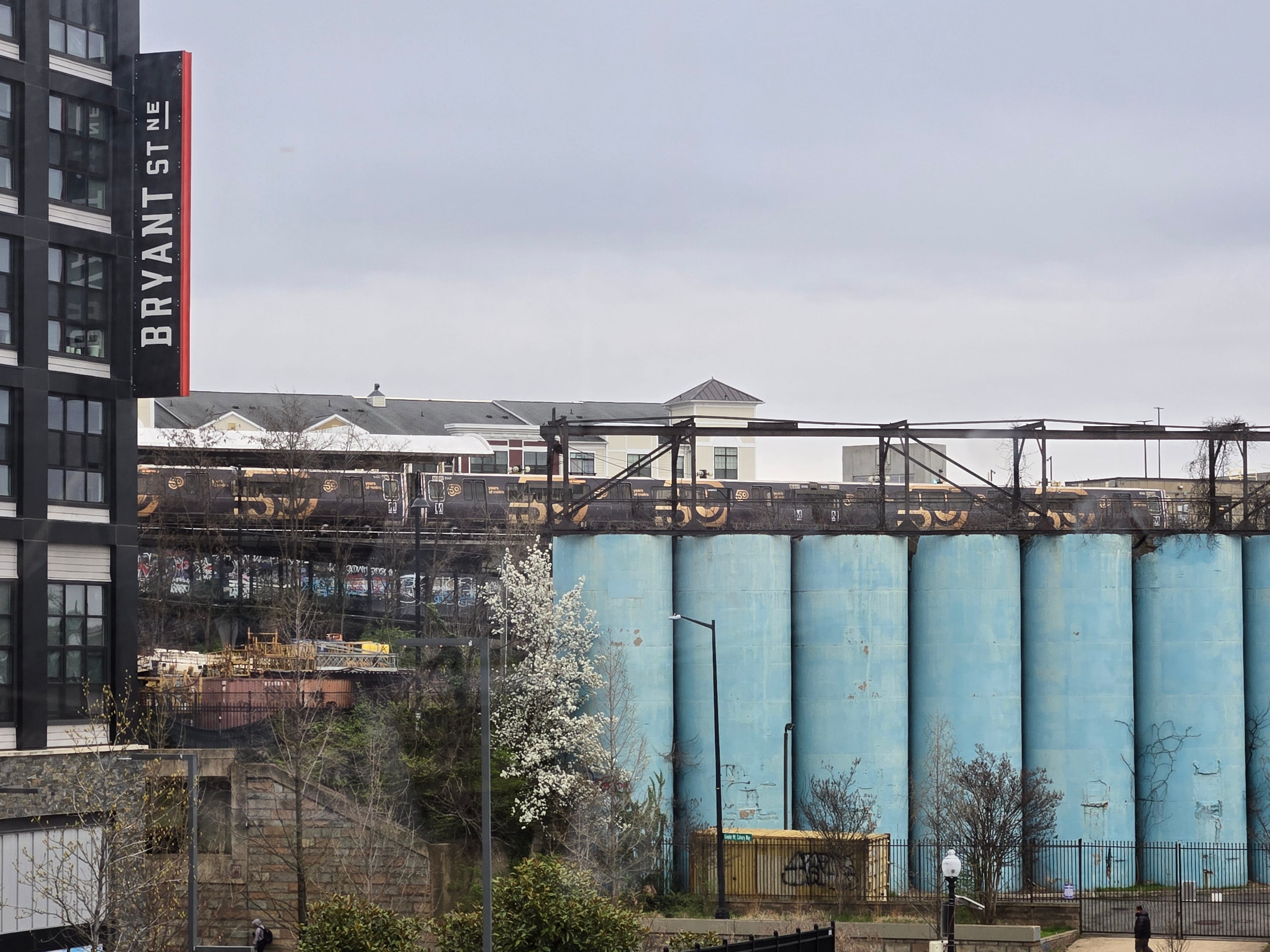
Over at the bar, we spotted this train, which was wrapped in a 50th anniversary decal:
There were a number of actual Metro employees at the bar, some probably just there for a drink, but a bunch, I think, for the happy hour. Some of the folks there were train or transit enthusiasts, but a lot of them were people who don’t think of this as a hobby or an interest but as a public service. In fact, you shouldn’t have to like trains to ride them. Ideally, they just get you where you’re going, and you don’t really think about it at all.
But we were thinking about it, because whatever problems the Metro system may have—and it has gotten a lot more reliable in the decade or so I’ve lived here—it really does connect the region and serve millions of people. Especially given the price of gas, it’s a very good value if you need to be somewhere within close range of a station. (Which makes the suburban stations less useful for going places nearby, and more useful as commuter stations—the Metro has always been a bit of a hybrid between a subway and a commuter rail.)
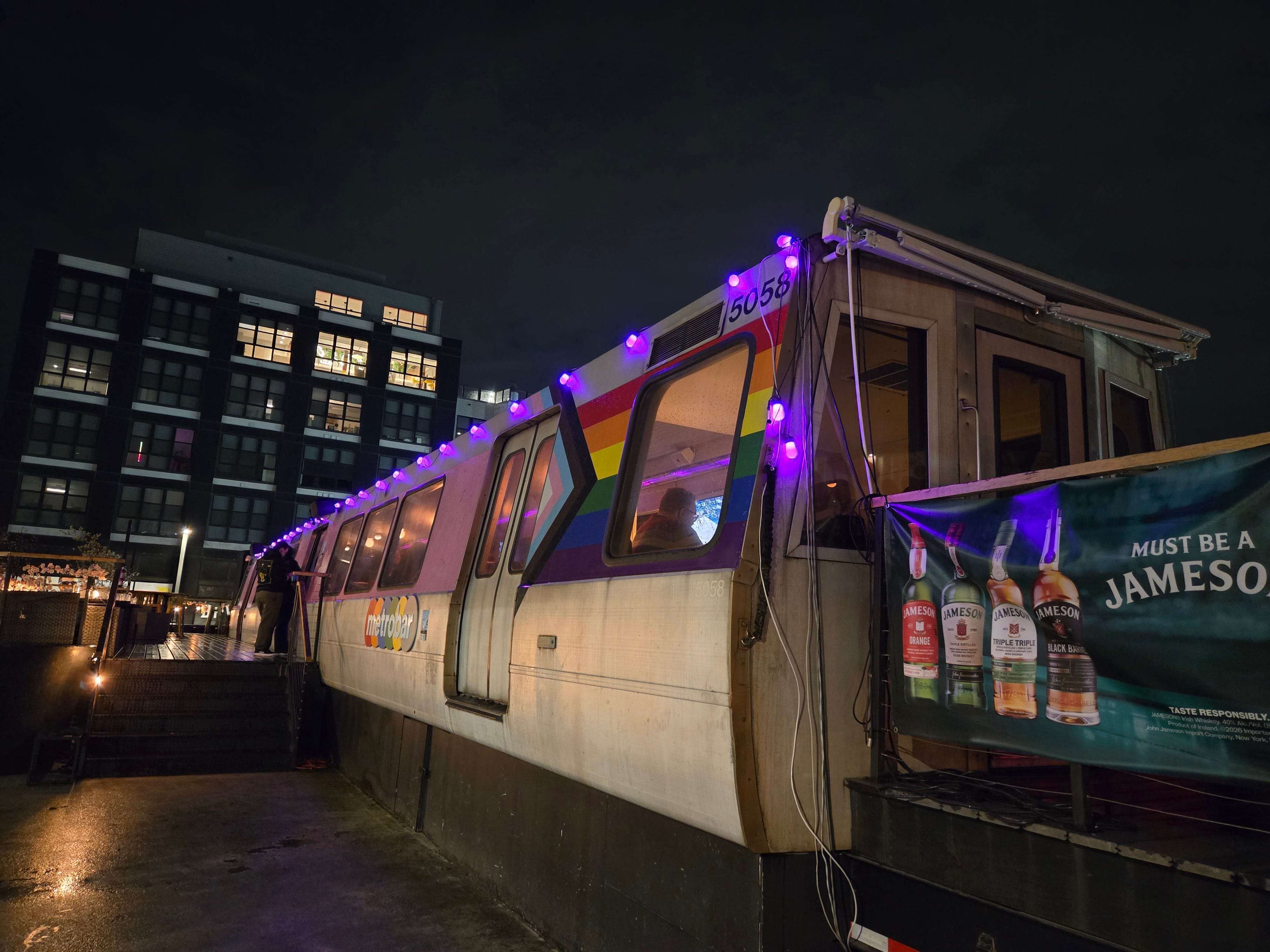
Anyway, why is it called Metrobar?
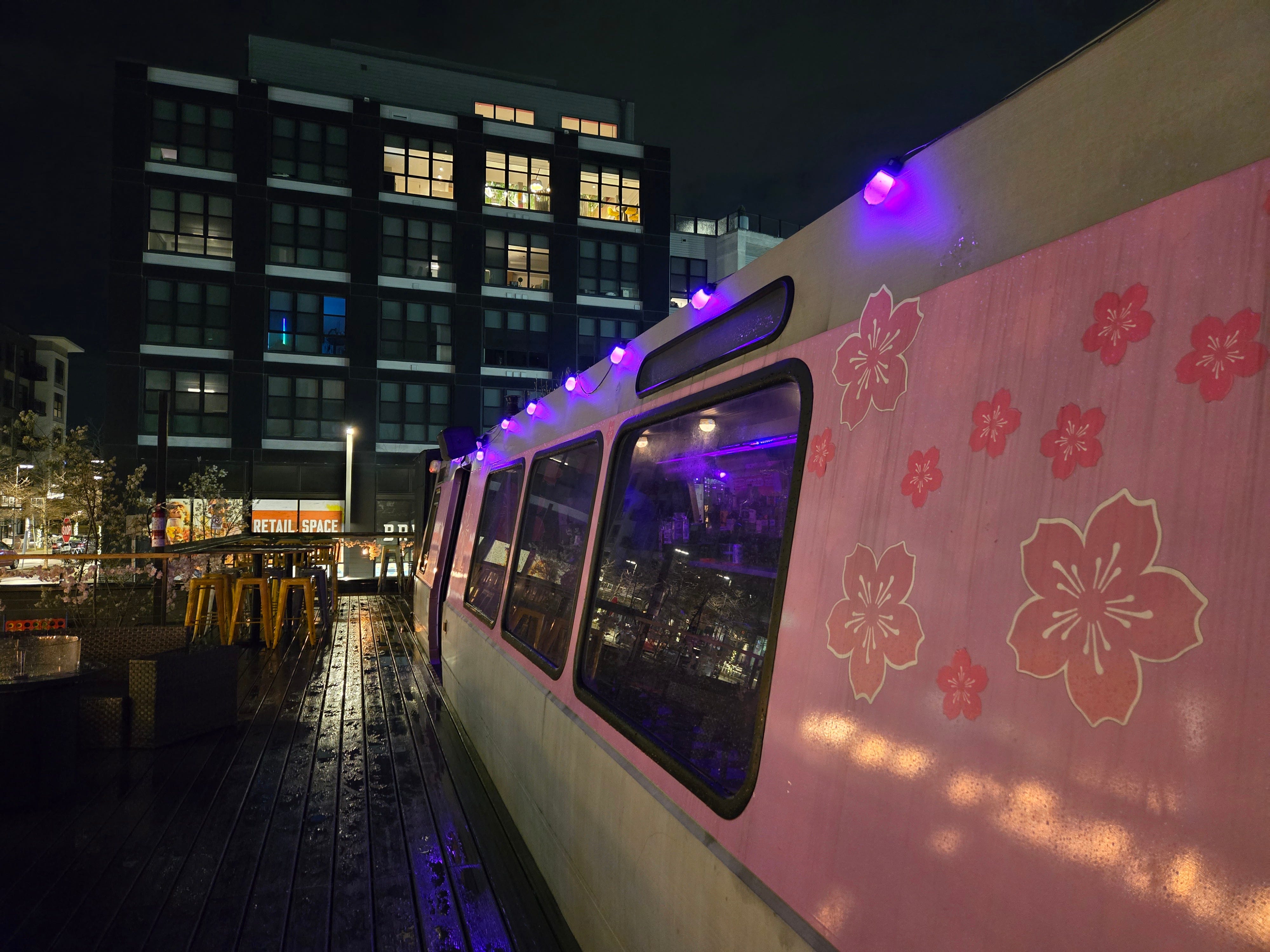
This part of the car has the cherry blossom decal:
That is not a prop; it’s a real retired Metro railcar. The inside has been retrofitted, and you can actually order and sit inside. A handful of the original benches have even been kept, and you can sit in them.
One of the cosponsors of the happy hour was Greater Greater Washington, a broadly urbanist organization that advocates for transit and housing. They’re a great organization (I’ve written for them), and at one of their events once, someone said that not every city has an organization like this. I suppose I wouldn’t know, but I think that’s probably true. We’re fortunate.
As I often write here, I really think this whole region has much more character than a lot of people give it credit for. It is a really great place to live. Some of that, of course, is the diffusion of federal money. But it’s not just that. So many regular people just make things work. I think people really do have a pride of place, and I think our regional thinking is kind of special.
1976—50 years ago, wow—really isn’t all that long ago. It’s amazing how much the whole place has changed. The city has grown, and the suburbs have sprawled, but they’ve also grown up. New waves of immigrants have settled heavily in suburbia, and given those places vibrant business communities and diversity that was not imagined when they were built.
Some of these communities are closer in (Silver Spring, Maryland, for example) and tied somewhat to D.C., while others are further out (Manassas Park, in Prince William County, Virginia). And many of them are not served by the Metro, and are pretty isolated without cars.
That has nothing really to do with the Metro anniversary per se. It’s more that exploring those places gives me the same sense of pride in this region as celebrating 50 years of our transit authority. It didn’t take me long, when I first moved to the D.C. area, to realize why public transit so important. It’s not ideological. It’s practical. Cities require a certain public spiritedness, a certain communitarianism.
I don’t think enough people really, truly understand that, or understand it only in the funhouse-mirror “cites are for commies!” sort of way. I try to convey this with my writing, but sometimes it feels a little dry and theoretical. This was one of those nights that brings it back to earth.
Related Reading:
Northern Virginia Is a Real Place, Revisited
Thank you for reading! Please consider upgrading to a paid subscription to help support this newsletter. You’ll get a weekly subscribers-only piece, plus full access to the archive: over 1,500 pieces and growing. And you’ll help ensure more like this!