The News Department
What Do You Think You're Looking At? #271
Take a look at this neat-looking newspaper headquarters building in Champaign, Illinois:
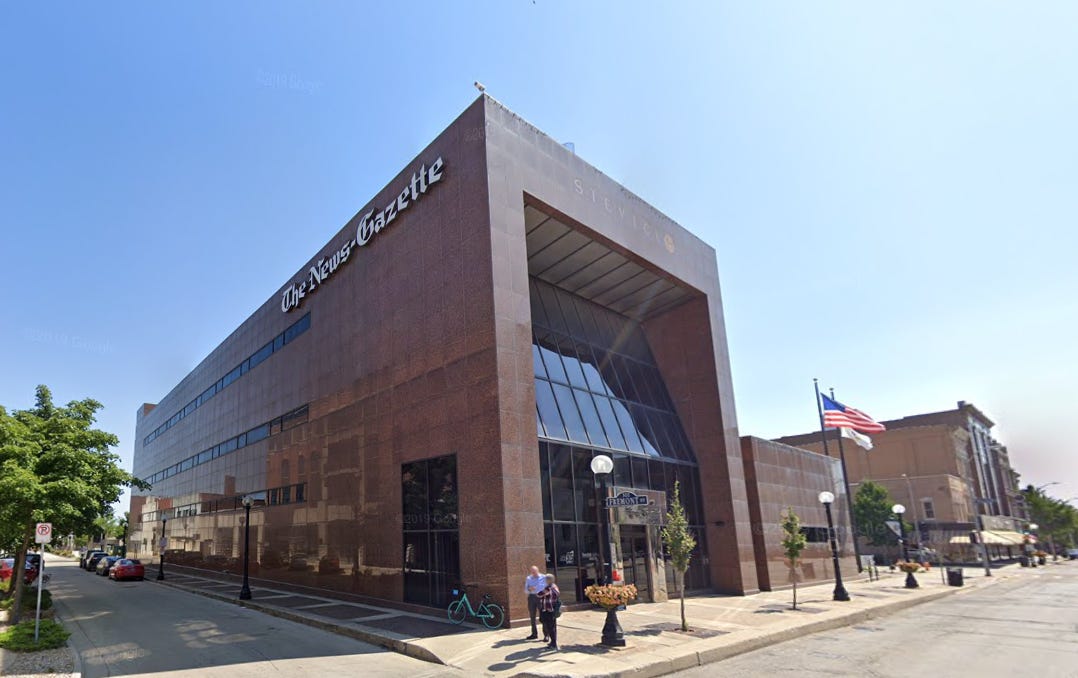
It’s nice to see a local paper. The building it’s in looks like a custom-built office building, to me. However, as you would probably guess, it is not. In fact, it isn’t even a previously existing office building.
Take a look at this, from a very neat post at the Champaign History website:
In the 1940s the building continued to stand out as one of the more “modern” structures on the north side of Main Street. However, you can see that by this time “Fields” had already “modernized” their building by adding a medal slip cover to the second floor. This trend continued throughout the 1970s along this block.
That’s pretty old! But actually, it goes back a bit earlier: “In 1913, Mr. Willis razed both 15 and 17 Main Street and started construction on his new department store building.”
This building was a department store for decades, from the early 1910s. It was modernized by J.C. Penney in 1961—a late date, it seems, for an urban department store to open. By today’s standards, it wasn’t very large:
The new store opened April 6, 1961. Robert Meyers was the new store manager and the department store featured three floors and over 27,000 square feet of retail space. The basement featured housewares, home furnishings, and dry goods.
18 years later: “JC Penney’s continued to serve Champaign from their Downtown store until 1979 when the store announced they were leaving their location for the newly completed Market Place Mall.”
The News-Gazette, which also dates to the 1910s, bought the vacant department store structure in 1984 and completely redid the exterior, making it look so much like a modern office building that the only indication of its past life is probably its depth and narrowness, which suggests an older structure (though of course a new building could be built on an old lot).
There are lots of photos in the blog post, which you should go look at. I’ve condensed it here but that is the full story, which put this building on my radar.
It’s really cool when a building can be reused, especially when the conversion is done well. More importantly, this also shows you how adaptable older buildings often were. Today different types of buildings—restaurants, hotels, office buildings, apartment buildings, industrial buildings—are often highly defined and distinct from each other.
Compatibility between types/uses was a neat aspect of old-fashioned buildings, or relatively small-lot urban buildings, or whatever you would call this type/period. That adaptability and smaller scale is an element of “urbanism” broadly, too.
It helps to give places that important sense of continuity while also being able to change over time. Urban department stores are a largely extinct breed; so, sadly, are local papers. Hopefully this one isn’t changing again any time soon.
Related Reading:


Wow, I'm not an architecture critic by any means and certainly not an historic preservationist, but sheesh, the last two major changes to that building are insulting to the surrounding context. The pre 1960 version of the building could have been modernized inside and still been very useful but also respectful to the context.