

I owe today’s entry to this blog post by Ted Shideler, a local Indiana historian. There’s a lot of neat miscellaneous history in the archive there; check it out.
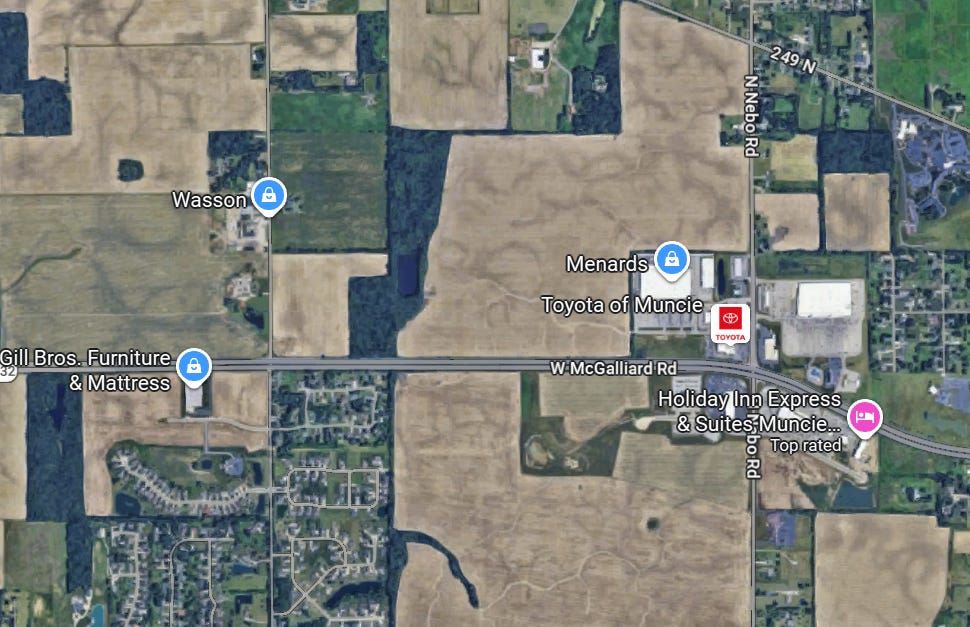
Today’s building is a sort-of strip plaza in Muncie, Indiana, a city of about 65,000 people a little over an hour from Indianapolis. Like a lot of places, there are different economic eras and development styles side by side in Muncie.
There are edge areas like this, where detached houses and big-box stores are literally carved out of farm fields:
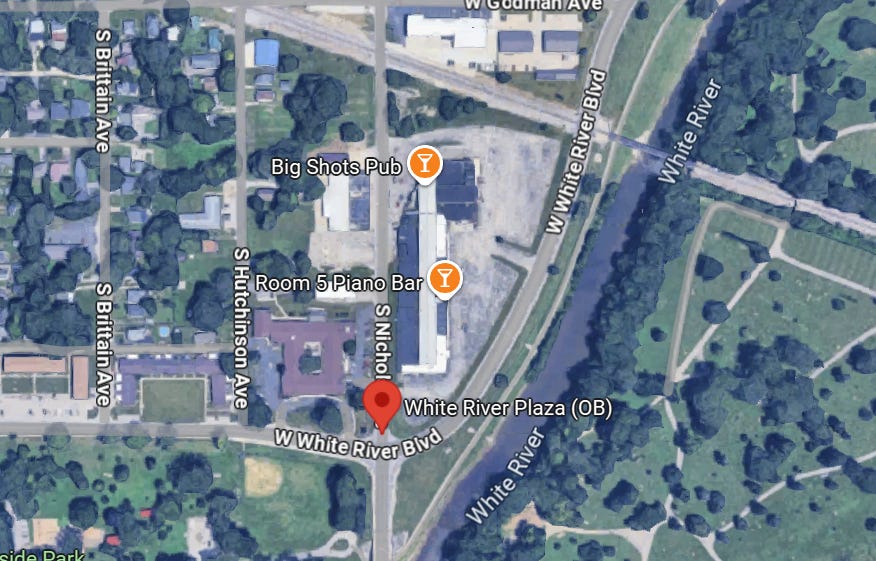
And then there’s today’s building, in this older corner of the city’s street grid:
Here’s what it looks like on the ground:
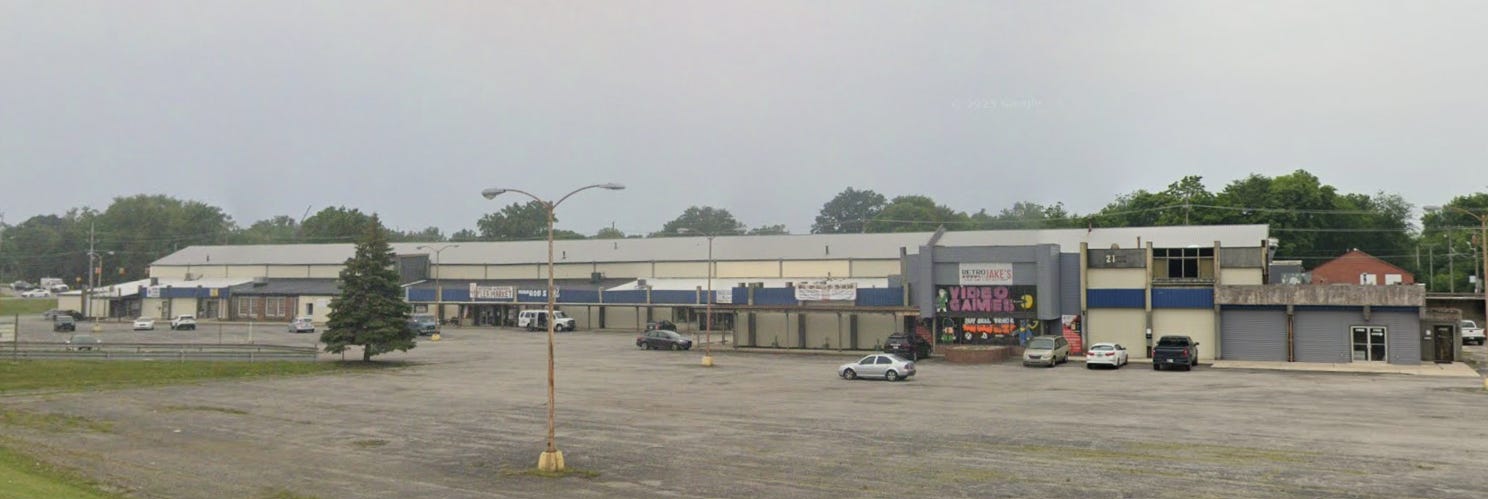
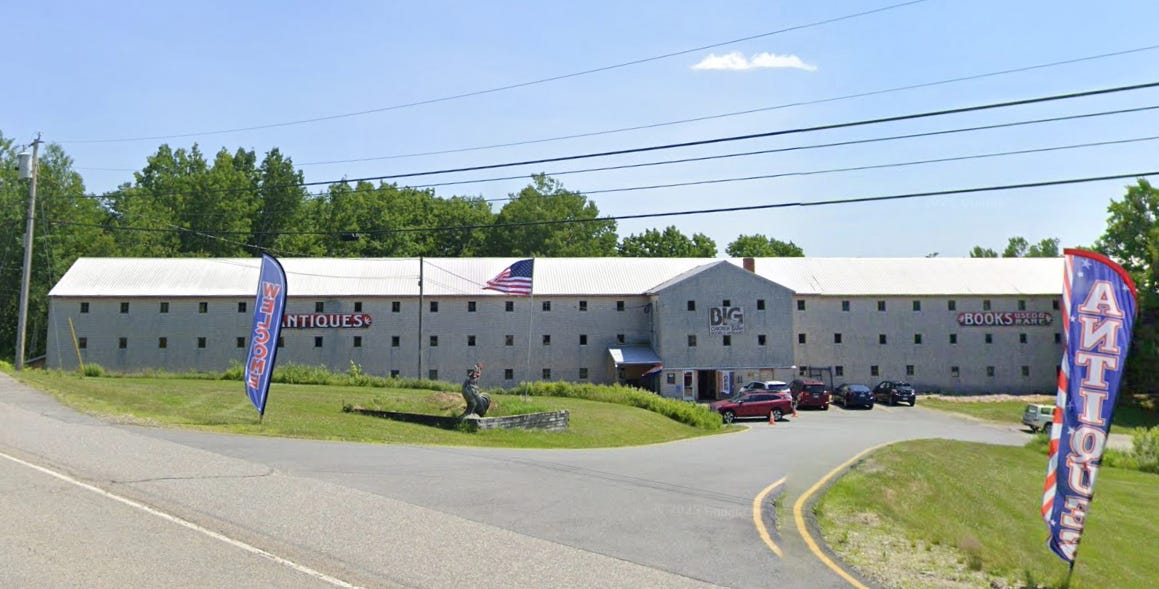
The only thing I’d be able to tell you from looking at it is that it definitely wasn’t built as a strip mall. It looks a little like a giant industrial chicken barn; it reminds me a little of the Big Chicken Barn Books in Ellsworth, Maine:
Shideler writes of the building:
From the Northwest Plaza to the Southway Center and everywhere in between, Muncie is dotted with the usual mix of typical shopping strips and commercial centers. One in particular, though, breaks the mold: White River Plaza. The place stands out not just for its strange design and layout, but for the stories hidden behind its storefronts. Most people probably pass it without a second thought, but the unassuming strip has roots stretching back more than a hundred years! Its past is far more interesting than might be expected.
The site itself goes back well over 100 years, to 1893, when a natural gas boom spurred the construction of a factory on the site. However, that building burned down, and Shideler notes that while the site is now within city limits, at the time it was outside, and there was no fire department to fight the fire.
The current structure is from 1911, where it housed a bed and furniture factory until 1960. Shortly after that, the site first became retail, home to what sounds like a fairly early Walmart/Kmart-type store:
Moore-Hager continued running with fifty employees, at least for a time, but much of the sprawling factory on the old Joseph Bell site was quickly converted into Miracle Mart, a 70,000-square-foot self-service discount department store that opened in the southern two-thirds of the Moore-Hager building on August 16, 1961. With forty-five merchandising departments and a staff of nearly 200 people, the Muncie store joined another outlet in Fort Wayne and several in Michigan and Pennsylvania.
It was home to a succession of local or regional discount department store chains1 before eventually downcycling, or upcycling, into a less corporate and more varied space:
Over the years, White River Plaza has played host to an ever-changing lineup of tenants. Some were national, many were regional, and most were unique to Muncie. For decades, names like Dunham’s, Dollar General, and Amber’s Beauty School anchored the plaza. These days, though, the center has found a new identity as a haven for local businesses. Set foot on the property and you’ll find a mix of hometown favorites: All Star Sports Cards, Bob’s Comic Castle, the Muncie Book Center, Squared Away Foods, Wizard’s Keep Game & Hobby, and RetroJake’s Video Games. Together, they give White River Plaza a distinct personality that feels less like a corporate strip mall and more like a local landmark that, for all its history, still seems very much alive.
I would not have been able to guess any of that.
And go read the whole blog post if this is interesting to you!
Related Reading:
Have You Ever Lived in a Strip Mall?
The consolidation in this sector is wild. It seems like every region had several of these kinds of stores from the 1960s through to the 1980s or so. Most of the larger ones folded in the 1990s or early 2000s. There are still some small discount department store chains out there, and there’s also Meijer, but Walmart and Target really dominate this retail category now.
I visited here last year during the holidays to check out the Retro Jake's used video game store! While the structure could definitely use a little TLC, it's clear from the moment you step into one of the stores that this place is not your standard retail architecture. It's a neat piece of history that is hiding in plain sight.