Ups And Downs
What Do You Think You're Looking At? #244
Take a look at this building in Seattle:
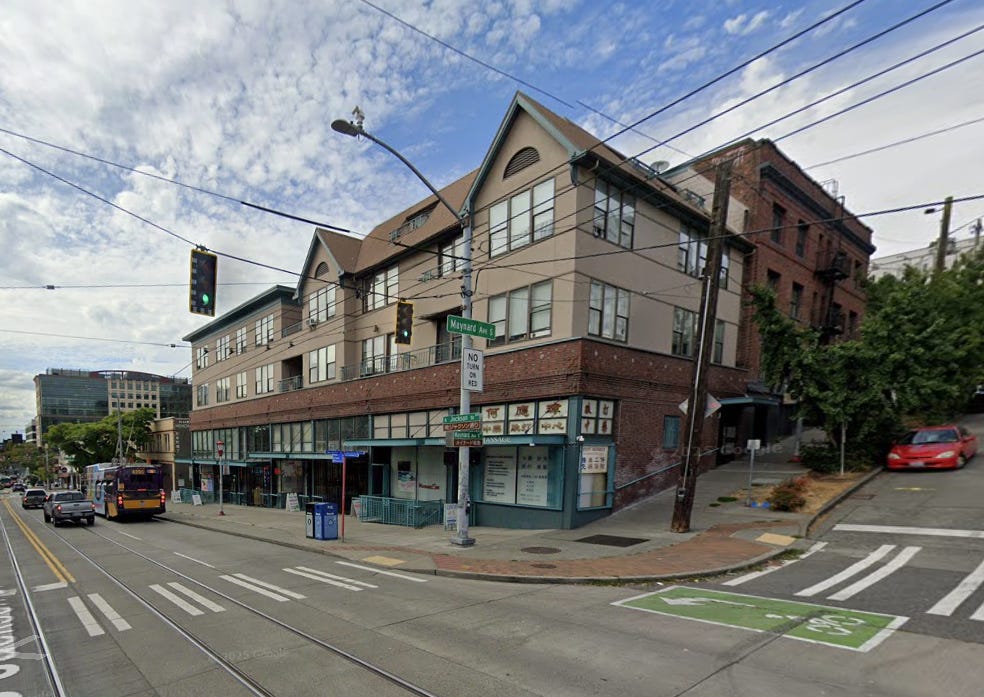
It looks pretty ordinary, like a lot of urban building from the first half of the 1900s. Which is what it is; one source actually says it’s from the 1890s.
But part of it is from the 1910s, around the time a major project known as the Jackson Street regrade began. This building happens to actually be on Jackson Street, though the project took place over many blocks/streets.
If you know about early Seattle history, you know that a lot of streets were regraded, either raised or lowered to flatten the city out. It seems like massive regrading projects was Seattle’s answer to the same problem San Francisco faced in a similar period, except they went with the cable cars and kept the terrain. There are tours you can take where they show you some underground spaces that used to be the street level, and stuff like that. We did one when we visited Seattle, and it was very cool.
So let me show you this 1910 picture taken during the Jackson Street regrade, and you can probably guess which part of the building came later:
Here’s another one:
If you’re not sure what you’re looking at, the now-top story used to be at street level; the regrading lowered the street by about 20 feet, necessitating buildings being either lifted or demolished. This one was lifted, and a street-level structure was built underneath it once the work on the street was done. So the current building is a hybrid of two structures, with the top floor having been built first!
Read this for a little more on the building and the regrade.
It apparently was a church at the time it was raised, but if you look at the modern top floor now, there are little balconies on it, and it looks like apartments. In fact, one person in the comments in that piece linked above wrote, “I live in that building.”
The author writes:
After the church was shored up on pallets, a new one-story brick structure, or foundation, was built on the site. Gullett then lowered the church on to its new foundation. In later years, the church became the Havana Hotel before undergoing renovation in 1984 and morphing into its present incarnation.
Now here’s something interesting: you can obviously see the part of the modern building that was originally the church. But the brick bottom floor and the modern apartment building is now almost twice as wide as the original structure:
So the old building to the left of original church was demolished, and at some point—sounds like probably after 1984—the facade(s) were renovated and an extension was added in place of whatever building was to the left. The extension has the same facade and windows now, but they didn’t bother to replicate the details or the roofline.
And the building is also attached to another building behind it, which it must not have been before the regrade. Who would know by looking that so much had taken place here?
Related Reading:
Thank you for reading! Please consider upgrading to a paid subscription to help support this newsletter. You’ll get a weekly subscribers-only piece, plus full access to the archive: over 1,400 pieces and growing. And you’ll help ensure more like this!


I always thought the roads were weird in the ID because of I-5. I didn’t know it went all the way back to the regrade era! I used to park around there for free in the 2000s. Yesler is the steepest.
The “ordinary” engineering capacity that they had back then is truly difficult to imagine today.