

A recent tweet about walkable cities, since deleted, generated an online firestorm:
“Been thinking about this and it really seems like a lot of the core walkable city stuff is a young adults’ discourse. a lot of their benefits don’t actually mean much to you if you’re a family of five and not a student or a young professional.”
This was a typical reply (“Zany” wrote the original tweet and followed it up with the one shown below):
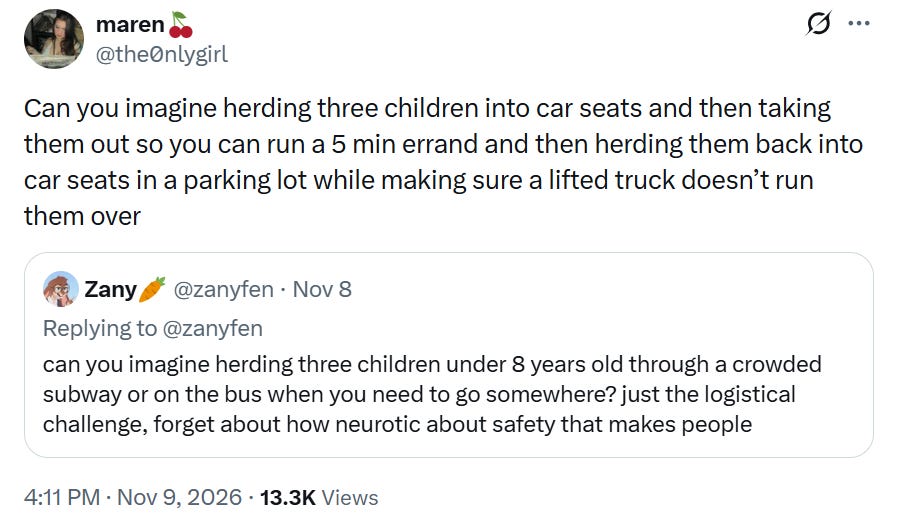
I want more walkable cities and neighborhoods, and there really shouldn’t be any culture-war or generational-conflict valence to the simple idea of things people need being close to where people live.
But I’m going to take this in a slightly different direction. This idea that walkability is for single, unattached 20-somethings—that it’s just about being able to walk to the bar or the cafe or whatever, an ultimately pointless lifestyle accoutrement—is at once conceptually absurd and descriptively true, in America.
That’s part of where the communication breakdown is occurring. A lot of people observe young people living in cities and enjoying this walkable urban lifestyle, and then moving to suburbia as they get older and get married and have kids, as evidence that there’s something inevitable about this pattern. To argue that we can just keep living that walkable urban lifestyle can sound like saying “I never want to grow up.” But we’re conflating too many things here: age, priorities, lifestyle, land use, housing policy.
There’s another aspect to this, though, which I find even more interesting. And in a certain way it backs up the impression that there’s something “immature” about walkability. It’s the question of the mood or feeling that we often think of when we talk about living in a city and walking everywhere.
There’s a technocratic walkability which is basically the “15-minute city” thing. Just a calculation of how close are you to services and amenities. That is what people mean by “walkability”—not just walking but walking to useful destinations. But there’s also a more cultural, je ne sais quoi aspect to walkability: the delight, the serendipity, the chance encounters, the just up and going somewhere.
In the common imagination, walkability doesn’t just mean “I live a five-minute walk from a coffee shop.” It means “I go take a little stroll and grab a coffee whenever I feel like it.” I feel like a coffee; I’ll go walk and get it. Fewer layers of friction between the idea and the execution.
In a certain sense, there is an “immaturity” in that. And not because “real adults” don’t walk to coffee shops. Or because it’s “entitled” to want to live near things. Or because many of us experience walkability in college and so the walkable lifestyle ends up getting conflated with not growing out of your college years.
No. It’s more that
