

Readers: This week marks the completion of the fifth year of The Deleted Scenes—that’s five full years of thoughtful, illustrated, locally rooted pieces on urbanism, culture, commercial history, and more. I’m offering a 20 percent discount for new subscribers, good until the end of this Sunday. This is a great time to upgrade to paid, and your support—reading, sharing, and subscribing—is invaluable. To year six!
I saw a pretty ordinary news item a few weeks ago that popped up on my Google app’s list of headlines: New Falafel Inc. on Duke Street keeps Philadelphia Cheesesteak Factory menu.
The story included a photo of the restaurant, which is in a little old A-frame building. Now if you know me, you’ll know that the first thing I thought was, What did that A-frame building used to be?
It’s actually quite a small structure: 992 square feet, and built in 1969, according to this real estate listing. I drove out to photograph it myself—of course:
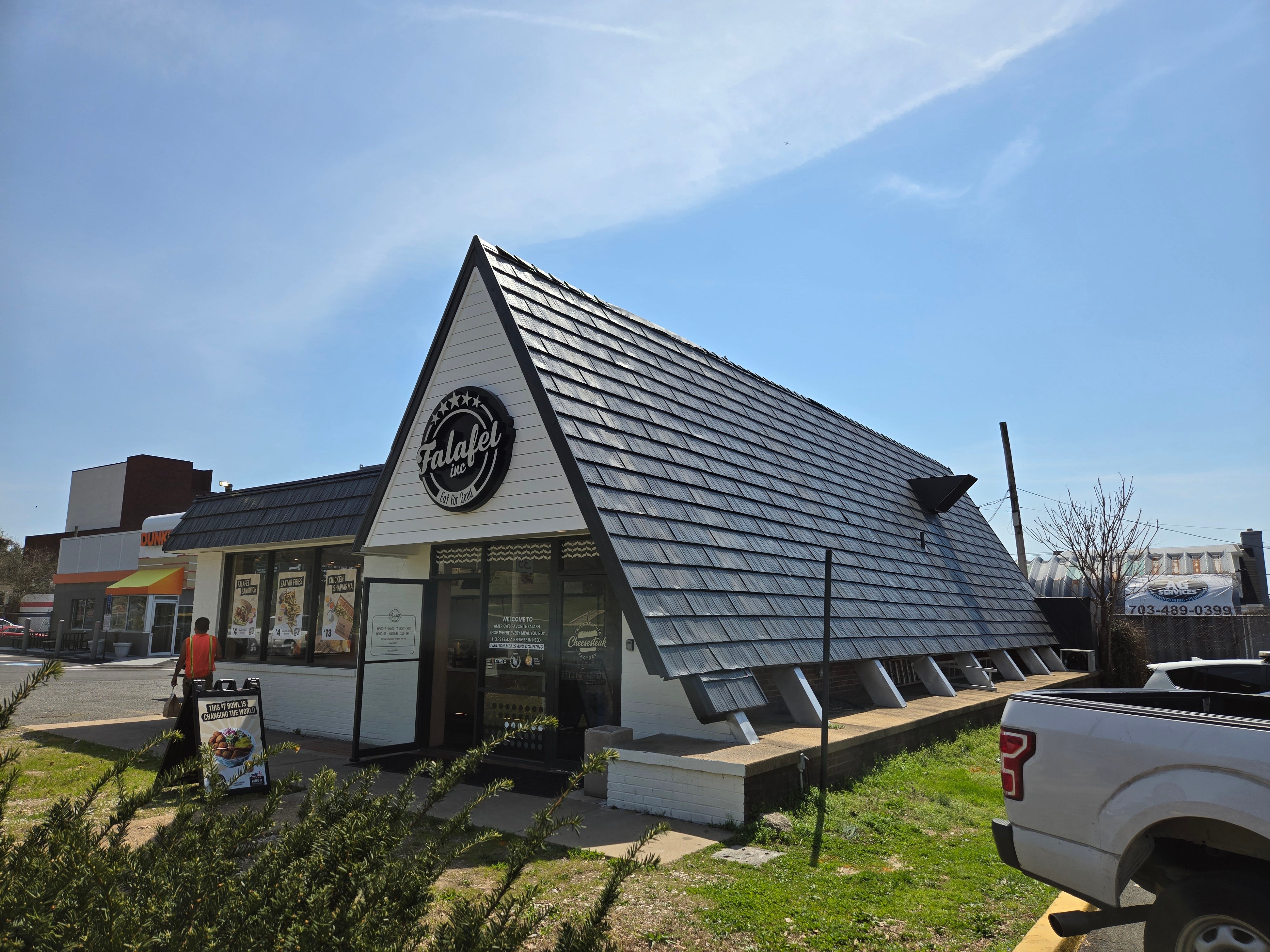
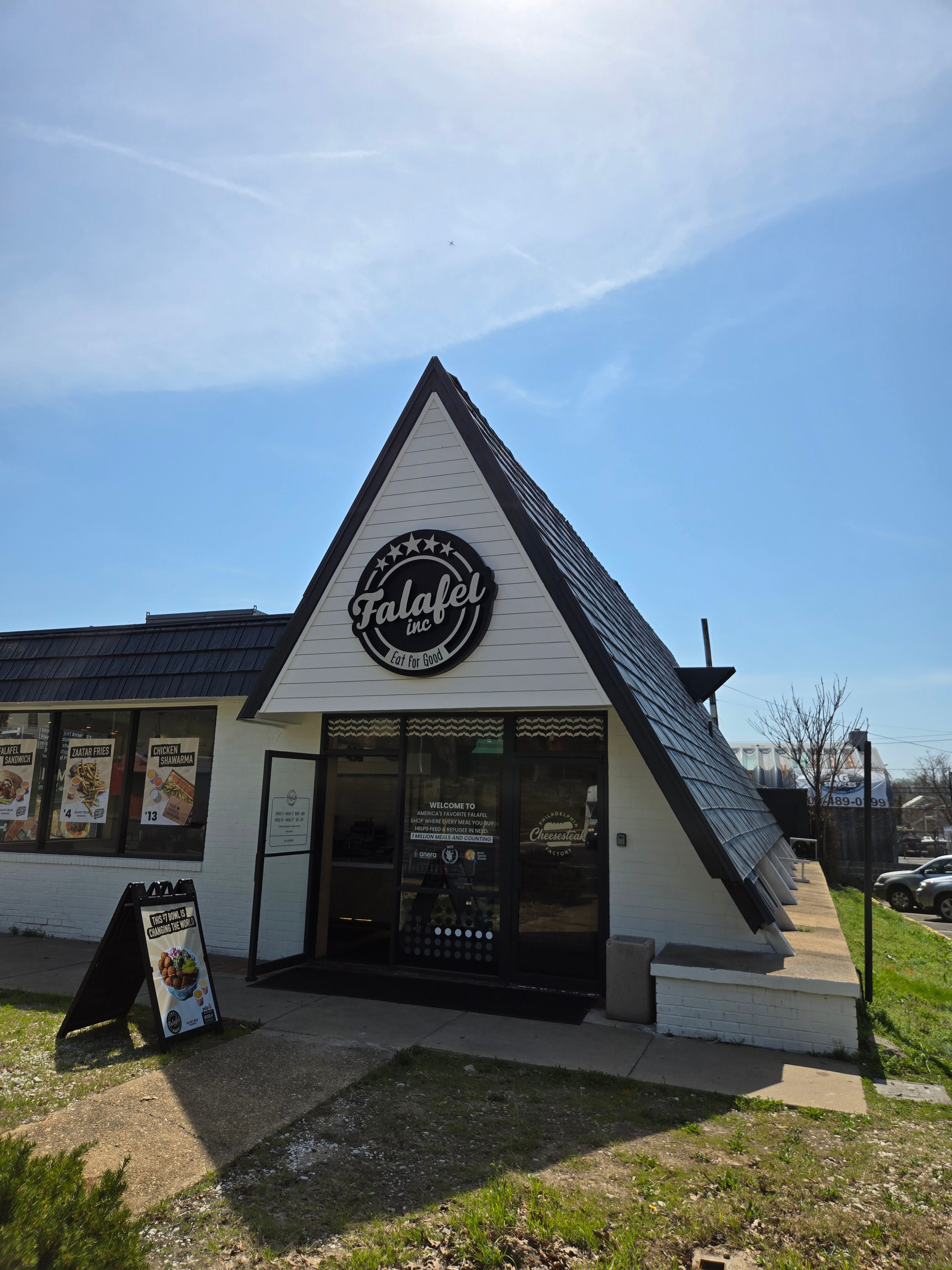
The building itself, as far as I have been able to tell, has no watertight feature that would definitively identify its original builder/tenant. It’s also always possible that this was a one-off building that simply aped a popular look, and that any real information about it is either lost to time or not terribly interesting.
I started my search by asking about it on a Northern Virginia history Facebook group, and got quite a lot of answers. I could immediately rule most of them out: the building is too small for an IHOP and is just not a match; it’s even less of a match for Howard Johnson’s or Little Tavern (a local chain with even smaller buildings that looked like this). Several of the answers were for later tenants: Breakfast Unlimited, for example, which goes back to the 1980s and is apparently remembered fondly.
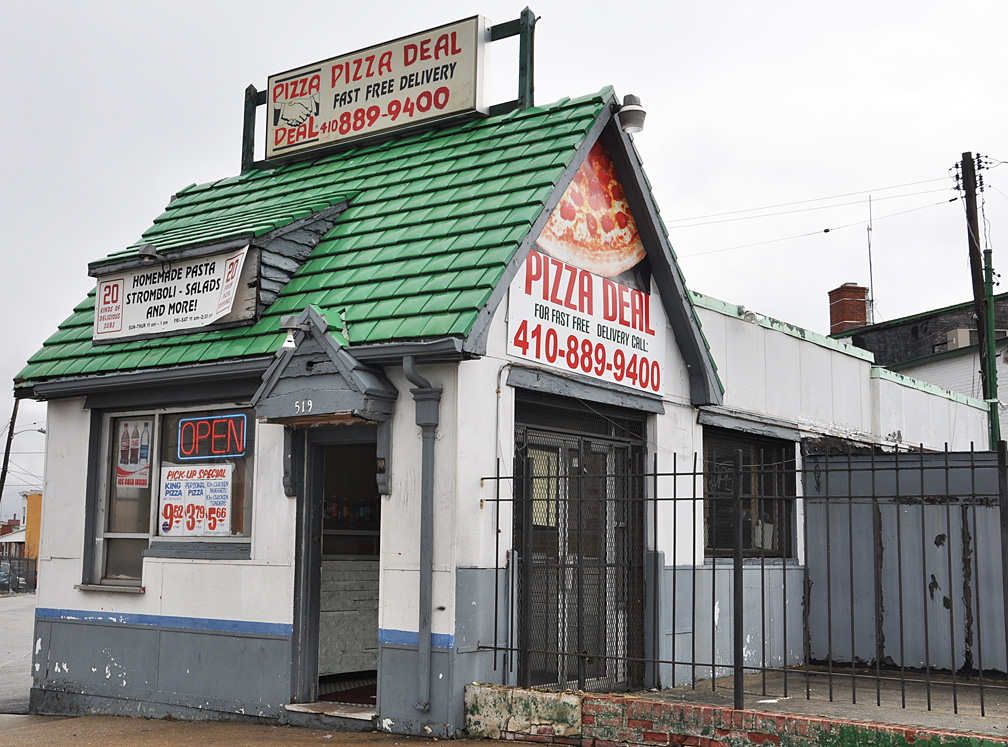
The real possibilities offered were Village Inn Pizza and Heap Big Beef. Both of these chains have surviving structures in the region, to which this building in Alexandria can be compared. This is important, because two buildings belonging to the same chain, in the same region, from the same time period, are likely to have used the same structure. Therefore, any key differences between the known locations of those other chains and the mystery building would suggest that the mystery building was something else.
Here is, according to Roadside Architecture, an old Village Inn 15 or so minutes from Alexandria:
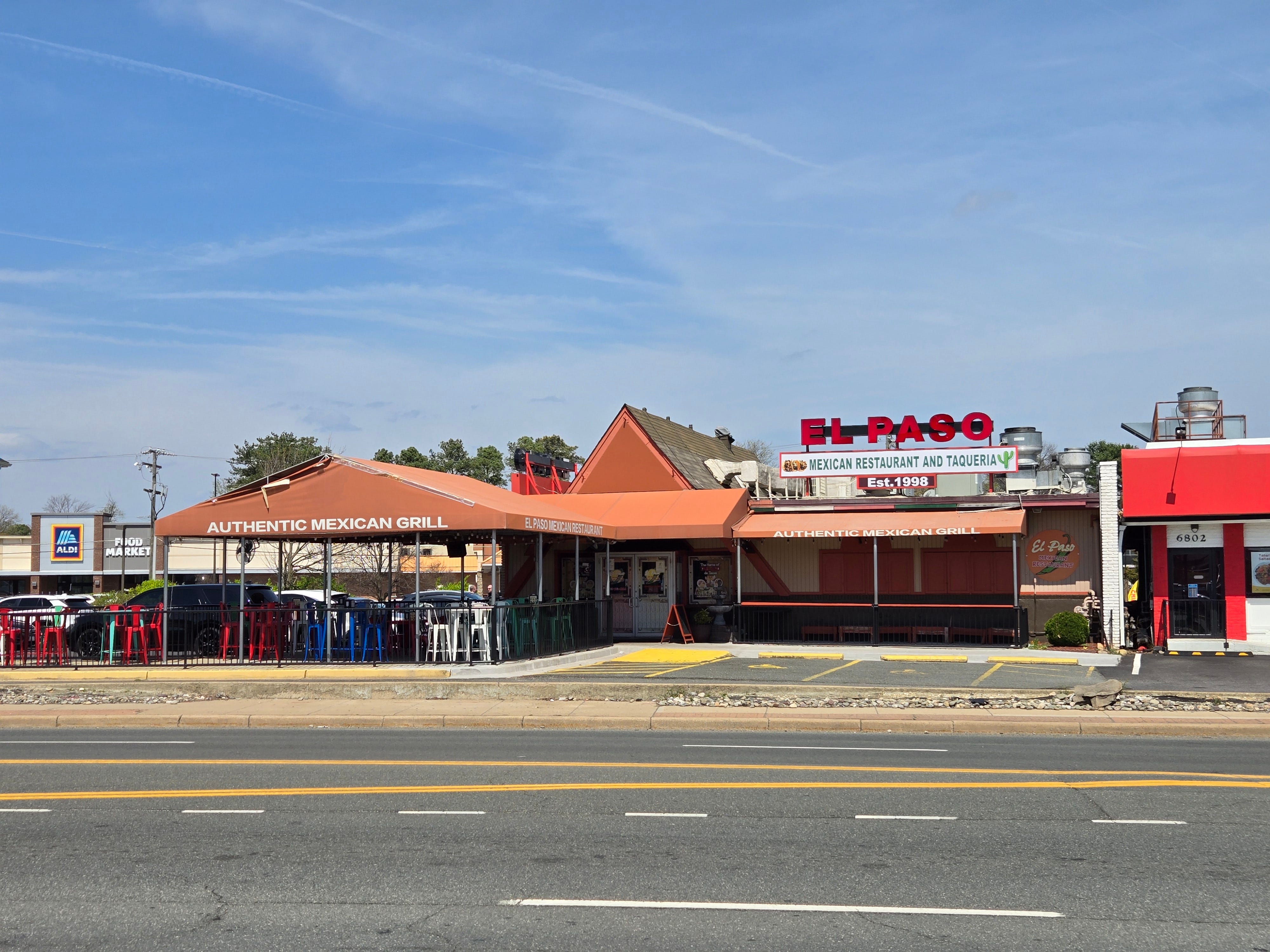
He calls these “less-steep” Village Inns, as the earlier ones were taller A-frames without a building surrounding them (here’s a good picture of one of those). They looked very much like the building in Alexandria. The Alexandria building also has a little additional space on one side of the A-frame. At least a partial match.
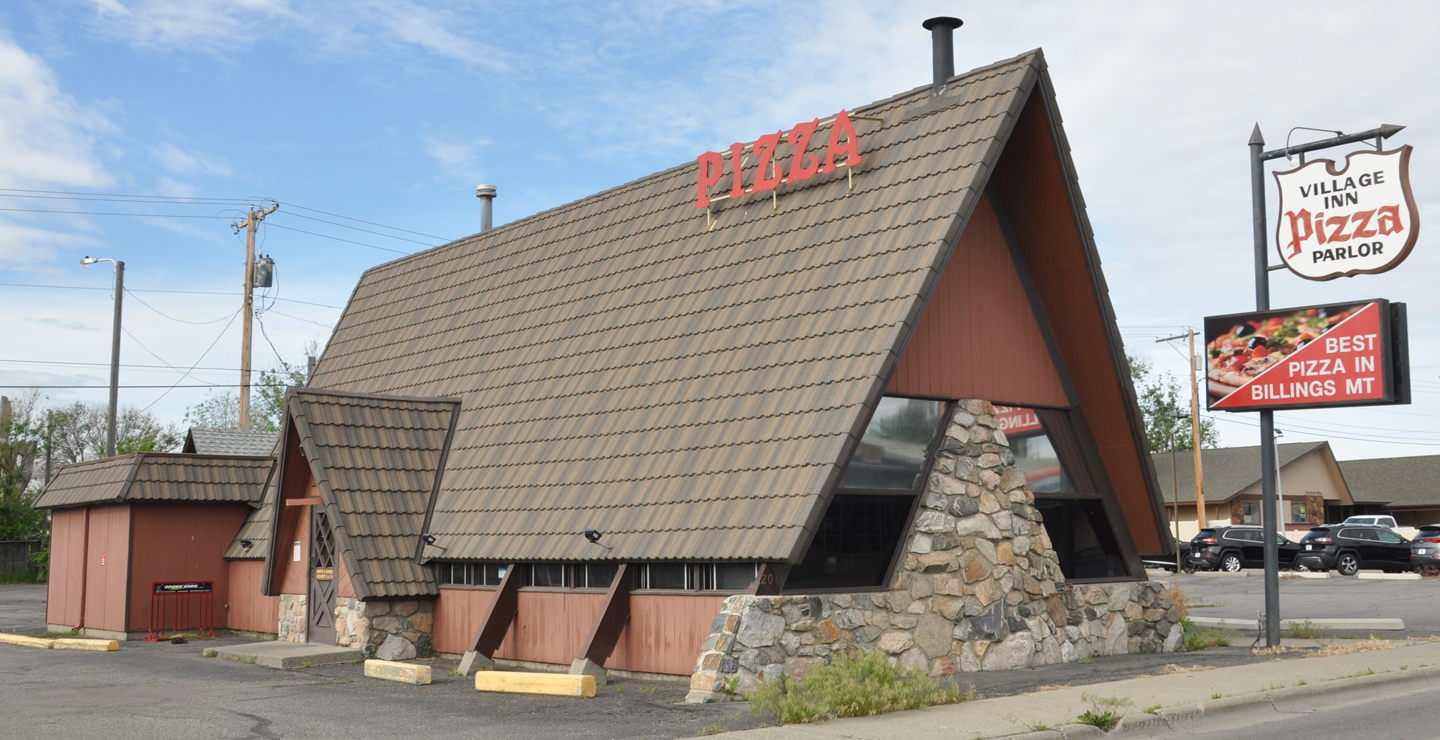
But here, in an old Virginia Supreme Court ruling from 1973, is a useful little fact: a Village Inn opened on or near Duke Street (not clear) in December 1968. That predates the mystery building by one year, and it seems too close for the mystery building to have been a duplicate. Several people in my Facebook post replies also remember the Village Inn being not the building in question, but being nearby. (Some also remember two in Alexandria, but I think we can conclude that is simply fuzzy memory.) That Alexandria location is not, as far as I can tell, still standing.
Heap Big Beef is a closer match: this old Heap in Temple Hills, Maryland is very similar to the Duke Street building. (Yes, I drove out to photograph these too.)
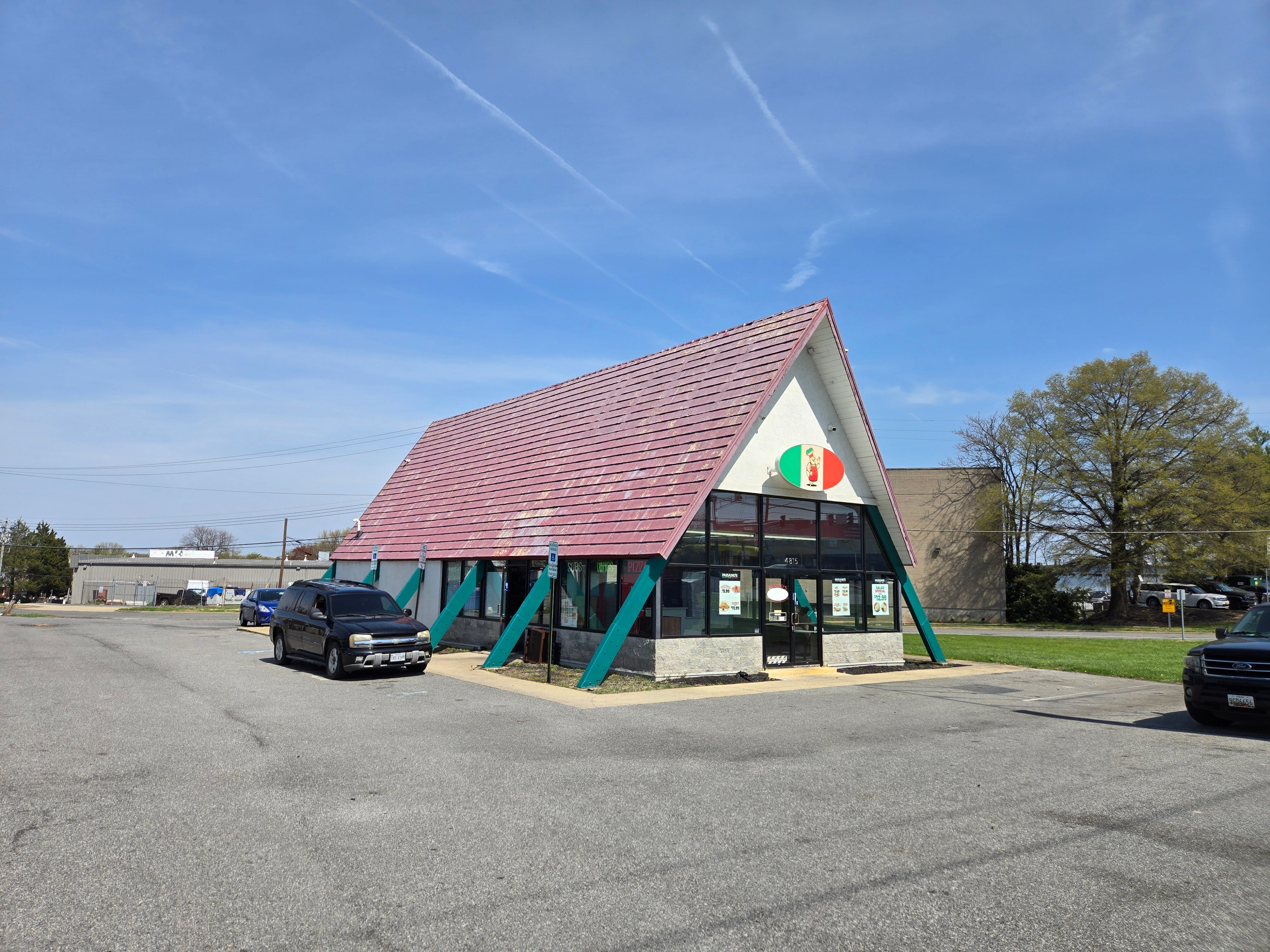
It has a similar number and style of roof tile rows, a similar exposed-slat base, and similar dimensions. The slats, however, are more exposed here, and there’s another subtle difference: the roof overhang part is angled inward, such that there’s more overhang the higher up the A-frame you go. The mystery building in Alexandria does not have this feature.
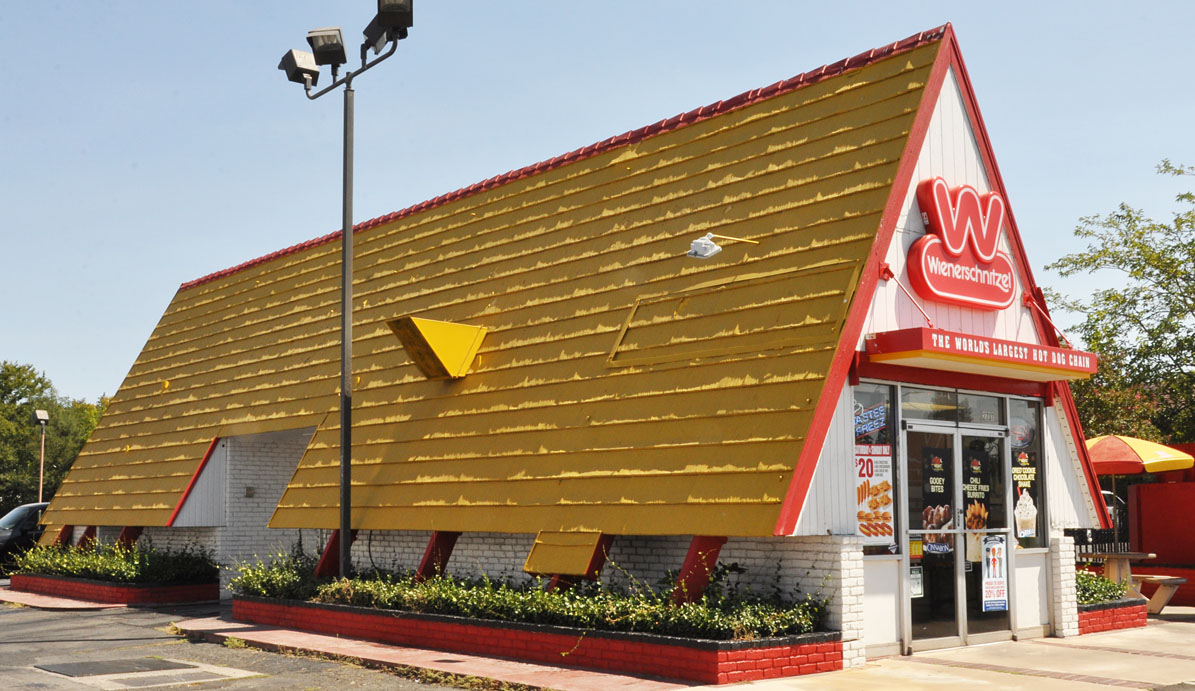
The other really intriguing possibility for the 3060 Duke Street building is Wienerschnitzel (then still called “Der Wienerschnitzel”), the California-based hotdog chain. Their buildings from this period were steep A-frames as well, with a very similar basic design.
Some, but not all, had an iconic drive-thru lane cut right through the middle of the building. (And some were walk-ups while some had front doors.) They also, based on these photos of various locations from Roadside Architecture, did not have that angled roof overhang. (They differ: either the roof overhangs by the same amount everywhere, or it’s flush with the roof.)
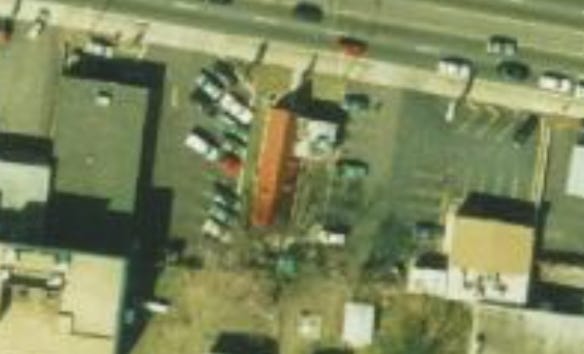
Wienerschnitzels also had red roofs, typically (though some seem to have had yellow roofs). If you look at the old Google Maps imagery of the building, before its recent conversion to the falafel restaurant, you can see there are flecks of red coming through the green roof.
Here is a 1995 aerial from the City of Alexandria’s GIS viewer showing that the roof was red. Early 1980s color aerials from NETR show the same.
Also, the style of the roof tiles almost exactly matches at least one confirmed old Wienerschnitzel location. In fact, there are even the same number of lines of tile—18 from the roofline to the ground. (Though this is true of some other A-frames.)
Most importantly, several people in the Facebook comments remembered this as a Der Wienerschnitzel location. The only issue, however, is that there is, as far as I can tell, absolutely nothing on the internet documenting that Der Wienerschnitzel ever operated in Northern Virginia.
In fact, it’s pretty commonly understood that it never operated on the East Coast. Here, from July 2025, is an article headlined “Wienerschnitzel Signs First East Coast Development Agreement.”
Wienerschnitzel, the world’s largest hot dog franchise, has officially kicked off a major growth opportunity on the East Coast with a seven-unit development deal in Norfolk and Richmond, Virginia, markets. Spearheading this new expansion for the brand is veteran franchisee, Leon Dickey….
“This is a major milestone for Wienerschnitzel as we expand to the East Coast,” said Ted Milburn, Director of Franchise Development for Wienerschnitzel. “Entering Virginia with a seasoned, rock-solid operator who has a strong background in running successful restaurants gives us tremendous confidence in the future of this market. It’s a big step in our national growth strategy and the beginning of exciting momentum beyond our traditional footprint.”
This 2021 article in the Orange County Register states:
The Irvine-based company, which calls itself the world’s largest hot dog chain, franchises 330 restaurants in 10 states and is pushing to expand in the Midwest and Oregon.
This article calls the 2025 Virginia deal the company’s “first East Coast market.” It would appear, then, that the received wisdom is that the company has never operated on the East Coast, and is only recently entering that market. I was intrigued by the possibility that this A-frame in Alexandria was, in fact, a Wienerschnitzel. It was tantalizing, but unlikely.
A whole bunch of searching yielded nothing specific. But I did manage to disprove that Wienerschnitzel had never been on the East Coast. First, there’s this curious ad for Wienerschnitzel franchises, in a 1969 (the same year the mystery building was built) issue of Popular Mechanics:
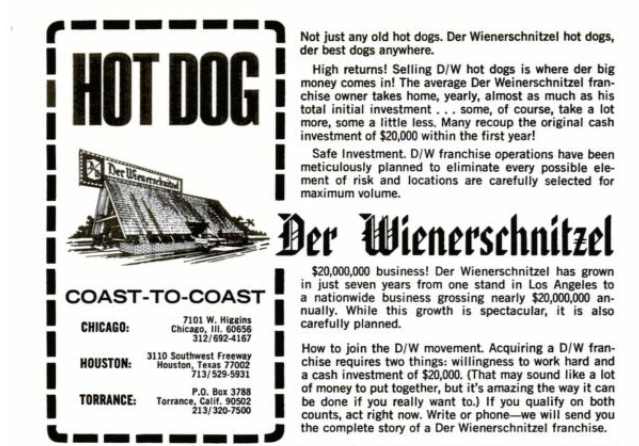
The company had a Chicago (Midwest) office, and also claimed it was “coast-to-coast.” Were they just using “coast-to-coast” to mean “Not just the West Coast?” Or were they referring to actual East Coast locations, or at least intended growth there?
The Roadside Architecture website comes in handy again, identifying two Virginia Wienerschnitzel locations: one in Hampton, and one in Newport News. Curiously, this is the same region as the Virginia restaurants announced in 2025!
The Hampton location is a dead ringer for the chain, and it had the middle-of-the-building drive thru, while the Newport News one is slightly different. I have not absolutely proven that these were Wienerschnitzels. But I’m sure the author of Roadside Architecture has some sourcing. Furthermore, someone in my Facebook comments recalled eating at a Wienerschnitzel down near Hampton in the 1970s.
A Yelp review for a later tenant, The Dog House, writes, “Remember from way back when this place used to be a wiener schnitzel.” And I found one other reference to one of these southeast Virginia locations in the comments section of a news article, which I cannot find again—something like, “I remember when there was a Wienerschnitzel there long ago.”
Roadside Architecture has no entry for any other East Coast or Virginia locations, however. And the internet has nothing at all. (In case you thought the AI chatbots might be any of help, I wondered that too, and nope, they weren’t—Google’s Gemini made up a bunch of non-existent Wienerschnitzel locations in Northern Virginia, complete with colorful stories, and then on another prompt, told me they had never been in Virginia.) None of the local Facebook groups I follow even returned any old posts about local locations for the search term “Wienerschnitzel.”
I had nothing to prove this unlikely story, of a national chain’s failed and completely forgotten Northern Virginia expansion. But I had nothing, after a lot of looking, to disprove it. I was nervously excited to be able to tell a story like that. But I had also never come across something this thinly documented, so I didn’t want to hope.
There was one lead I had ignored.
Well, not quite ignored, but sought to verify. The person who offered it didn’t seem to be online much, and didn’t answer. He wrote that the 1970/1971 Northern Virginia White Pages listed “Der Wienerschnitzel” at 3060 Duke Street!
I was able to find a Fairfax County history page with links to a series of archived resources, including a Library of Congress scan of said White Pages.
But a search of the text version of the document for “Wienerschnitzel” returned nothing, and the quality of the scan itself was very poor, so I thought that perhaps 1) the person who offered the tip was in error, or 2) maybe he meant a different edition that was not archived at all, 3) maybe he meant Yellow Pages, or 4) maybe he was pulling my leg.
But I decided to revisit the White Pages lead. Why the heck would an old guy make something like that up? I’m going to find this entry. I returned to the searchable text version of the White Pages, and stared, and stared, and then, instead of “Wienerschnitzel,” tried “Der W.”
And there, in the text, popped up “Der Wienzrschnitzel.” Wienzrschnitzel, with an extra Z for the second E.
A misspelling had stopped me from finding the full name the first time! (The word was probably unfamiliar, and whoever transcribed it duplicated the Z). But the text version of the White Pages, agonizingly, had not captured the associated address, likely because the quality of the scan was too poor and illegible.
So I went over to the scan/image version of the document, which also had a search function. And now, armed with the wrong-right spelling of the name, I was able to search for and find the entry there and squint at the address myself.
And if you look very closely, you see that it says “3060 Duke Alex”—short for Alexandria. And here it is:
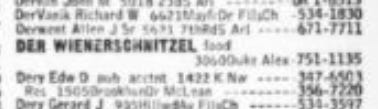
Is it at all possible that “Der Wienzrschnitzel” was some kind of one-off knockoff restaurant? I don’t think so. There are no Google hits for such a thing, at all, but more than that, Wienerschnitzel was mostly known in California. There would have been no point in imitating it in Northern Virginia, down to the exact style of building and the “Der” prefix, because few people would even know what it was an imitation of. And, of course, the original name is silly but makes a bit of sense, because a wiener is a hotdog. So I think we have our proof.
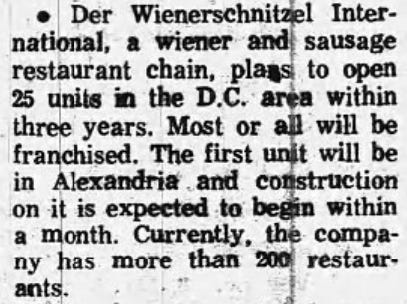
And one more note: following publication, an eagle-eyed reader found an April 29, 1968 issue of the Washington Daily News, which proves this beyond any doubt. This was the company’s first East Coast deal, and it apparently never went anywhere. (The later editions of the same White Pages also list no Wienerschnitzel/Der Wienerschnitzel locations.)
So there it is. This is not just a one-off building, or a bit of local trivia of minor historical interest. It is a piece of a fairly large, long-running, and still-existing company’s history which—so far as I have been able to tell—is absolutely unrecorded on the internet, not a part of the company’s official story, and perhaps not properly written down and told anywhere at all. A call and message to Wienerschnitzel’s corporate office was unanswered; neither the Alexandria Historic Preservation department nor the Virginia Department of Historic Resources had any information on the address or building.
It is such a fascinating, humbling, and slightly spooky thing to find a story like this in plain sight. To realize how much about our everyday built environment will be lost and may already be lost. How quickly knowledge can decay.
There is something worthwhile about piecing together and telling these stories. Not because an old fast-food A-frame is important, in the scheme of things, but because small-h history matters, continuity matters, and telling stories matters.
If these are the only stories we have in suburbia—if perhaps we are a bit deprived, for feeling that an old fast-food building counts for anything—then telling them only matters more.
Related Reading:
Thank you for reading! Please consider upgrading to a paid subscription to help support this newsletter, discounted just this week! You’ll get a weekly subscribers-only piece, plus full access to the archive: over 1,500 pieces and growing. And you’ll help ensure more like this!
Fascinating! I did a newspaper archive search based on your article. It appears that the Der Wienerschnitzel outlet in Alexandria was part of a planned DC-area expansion that never took off. From the Washington Daily News, 4/29/1968:
"Der Wienerschnitzel International, a wiener and sausage restaurant chain, plans to open 25 units in the D.C. area within three years. Most or all will be franchised. The first unit will be in Alexandria and construction on it is expected to begin next month. Currently, the company has more than 200 restaurants."
I don't see any evidence that they ever got past that single Alexandria location, however. That planned expansion is apparently so long forgotten that even the company doesn't remember it!
Despite the owner's sketchy history that falafel franchise is delicious, glad we have one