With A Capital T That's Next To S Which Stands For Sky(scraper)
What Do You Think You're Looking At? #264
This curious little building in downtown Wichita Falls, Texas may not look like, well, much of anything:
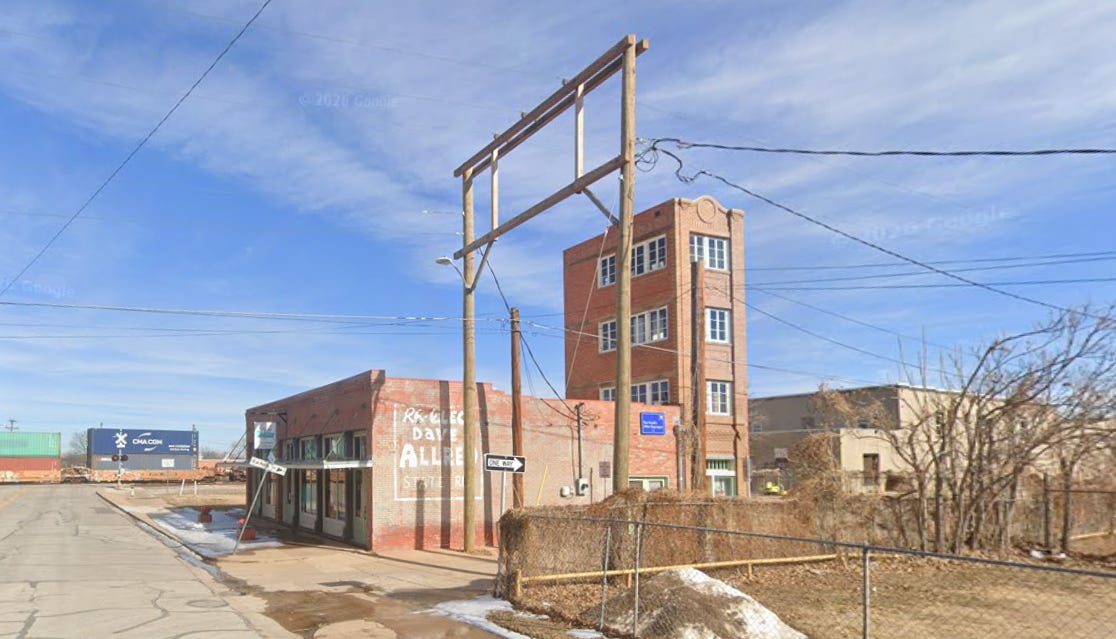
If you asked me to guess, just from the image, what this is or was, I would guess that it had been a four-story block that had lost its top floors except for that little narrow four-story segment. You see that sort of thing done to buildings sometimes; it’s pretty wild.
That is not the case here. It was always a tall, narrow building. And the story behind is possibly untrue, maybe too perfect to check. It’s a perfect American Wild West tale.
Many sources record the history as “according to legend” or something like that, but an official tourism website presents it, more or less, as fact:
Investors practically stood in line to buy stock in a construction project proposed by a Philadelphia building engineer, the plain-looking tenant of the Newby Hotel, a man whose given name has been lost to history. He probably was a genuine building engineer or he could never have presented his $200,000 (c. 1919) project so convincingly! Contracts were signed, money changed hands and construction began on the lot next door to the clever visionary’s hotel address. Trouble was, none of the investors seemed to notice that the Philadelphian’s blueprints, which called for dimensions measured in square feet, were actually executed in square inches until after the property, still standing after 80-plus years, was finished. By then, the Easterner had long checked out of the hotel, taking the bulk of his ill-gotten $200,000 along.
During the 1920s, the Newby–McMahon Building was featured in Robert Ripley’s Ripley’s Believe It or Not! syndicated column as “the world’s littlest skyscraper,” a nickname that has stuck with it ever since. The Newby–McMahon Building is now part of the Depot Square Historic District of Wichita Falls, a Texas Historic Landmark.
Some versions say that rather than actual bait and switch—from square feet to square inches—the blueprint itself contained accurate but almost hidden dimensions:
The blueprints of this building said that this would be 480" long, which is 480 inches. But it was meant to be 480' long, which is 480…
They filed a lawsuit against J. D. McMahon, the head of the construction firm that made this building. But they lost it as it was their own fault that they didn’t see what they were getting in the blueprints.
They were scammed, and there was nothing they could do about it. J. D. McMahon had very cleverly sneaked in an extra line to make this blueprint legally binding.
The building was preserved, restored, and, as of 2008, housed an antique store (that doesn’t seem to still be there). The upper floors were restored and used, too, which doesn’t always happen.
In 1986, the city deeded the building to the Wichita County Heritage Society, which attempted to preserve it. In time, however, it was again orphaned, and there was steadily growing talk of having it demolished before the architectural firm of Bundy, Young, Sims & Potter was hired by the city to stabilize the downtrodden structure. So fascinated did Dick Bundy and his partners become with the historic site that in 2000 they arranged a partnership with Marvin Groves Electric, purchased the building and spent $180,000 remodeling it.
“Frankly,” says Bundy, “it wasn’t a very smart investment, but so many people wanted it preserved. And, it’s a unique part of our local history.” Plus, he says, it is a great conversation piece. On a recent visit to Harvard University for a conference on the construction of high-rise office buildings, Bundy casually mentioned his firm’s involvement with the World’s Littlest Skyscraper. Before the gathering ended, he was asked to the podium to tell the story of the building and his history.
Today, it serves as more than an attraction for a steady stream of curious tourists. Local antiques dealer Glenda Tate recently leased the building, which now houses her business, The Antique Wood. Upstairs, Bundy’s artist wife, Merri, has converted the third floor into her studio.
British YouTuber Tom Scott did a short video on the building, and he dug through newspaper archives and spoke to some people at the city offices, and couldn’t find any reference to the actual scam, though the building was viewed as a scandal at the time. So it’s hard to say how much of the story is true, but some element of it is probably is.
You see where the plot of The Music Man came from. This little, possibly legendary but certainly credible story about a con reminds me of the backstory of Harland Sanders, who was not a conman but lived and worked in this more entrepreneurial, less secure, more rough-and-tumble America.
I wrote this, a long time ago, and it’s a little bit I’ve come back to often when writing about things like risk, business, and entrepreneurship:
Reading about Sanders and his string of odd jobs on boats and trains and his many ups and downs as he slowly perfected his iconic chicken recipe, one almost feels that it took place in a different country. That whole milieu—a freewheeling, chaotic, entrepreneurial era made possible by the sting of poverty and the absence of a social safety net—is a figment of a vanished economic and cultural era. Chandler describes Sanders’ career as tracing “America’s adolescence.” Perhaps countries, like people, go through phases of life, and one consequence of America growing up is that we no longer tolerate the chaos and lack of regulation that made these classic American stories possible. The Colonel’s jerry-rigged pressure cooker wouldn’t last long during a modern restaurant inspection, and perhaps that is for the better.
We’ve certainly gained some things, in having a more secure, more regulated system of banking and finance, job safety, all that stuff. But it seems undeniable we’ve lost a few things, too.
Related Reading:
When Small Towns Wanted Tall Buildings
A City’s a City No Matter How Small


Hilarious. This is straight out of the Stonehenge scene from Spinal Tap, when they lowered the 11-inch-tall fake stone arch on stage.