

I want to show you a couple of social media posts:
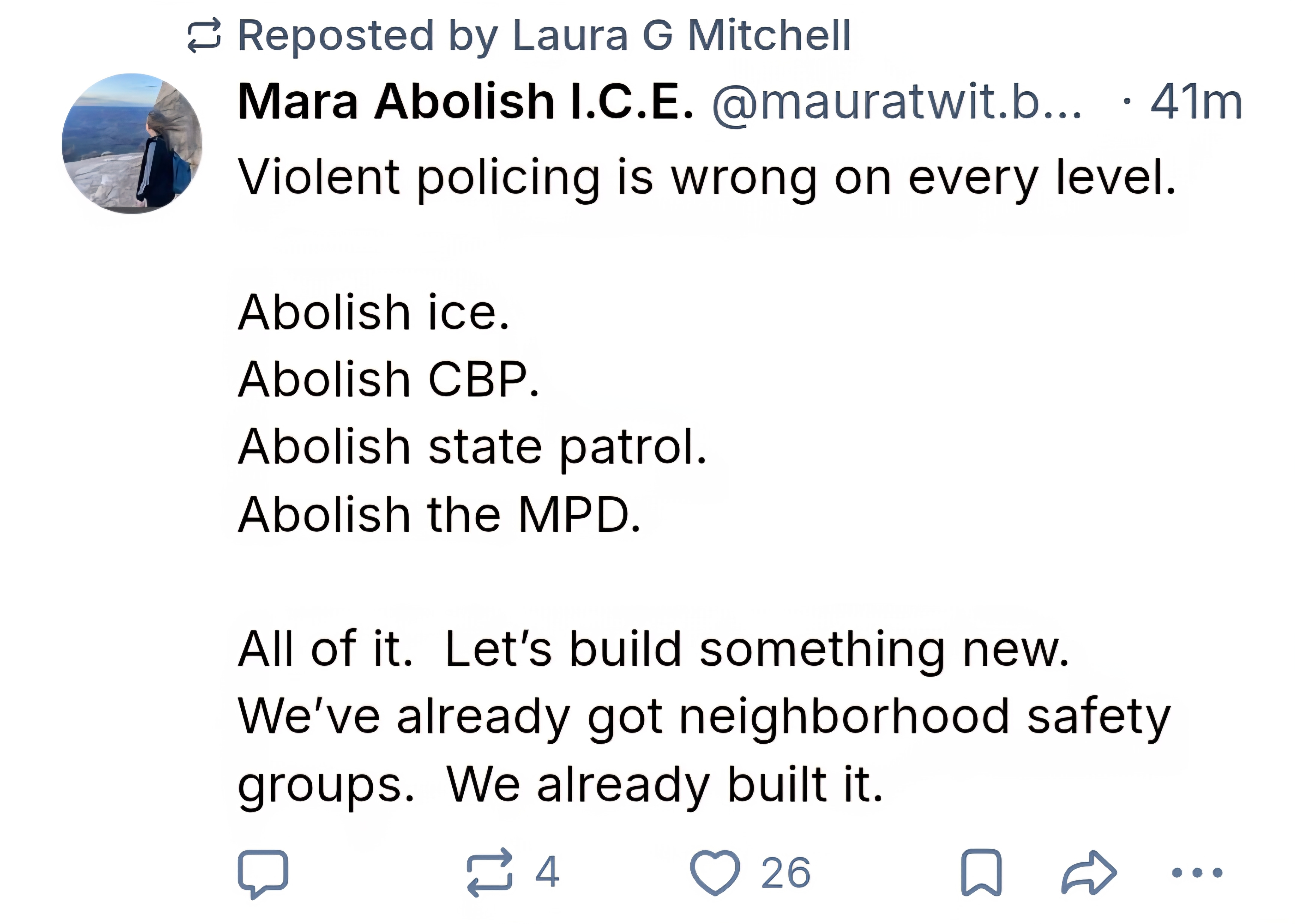
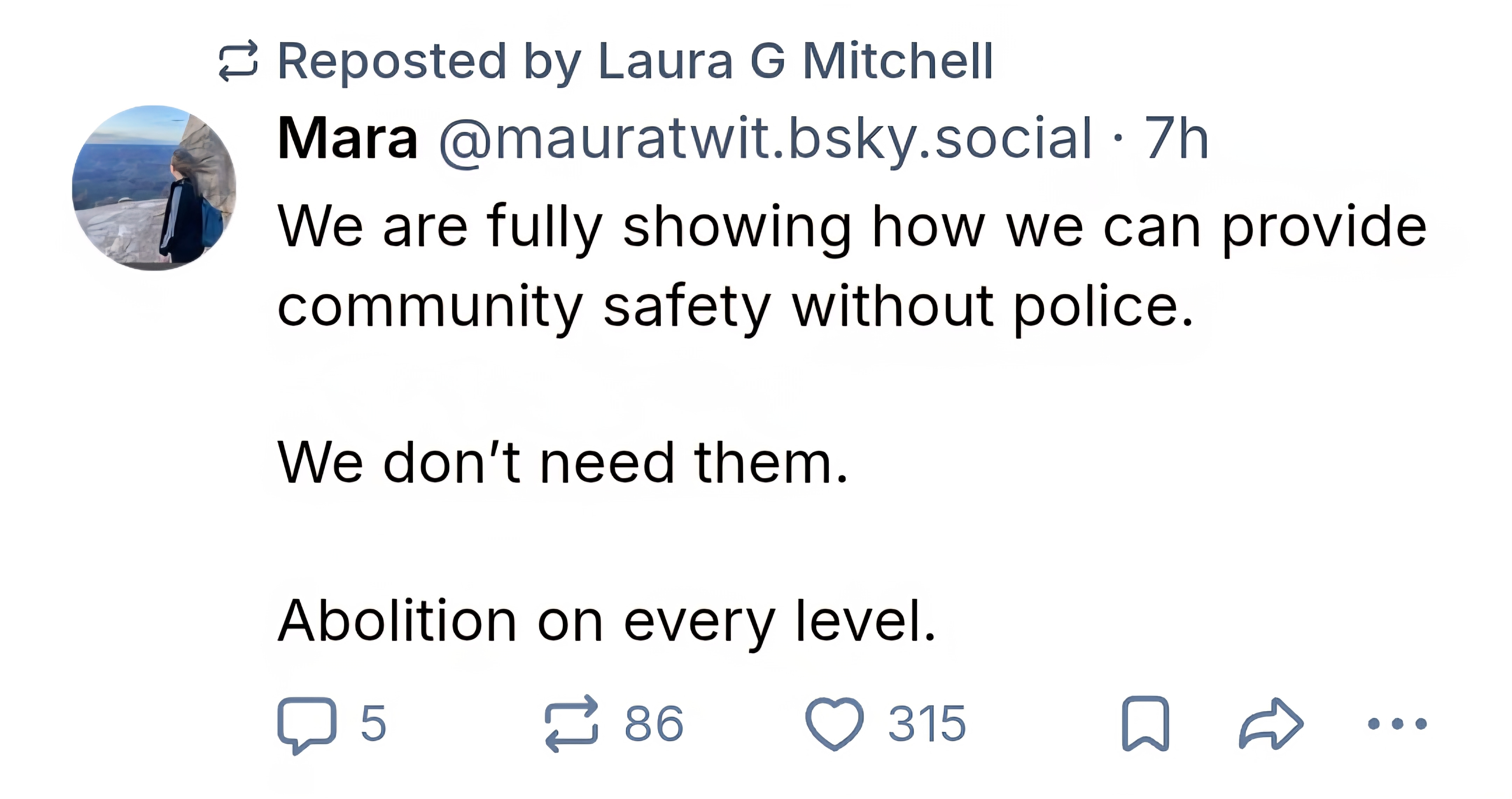
I don’t follow the original poster or know who she is; but I follow Laura Mitchell, who reshared both of these. She’s a Minneapolis urbanist and bike advocate who I’ve followed for some time (for that reason), and she has become very involved in the anti-ICE organizing and protests in her city. Because I know she’s a real person who lives there, I basically trust her dispatches from city.
It gives me some pause, however, to see her endorse, apparently, the abolition of all police. Not only because I do not agree with that, but because it is the kind of thing that makes conservative skeptics of urbanism say “I told you so.” Or that makes conservatives say “If the people who don’t want mass deportation want to abolish the police, then mass deportation must be good.” It twins ideas that have—in my view—nothing to do with each other.1
On the one hand, the message folks on the ground in Minneapolis are sending is that they are just regular people looking out for their neighbors, forced to “protest” by unprecedentedly aggressive law-enforcement tactics. It isn’t political, per se, except in the sense that caring about your neighbors is political.
So when I see people involved in the anti-ICE activities calling for the abolition of all police—which, by any definition, is an extremely “political” thing to advocate—it makes me think something like: why does “choosing your neighbors over the abstraction and aggression of maximal immigration-policy enforcement” end up “bundled” with abolish the police? And what is someone who has no issue with the first, but a major issue with the second, supposed to think? Why can’t we have people who say Of course we need police, and of course we shouldn’t be brutalizing immigrants. I understand how (certain segments of) the left bundling these together ends up turning other people against both.
Now I can hear one objection: no American political party or notable local government will ever abolish the police, or dismantle it and rebuild it from the ground up. It’s not a thing that will ever happen, so you can ignore it. On the other hand, brutal immigration enforcement is a thing that is happening, at the direction of the current president of the United States. How can you put the president on the same level as a random local organizer with a lefty social media account?
I understand that; yes, the Democratic Party isn’t going to abolish cops (and in fact, many progressives are angry with the Democrats for, in their view, not opposing Trump’s agenda aggressively enough). But the idea that we’re going to say a thing and then blame you for taking it seriously is distasteful to me. It strikes me as a kind of civic dishonesty. It’s a way to advocate something apparently sincerely, but take none of the heat for it. I don’t think “What about the president’s much greater wrongdoing?” is a license.
Anyway, what does “abolition on every level” mean? I will try to give it a kind of fair reading, because I really don’t think it means “no laws and no law enforcement.” I don’t think progressives are that insane. I genuinely think there are so many divergent assumptions and base ideas that we talk past each other. At least, assuming that to be true, this is what I would say.
More accurately than calling this “radical” is probably calling it utopian. It seems to assume that the problems with cops are because they’re cops, not that they’re humans; that the problems with police departments are because they’re police departments, not because they’re human institutions.
The original poster is arguing that the networks of neighbors they’ve put together function in many ways as police are supposed to: essentially, as a rapid response/deployment mechanism for people to show up quickly at some kind of situation, to respond or deescalate.
The immediate purpose is to act as a kind of ad-hoc legal oversight on federal cops, or to interrupt their aggressive tactics, which apparently include, basically, the show-your-papers equivalent of stop-and-frisk. But the idea is that this network could be repurposed for others sorts of situations. For example, someone noted in one of these threads that there was some kind of fight in a bar that local folks showed up at, and they got the guy who started the fight to leave.
This isn’t “abolishing the police” as much as it is…reinventing or reverse-engineering the police.