
First Train To Clarksburg?
The perennial disappointment of transit projects

Years ago, I saw this thread on Twitter from Dan Reed, who’s now the Maryland policy director at Greater Washington. It was this tweet, particularly, that stood out to me:
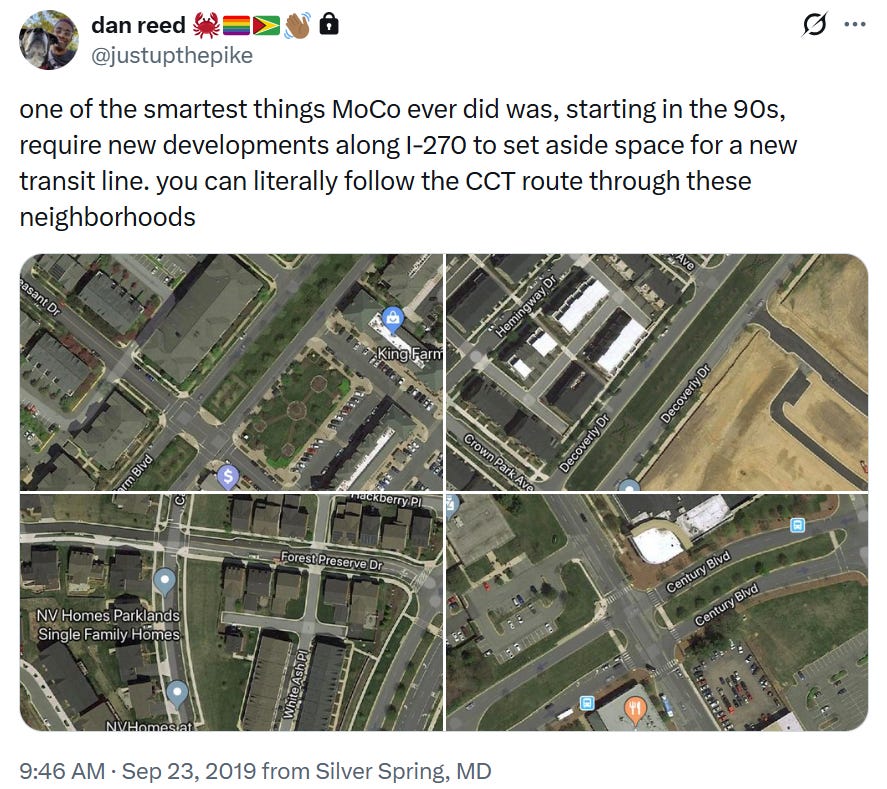
Reed was talking about the Corridor Cities Transitway. This was an old rail-line proposal, which would have connected the outer edge of the D.C. Metro, near Rockville, Maryland to the I-270 “corridor cities,” running through Gaithersburg and Germantown and terminating in Clarksburg, in northwest Montgomery County. There was even the idea of running it from Clarksburg out to Frederick—the next county over—which would have made it possible to hop on a train in Frederick and end up in D.C., or anywhere in between.
It’s a really cool idea, and it’s kind of mystifying it doesn’t exist. This route in particular is a new proposal, but routes like that, connecting places that feel pretty far apart and kind of in different immediate economic areas, existed a century ago, which is almost hard to wrap your head around.
The Corridor Cities Transitway was first proposed as a light-rail line, and later reduced, in planning documents, to a bus-rapid-transit line—essentially, a bus lane where the bus could run at fairly high speed, without mixing with automobile traffic. In 2019, a few years after this paring back of the idea, the project was effectively killed:
The CCT has been listed as a transportation project in Montgomery County for nearly a decade, Reznik added. The transitway was originally planned as a light-rail line from Shady Grove to Frederick County, but MDOT gradually shortened the anticipated route to end in Clarksburg.
In 2012, then-Gov. Martin O’Malley announced that the project had been changed from a light-rail line to a bus rapid transit system. The Federal Transit Administration described that type of project as a high-speed bus line with dedicated lanes and right-of-way under most traffic signals.
The planned route extended from the Shady Grove Metro station to the COMSAT site in Clarksburg — a roughly 15-mile line with stops in major new residential developments.
“I was very displeased when it became a bus rapid transit system, but at least the project still existed,” Reznik said. “There was at least the idea of public transit upcounty and a hope that we could expand the project later.”
“Gov. Hogan has put a final knife into the heart of what could be a very useful transit line in a rapidly growing area of the county,” Reznik added. “The previous plan put the project on ice, but at least it was still listed. This latest move signaled to all of us that they weren’t going to go forward with anything.”
You can take a bus from Clarksburg to the D.C. area, but it’s cumbersome. From Frederick, your options are reduced to inter-city or commuter buses; there’s no true regular, all-day transit option. This illustrates how we build housing and communities with transportation as an afterthought.
But it’s even worse, because the corridor cities did grow with the idea that transit would follow. One of the communities near Rockville, King Farm, was, as Reed’s tweet notes, laid out with a right-of-way set aside for a future transit line. It was widely considered “transit-ready,” with the then-forthcoming Corridor Cities Transitway touted as a future amenity.
And yet, there were NIMBYs, who bought homes in a community marketed on its future transit, and then complained that the expected transit line might be built! Take a look at this article from 2016, when the project was still live:
Eight hundred residents of the 3,200-unit traditional neighborhood development recently petitioned Rockville City Council for help in getting the state to build a mass transit line somewhere other than through the center of their community.
Their request — viewed by many smart-growth proponents as self-centered and short-sighted — has ignited criticism on a number of blogs.
“So much for the widely-touted concept of ‘transit-ready’ development,” wrote Kaid Benfield of the Natural Resources Defense Council on his blog. He characterized the residents’ assertions as “NIMBY complaints” from people “who are just fine with driving their cars and apparently see transit as blight rather than benefit.”
“One assumes that residents of King Farm moved here knowing the plans were in place for transit and it’s not clear how it became a matter for debate,” wrote Allison Arieff, former editor in chief of Dwell magazine, on the GOOD blog.
Even before the first residents moved into King Farm in the 1990s, the 440-acre development, about 10 miles beyond the Capital Beltway, had been laid out by Torti Gallas and Partners to feature a 50-foot wide median down which light-rail service (or alternatively Bus Rapid Transit) would eventually run. Currently just a grassy strip, it was designed to be part of the future Corridor Cities Transitway.
Now that the transit plans are coming closer to implementation, many residents are unhappy. One of them, Lisa Conners, protested in January about the prospect of having light-rail trains pass through a median that’s 20 feet from her condominium unit on King Farm Boulevard.
The line “would cut the neighborhood in half, block vehicle and pedestrian traffic, create noise and change life as King Farm residents know it,” several residents told City Council members, according a summary of their complaints in the Rockville Patch, available here.
On a 4-1 vote in January, the Council asked the state to study alternative routes on the periphery of King Farm. Governor Martin O’Malley is to decide this spring where the 14-mile transit line between the Shady Grove Metro station and a site near Clarksburg, Maryland, will run.
I think about this a lot. The excruciating timelines and setbacks and reductions in the original promises. That near-certainty that nothing that ever gets proposed will actually happen. And the fact that people see nothing wrong or weird about NIMBYing an obvious, expected feature of the neighborhood they bought into.
Reading about this in 2019 was one of my early “Huh, this NIMBYism thing is a real problem, isn’t it?” moments. Look, I get it, it’s seductive to think, “Well, this doesn’t make sense here; put it somewhere else, where it does make sense.”
But every place where it “makes sense” has its own NIMBYs who want to pass the buck—up to and including New York City. If big cities and “transit-ready” communities with pre-built transit rights of way still have NIMBYs, then you have to be very skeptical of the particular things those folks are saying, because, apparently, people will say them about any place at all.
The CCT was not a complete loss: a new plan, Corridor Forward, approved in Spring 2022, sets aside some bus lanes and basically functions as a kind of dime-store CCT:
The Corridor Connectors build on existing master-planned projects, like the MD 355 and Veirs Mill Road BRT projects, to connect I-270 corridor communities to the county’s existing and planned rapid transit network. They leverage the work previously completed for the CCT and refine it to create transit connections that are efficient, equitable, and realistic to build.
This is all, in a word, maddening. A project that began, loosely and conceptually, in the 1990s, in earnest in the early 2000s, was cut back, canceled, and then essentially cut back even more and re-proposed, with that 2022 plan itself a kind of first phase of future planned transit improvements…it’s Kafkaesque. This sort of thing, I think, is an underappreciated factor in the erosion of public trust.
And the fact that the rights of way are still sitting there is the cherry on top of the sad sundae. Take a look at this. In King Farm, you can see the erstwhile transit median snaking through the middle, left to right:
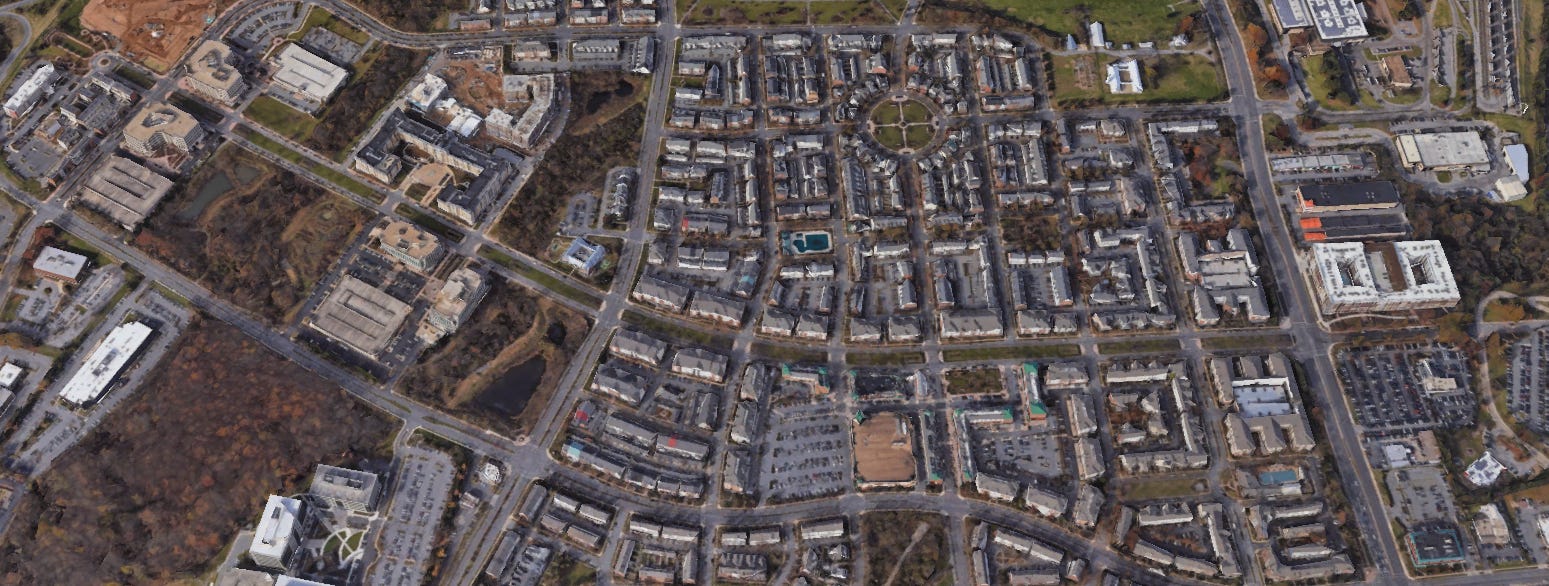
I can’t find all of them on satellite maps, but King Farm started construction in 1997. This is over a quarter of a century. “You can just do things,” goes the political slogan. Wouldn’t that be nice?
Related Reading:
Taking Off the Car Blinders, Opening Your World
Thoughts on Density and Distance
As a person in the middle of moving from DC to Frederick, this is a very interesting post. The one struggle I’ve had in thinking about the move is how I’d commute to DC if needed on public transportation. I reached the conclusion that other than driving to Shady Grove and taking the Redline, no other meaningful option exists. It seems crazy to me that there isn’t a direct train line alone I-270 to serve these areas. But now at least I can better understand why.
The major flaw in your thinking is this statement: "This illustrates how we build housing and communities with transportation as an afterthought."
Not so. The transportation that is, has always been, and will be until it gets to be more money than building good transit (and of course places that are well served by such transit), is automobile transportation. It's not a bug, it's a feature. That is what most people want, especially when they buy into suburban and exurban places. Sure having a rail line might be nice to commute, but the development patterns in these suburban counties have so much low density development in between that it becomes (at least in people's minds) impossible to live without a car.
100 years ago when there were dense, walkable population centers connected by rail, it worked because the interstitial space was either unused or farmland that people didn't need/want to go to regularly. This is why building rail in suburban locations generally doesn't work and never meets expectations because it just becomes the rail version of a STROAD. Very expensive, low ridership and if there are enough stops to get you to every little strip mall, very slow.
While transportation and land use are flip sides of the same coin, the problem is not we don't do proper transportation planning, it's that we don't do proper land use planning... that is if you want successful rail. People who want low density autocentric development are another story entirely.
</ rant>