My New Kielbasa Home
A lovely local business in a quirky old building
I consider this a pretty good haul for $36:
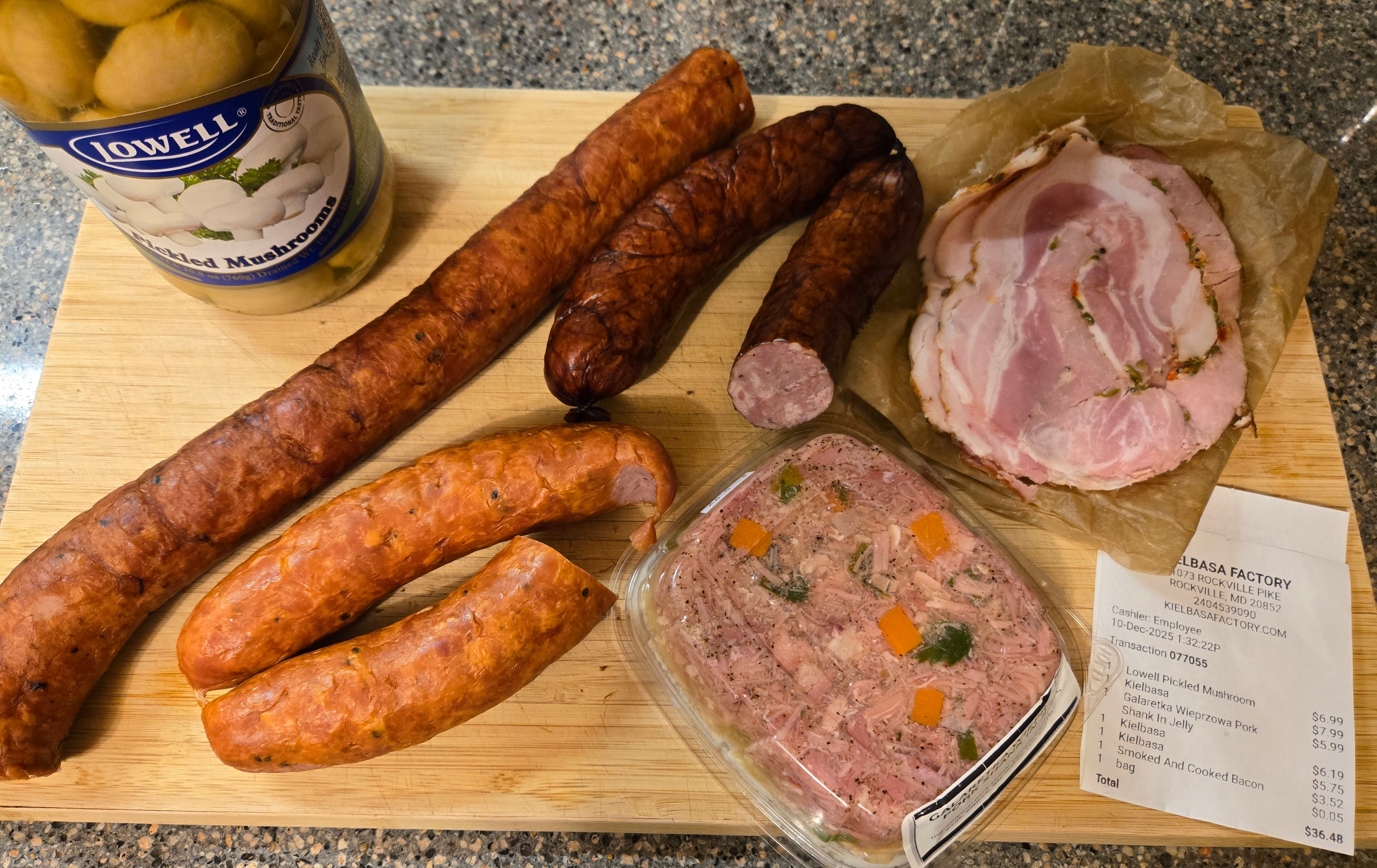
That’s what I paid at the Kielbasa Factory in Rockville, Maryland1 for roughly two link’s worth of three varieties of kielbasa (I’ve already sampled them, which is why the links are not whole!), a bit of spiced rolled bacon, pork in aspic, and a big jar of marinated mushrooms.
I’ve been to this store before, and I even had to do a search to make sure I hadn’t written about it already! It’s the kind of store I like in general: locally owned, staffed by people who really know what all of the products are, and not set up and priced like a gourmet or specialty store. It’s just an everyday store for people who like the cuisine/ingredients (Polish, all or mostly).
The lady at the deli counter, where all the kielbasa and deli products live, gave me a little sample of four different different varieties so I could choose which one(s) to buy; of those four, I only didn’t buy one.
When she noticed that I was buying the pork in aspic, she offered me a slice of a pork-tongue-in-gelatin cold cut. “Do you eat tongue?” she asked. “You don’t have to buy it, just try it.” I did try it, and it was very good. It tasted like good-quality pork/meat broth. But by that time I’d already committed to buying too much.
The prices of all these meats hover around $10 per pound. Most of it is a lot cheaper than, say, the products in the Wegmans deli counter. There are all these fancy charcuterie products Wegmans carries now—Calabrian salami, smoked coppa, salami with rum—stuff that feels almost designed to be upcharged. It runs closer to $20 per pound. The difference between that bespoke overpriced fussy stuff, and these normally priced specialties, is incredible.
And this kind of customer service and shopping experience—stores that have actual proprietors and long-term employees—is really special, and as much as I like a big supermarket where you can just explore and buy whatever you want anonymously, I feel like I have a nostalgia for this kind of place even though I grew up mostly shopping at big chain stores. Especially around the holiday season, these little shops feel special.
I’m always amazed by how efficiently they pack merchandise into very small spaces. I don’t know how big this space is, exactly, but it can’t be more than a few thousand square feet. And there are two deli fridges, two or three freezer units, an open fridge (where I got the aspic, and where there are also ready-to-eat pierogies), bread/pastries, and a selection of mustards, spreads, and jarred, canned, and pickled foods. And more.
You might be wondering, if you’re not a kielbasa connoisseur, is this really different from Hillshire Farms? You be the judge. Here are some slices of the three varieties I bought. Notice how there’s less visible fat, and how the meat is coarsely ground and looks like, well, actual meat:
It’s good stuff, and because the cuisine is kind of broadly familiar to me, but unfamiliar in many of its details or specialties, it’s the kind of place I can visit once in awhile and always try something new.
The other interesting thing about the Kielbasa Factory is the building in which it is located. It’s in this large, somewhat old-fashioned strip plaza on Rockville Pike:
I say old-fashioned because 1) it’s a double-decker building, which don’t seem to be built much anymore but can be found on these older commercial strips,2 and 2) it has no anchor-store space; it’s just a collection of relatively small, and mostly independent, stores.
It’s kind of a throwback to strip plazas that were more like urban streets transposed into suburbia, than true suburban shopping centers.
This building even has a ground-level entrance to the second floor, around the back! Here I am, at the top of a staircase that will take you from the parking lot facing Rockville Pike to the back of the building:
Here’s the whole building and site on Google Earth:
I don’t think there are actually three sets of stores, i.e. any spaces that only have a top/back entrance. There certainly could be, though, if the space were divided in the middle.
Here’s one more Google view, this time showing the whole back of the strip, along with the staircase in the front of the building that will take you to the second floor from the main parking lot:
I’ll bet the rent here is cheaper than in one of the more modern shopping centers, and that’s partly why you get a sew and vac, a fan shop, and this little Polish deli. Places like this make suburbia feel lived in, if you know what I mean. I’m not against chain stores or big stores, but this is character and place, in a place that at first glance might not look like much.
Related Reading:
Roses Are Red, Walmarts Are Blue
Brother, Can You Spare An Oyster?
Thank you for reading! Please consider upgrading to a paid subscription to help support this newsletter. You’ll get a weekly subscribers-only piece, plus full access to the archive: over 1,400 pieces and growing. And you’ll help ensure more like this!
I was in Rockville doing photography for an upcoming piece for next week (during the week before Christmas, I offer a discount for new subscribers and run longer pieces that I think of as “specials.”) It’s a very Christmas-season-appropriate story. Stay tuned!
There’s one a lot like this on U.S. 22 in New Jersey, which is a very similar landscape to Rockville Pike.


My husband shops at this place sometimes but the little local store we really go to this strip for is Maruichi, the Japanese grocery. It's the only real Japanese specialty grocer I know of in the area. And yeah you can get a lot of Japanese stuff at HMart and the other big Korean groceries, but this place has things they don't have and also that same nice vibe of being run by real people.
We have a similar store about 25 minutes from our place and it’s run by Polish people The key is that most of the food is from Poland or nearby like Slovakia.