

We can never go back, Urban Proxima, Jeff Fong, June 23, 2026
This piece is about memory, nostalgia, place, the character of a place. All that stuff. And I think it’s about as good an expression of the general sentiment as is possible.
I don’t often express unqualified opinions, but I’ll venture one here: New Orleans is the greatest city for street music that has ever existed. Walking around the French Quarter, you can go from listening to a classically-trained cellist on one corner to the most talented percussionist you’ve ever heard plying their trade on an arrangement of plastic buckets on the next. When I visit those memories, I can still feel the cobblestones under my feet and the sounds of the music swimming through air so thick with humidity the drumbeats may as well have been traveling through the ocean.
But for all the poetry I can muster to tell you about the city of my birth and countless childhood trips…at the end of it all, this is an elegy.
The place I’ve described no longer exists, and not because of some specific cataclysm or social malaise. It’s because a city isn’t merely a place; a city is also a moment.
More:
It’s not that the music has stopped; it’s just that an entirely new song has started playing. So, maybe, in a way, it feels like not getting to say goodbye to the old and only realizing something’s passed once you’ve already been introduced to the new. At the time, I wasn’t sure I knew what to think, let alone how to feel, about that.
Maybe I do now.
The difference between medicine and poison is often a matter of dose. The same is true for nostalgia. Given no countervailing force, it will fill up a soul and sour into a backward-facing melancholy. The opposing force is simply optimism for the future and a vision of what better might actually look like.
That realization has been, for me, a palliative.
This tone and register is often missing in work on urbanism and housing, and the ability to validate these feelings without viewing them as guides for public policy is very important. Read the whole thing.
In praise of junk stores, Ruins, William Collen, June 8, 2026
Oh do I love this piece! I’m a big fan of estate sales, garage sales, checking out mounds of stuff on curbs, etc. (And I think about it all in broader ways, too).
There are two vital points to remember when going to the junk stores. The first is that everything you see for sale, no matter how amazing or incredibly awesome you think it is, was once considered, by someone, somewhere, to be junk. As in, the things for sale are all either donations, castoffs, or the leftovers of someone’s estate after they died and their heirs picked over their accumulated horde and kept what they wanted. Nothing at the junk stores found its way there as an item of value. This is the opposite of the philosophy behind pawn shops; at a pawn shop everything you see for sale is assumed to have value. If it hadn’t, the pawn shop wouldn’t have taken it into their inventory. This is an extremely important distinction and it is reflected in the kinds of merchandise you’ll see for sale.
He notes (in a footnote) that much of what ends up in these stores was once ordinary and ubiquitous, even modern. And then:
The second thing to remember about junk stores is that everything in them was made by some person and had, at one time, actual value. This is a truth about every item in a junk store: someone once said of it, “Yes, the world will be a better place if this object is allowed to exist in it.” Or: “I bet if I make this I’ll be able to get some money,” which is essentially the same thing if you believe the capitalist line that a person’s self-interest is to serve the market, and the market’s interest is that of the world at large.
It’s not for nothing that I often talk about the pre-urban-renewal cities as artifacts or antiques: things which were once common, which the winnowing of time and changes in preferences rendered rare, and then later special, in the manner of an antique rather than an ordinary thing. That’s my tie-in.
If you also like browsing and thinking about old stuff, you will also love this piece.
The challenge of changing colors, Food Business News, Jeff Gelski, July 8, 2026
Interesting trade magazine piece on the surprising (to me) complexity of swapping artificial colors for natural colors, and also on the reality that natural colors are also very much manufactured chemicals.
“FDA has indicated that it’s working with industry on the transition away from petroleum-based synthetic dyes, and many companies are already making public commitments,” said Alice Lee, technical marketing manager for GNT USA, Dallas, NC. “At the same time, this is not a simple, one-for-one ingredient swap across the food supply. Natural color performance depends on the full product matrix, including pH, heat, light exposure, processing conditions and packaging.
And:
“Some products are relatively straightforward to transition, while others require more development work, validation, supply planning and consumer testing,” she said. “In some cases, manufacturers may be looking for a very close match to an existing synthetic color. In others, the better approach may be to rethink the visual target, refresh the product’s appearance or build natural color into a broader product story. That’s especially true for new innovations, where brands have more flexibility to design the product experience around colors from plant-based sources from the beginning.”
Vermicelli Noodle Bowl With Imperial Rolls, Serious Eats, Vy Tran, February 13, 2025
This is one of my favorite things to make when I’m going for a restaurant-style meal at home, and it’s also an excellent summer dish because it is essentially a salad. I also found this little bit of history interesting:
On a recent trip to the Mekong Delta, I visited Sau Hoai’s noodle shop, one of the few remaining noodle factories in Con Tho that still produces handmade rice noodles. Hoai is a second generation noodle maker with over 45 years of experience and oversees and trains workers on the craft of handmade noodles, a practice that is quickly disappearing. Fresh rice noodles with the perfect texture and fragrance require high quality rice, a thorough understanding of mixing flours and water, and a lot of manual labor.
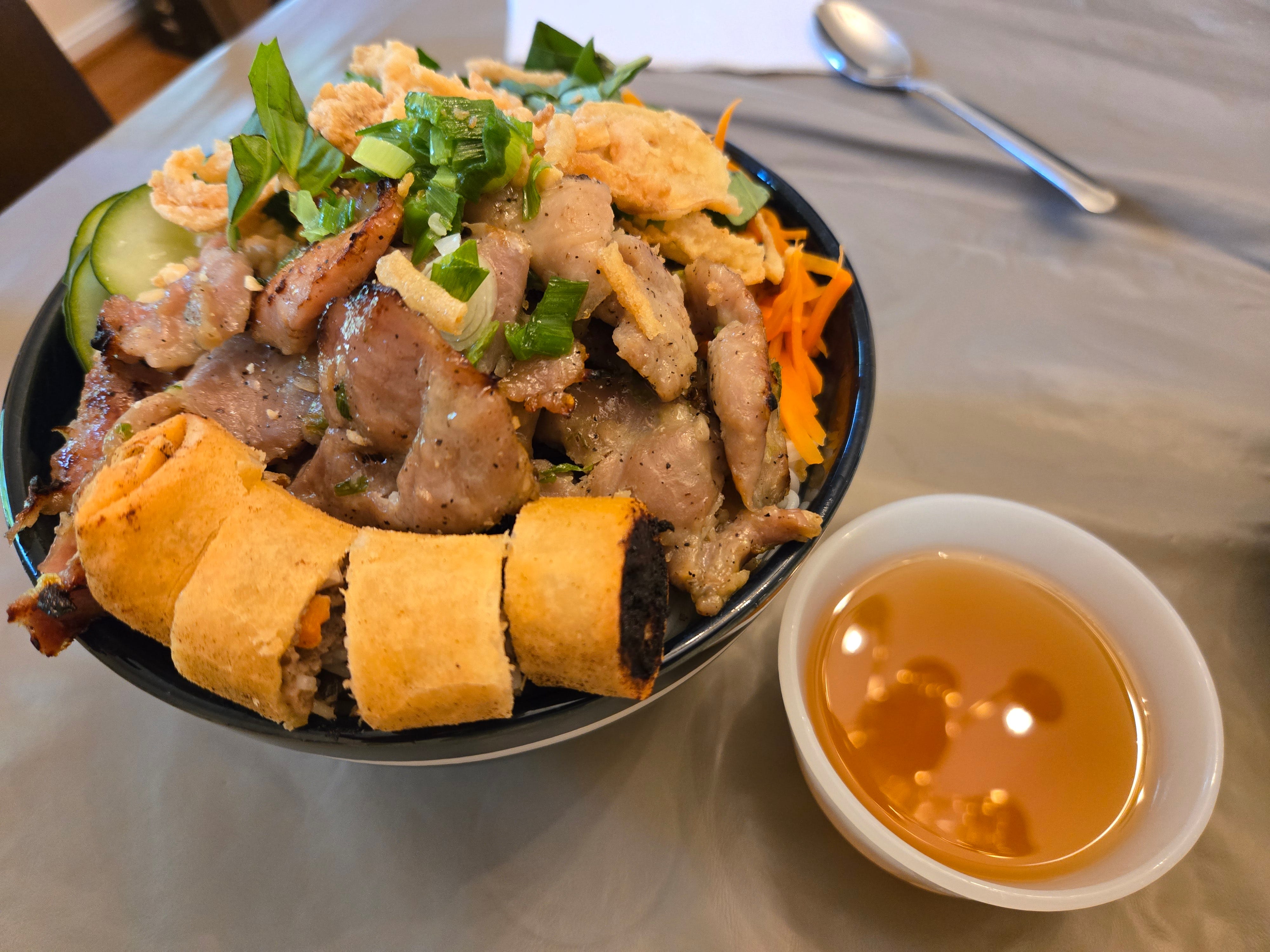
I’ll also show you my own version of this basic dish:
Related Reading: