
NIMBYism, "Enshittification," And Best Buy Hating Vintage Electronics
Economic concentration is an economic and social problem

I made the mistake of reading about Best Buy’s e-waste recycling program, because of a post I saw on a CRT TV collectors’ page on Facebook, and found this story on Reddit:
We had an In the box NES and Sega genesis some lady found in her attic and wanted to get rid of. One of the employees tried to take it. And my manager not wanting anyone to try and take it from the Gaylord walked into the warehouse. Opened the boxes and smashed both consoles.
He said he’d rather do that and hurt himself (he was a gamer himself he knew the value of them) then see someone be dumb and lose there job because they couldn’t help themselves and come to the warehouse and take it.
Also, there’s this infamous story.
I am very grateful I do not work in a retail store where I would have to go to prison for [redacted] not be allowed to take that home!
“Because he would hate to see someone lose their job.” It’s funny how close that is to “I’m hitting you because I love you,” yet how—because it’s happening within the bland structure of a big corporation—there’s no responsibility or intent anywhere. Nobody ever does anything. It’s “just following orders.” The rules are the rules, and the drones just execute them.1
I have trouble finding that little story anything other than an example of psychotic behavior, and for that matter, I have trouble distinguishing the normal behavior of corporate bosses in general from psychotic behavior. I also think of myself as a capitalist and a firm believer in private property, but policies like this test me.
Now look, I only care about this particular instance because I like old video games and electronics. But I also like history, and I also like the idea of old stuff with real value getting sold or collected and generating economic activity instead of going to a low-value recycling program. The entire e-waste recycling industry is a bit of a scam, and some of the stuff collected doesn’t even get recycled.
Remember the saying “Reduce, reuse, recycle”? These programs ban reuse and often do the recycling part questionably. So I consider them not just distasteful personally, but also dishonest, and not good environmental policy.
It strikes me as a kind of “does not compute” situation: a senseless result that you only get when there’s an error somewhere in the code. And you have to go find where and what the bug is so that you can get a result that makes sense.
Maybe the bug is liability of some sort (the lawyers tell us we could get sued if we have a salvage shelf where customers can leave stuff for other customers to take, because if someone leaves a TV and someone else throws out his back trying to haul it, he can sue us, blah blah blah. If we had a salvage rack like that, we’d need to pay more for insurance, blah blah blah.) Maybe the bug is some sort of strict interpretation of fiduciary responsibility or contract law. In other words, there may be a massive loss of human interest and economic activity downstream of trying to force life into these rigid boxes.
Maybe the bug is distant, detached corporate management where procedure replaces actual, you know, management2. Maybe the bug is simply the inveterate risk aversion of large institutions, which is one reason why economic concentration is not only an economic and political problem, but also a social problem.
Against any notion that saving one of the cool things brought in for recycling would be “stealing,” I find it much more accurate to say that Best Buy is stealing—from the economy, from people who value things, from the intangible heritage and distributed ownership of our own cultural and technological history. Otherwise, the concept of “stealing” has no moral content.
That gets more to my broader point here—that I find it more difficult to respect the law when I see these things happening. The law should represent doing the right thing. When doing the right thing (saving and/or capturing the value of cool old stuff) is foreclosed by the law, you lose trust and respect. Multiply this by millions of instances and millions of people.
And there’s also this aspect, of course: the irony of an electronics store that sells increasingly little in the way of real, tactile, interesting stuff now being in the business of collecting and destroying old things. It’s one of those things that doesn’t matter that much but feels darkly symbolic. Like a casino replacing Bethlehem Steel.
It is symbolic of an economy that conjures wealth on paper while extracting and destroying real value.
Rant over. So what the heck does this have to do with NIMBYism? Well, I’m thinking that, given the massive scale of so many new developments—corporate chains for retail tenants, huge block-sized residential structures—a lot of people intuit this development as being on a sort of distant or abstract scale.
Perhaps that gets described in disgruntled NIMBY language like “neighborhood character” or “too big” or “too many people,” but at least some of the time, there’s a real insight and a real legitimate critique there.
If “development” does in fact tend to mean “large-scale corporate-developer-driven projects,” then on some level people are right to be skeptical of that. Not because we don’t need more people or whatever, but because economic concentration is a bad thing.
I’m suggesting, in other words, that there may be a strain of NIMBYism that isn’t so much “Don’t build anything!” as it is a kind of over-broad insurance against the enshittifcation of the built environment. A way to try to keep some granularity and localism, to stop the communities we live in from becoming bland, rigid, distantly overseen, like big corporations.
What a company like Best Buy is doing—selling less and less stuff that people want, while running a scammy recycling program for stuff people do want—is the enshittifcation of brick-and-mortar retail. So that’s the connection: that there is a version of this with regard to development, and that people are wise to it, even if they don’t quite have the language to describe it precisely.
Now. The flip side is that just as economic concentration kills opportunity and bland-ifies daily life, so does NIMBYism, by pricing people and workers out of job-rich communities. New development may kill things that are visible: trees, a local business disrupted by construction, a historic structure, a general sense of quirky human interest in a local area.
What NIMBYism kills is not always visible. It is not as visible or visceral or outwardly absurd as a wild-eyed cartoon corporate drone sacrificially smashing a retro game system to protect his employees from themselves. But nonetheless, the shrinking of opportunity—which is what happens when we underbuild housing—kills opportunity.
Yes, I’m questioning my own argument, and saying that because the status quo also costs something, we should be cautious about how new development proceeds, but should generally favor it.
This question of defending the things you can see being destroyed with your own eyes, but at the cost of much greater but less visible and more diffuse destruction, is very tricky. If you look at it long enough, it all becomes a haze.
We have expressions to capture something like this: penny wise and pound foolish, strain at a gnat and swallow a camel. But the juxtaposition of a bad thing you can see being necessary to avoid much worse things you can’t see? That’s a tricky one.
Related Reading:
“We’re Rich, We Can’t Afford That”
Now, Folks, It’s Time For “Who Do You Trust!”
Whose Leftovers Are They Anyway?
Development and Open Space in Madison, NJ
Thank you for reading! Please consider upgrading to a paid subscription to help support this newsletter. You’ll get a weekly subscribers-only piece, plus full access to the archive: over 1,500 pieces and growing. And you’ll help ensure more like this!
It seems like replacing middle managers and maybe the entire command structure of corporations is a good use case for AI, since so little original thinking or discretion is involved!
The right answer from the boss is any of the following: 1) “Look, the fellow who brought this is would have been happy to let you keep it in his personal capacity, so his giving it to our recycling program was a clerical error. You’re lucky today!” 2) “Look, I can’t let you keep this because then our program becomes a personalized conflict of interest, and I can’t keep it for the same reason, but I’ll stick it outside the store with a little note so a lucky customer can grab it.” 3) “[Same reasoning as 2), so I’ll forget how this neat boxed game console got inside our store and I’ll drop it off at Goodwill on my way home so someone can enjoy it.”
Those would be human answers, there are no other acceptable or moral answers, and the fact that the policy apparently forbids these only indicts the policy and whatever led to its forcing this outcome. My view on this is G.K. Chesterton’s on the little girl’s hair.
See this, on someone suggesting that the guy with the boxed NES with the robot too, try to involve a higher-level manager to save the thing and do something cool like display it in the store or raffle it off?
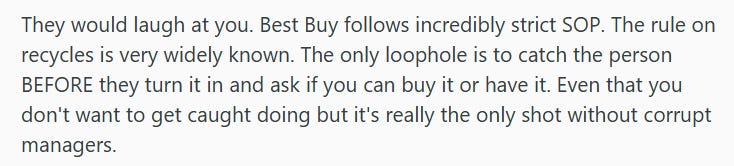
If “corrupt” means “using enough discretion to not behave in a morally sane manner,” well, like I said, we have a bug somewhere in the code.
And—it turns out the joke’s on the brainwashed goody two-shoes, because in the special case of the entire boxed NES set, Best Buy did in fact save it and display it at its HQ! (Which only shows that they are more culpable in every other case, because they do know how to do the right thing.)
This story about Best Buy isn't surprising. When I worked at Target two decades ago, there were three categories of damaged goods. One set were returned to the manufacturer (presumably to salvage parts), one category went to a salvage vendor to sell in discount/surplus type stores, and the third was to be thrown in the dumpster and destroyed. There were often things of value or use that we would argue to keep, but were not allowed to by policy. The manager had purview over the items to destroy and had to sign off that he/she crushed them and put them in the dumpster. (It was also a closed style dumpster, not one with an open top, so dumpster diving wasn't an option either).
So many useful things just crushed and sent to a landfill for no real reason...
Might your rant about stealing be a more general complaint about definition creep within corporate culture?