
Nostalgia and NIMBYism
Meeting our need for meaningful, enduring places


Today’s piece is a guest piece from fellow urbanist writer Andrew Burleson. I don’t think that Andrew’s argument here is an entire solution, just as he argues, in response to a recent piece of mine, that my original argument does not capture the whole story. There is probably no single answer to the question of preempting NIMBYism or arguing people out of it. But with his focus on place and placemaking in this essay, Andrew adds an important dimension to the discussion. Check out Andrew’s Substack here.
During high school, I lived in Round Rock, Texas, a suburb north of Austin. I’m not fond of the place—I moved out of Round Rock at age 18, and won’t be moving back. But my family still lives there, so I go back to visit fairly often.
To say that the city has changed is inadequate; Round Rock today is nearly unrecognizable compared to my experience living there 20 years ago. But a few particular changes stand out in my mind.
This is the Movies 8 theater in Round Rock, Texas. Or at least, it was.
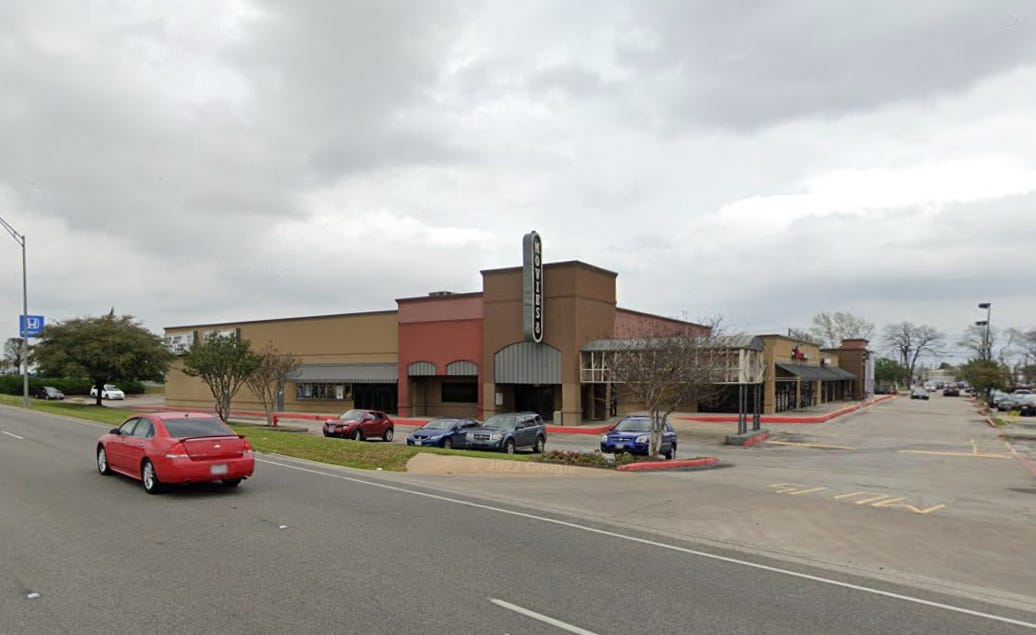
At some point after COVID, the theater went out of business, and has since been converted into Tyler’s, a shoe and clothing store. When I saw that the theater had gone out of business, I was upset and disappointed. I remember thinking, “They can’t close Movies 8!”
Another example: the building below was once the Little Red Wagon, a burger-joint sort of place. It closed in 2017, and became a kolache bakery.
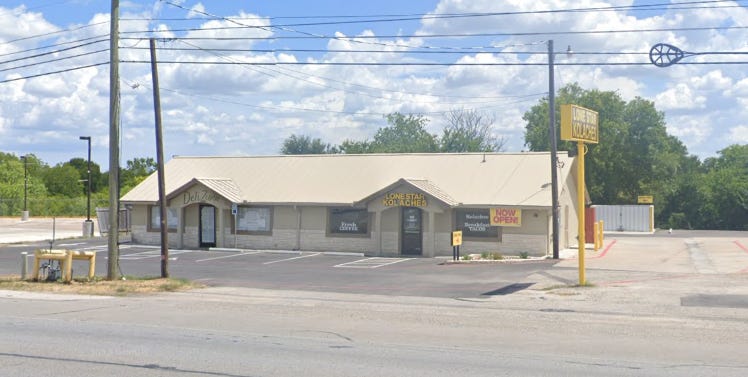
I only went to the Little Red Wagon a few times—I recall the burgers being so greasy that even as a high schooler I thought they must be terribly unhealthy. Nevertheless, I feel a sense of loss when I drive past and see that old business is gone.
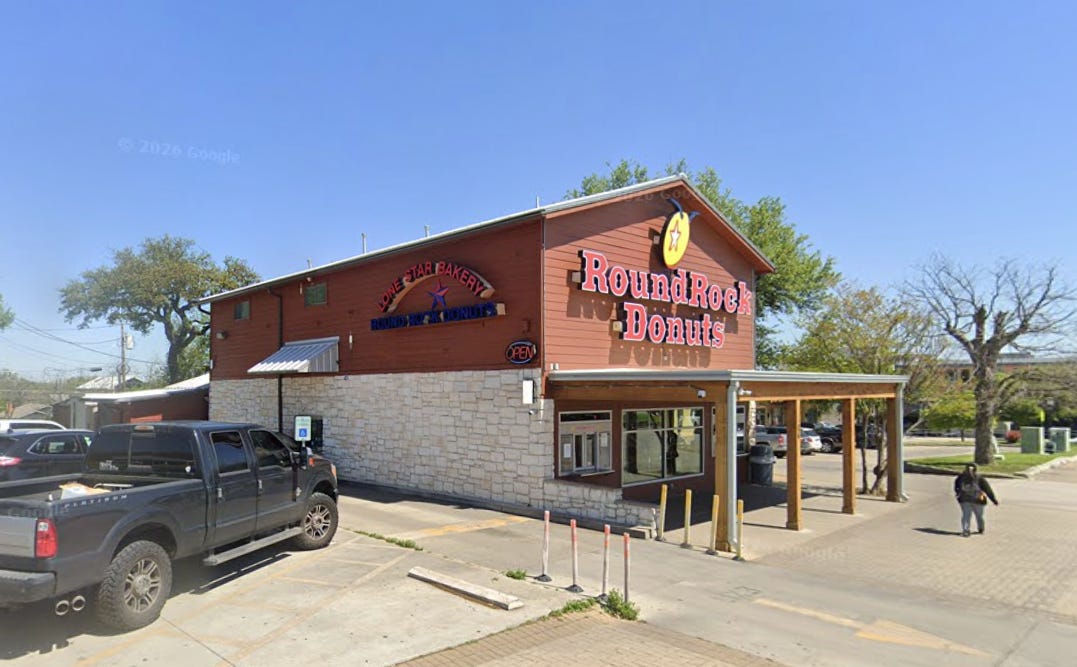
There’s no reasonable reason for me to feel this way. But even though I am the last person who should care, I do. When we go back to visit family, I find the only place left that I have any memory of is the Lone Star Bakery (aka Round Rock Donuts).
To be honest, I don’t even want to eat donuts. But I take my kids there nearly every time we visit my parents because…it’s all I have to share with them about the place I’m “from.”
All these thoughts came to my mind when reading Addison Del Mastro’s piece, “Nostalgia should not be locked behind NIMBYism.”
In that essay, Del Mastro was responding to a comment from Sonja Trauss, who described NIMBY groups as the only outlet people have to process grief about places changing:
Unfortunately, for a person who intellectually could be OK with some neighborhood change, but wants to get together with other to process their grief, the only available place is in the group that is organizing to stop the change. That’s where you’ll find neighbors who want to reminisce and validate your sadness.
I think there’s something to this notion that a lot of NIMBYism is effectively an outlet for normal, understandable grieving of change. It’s an insight that, once you begin to see it, you can’t unsee.
Shortly after reading Addison and Sonja’s thoughts, I saw this social media post, from Chris Nocera about a recent piece of his1, which almost exactly matched my reaction to Addison’s piece. Nocera writes:
After spending a weekend at home visiting my parents in Long Island, I couldn’t help but reminisce about the old stores that once graced our neighborhood and the milestones associated with them. I vividly recall buying my first bike at K-Mart, my college comforter at Bed, Bath, and Beyond, and my first suit at JC Penney. All these places are now gone, but they aren’t left vacant. In fact, they were leased up almost immediately. This made me curious about the current state of the retail industry.
While I think this diagnosis of NIMBYism being closely related to nostalgia is insightful, I also think the initial conclusions from Addison and Sonja were on the wrong track.
Addison responded to the nostalgia angle pragmatically:
What the pro-growth philosophy, broadly, really boils down to is not attacking the past, but rather something like this: Whatever we think of these old things and remember about them, they’re not necessarily viable as business enterprises anymore—which is what they always were—and so it’s time for what comes next. Not in a metaphysical sense, but in the nuts-and-bolts sense of allowing places to evolve as conditions and trends and demographics change. This means understanding that the past that we view as hallowed may be in some sense, but is also just, ultimately, what served people here in a previous time. It isn’t inherently more worthy than whatever does or will serve the people who are here now.
To this, I would say, “yes, and…”: pro-growth advocates certainly can and should try to both understand and honor the past, and that may help win over some fence-sitters. But I don’t think that will be sufficient to change the debate. There’s no amount of “the business model of Movies 8 just doesn’t make sense anymore” that will make me not grumpy about it having died. Even though I would probably never go back to see a movie there.
But my stronger reaction is to Sonja’s conclusion:
If we had unlimited resources, we would organize neutral neighborhood change grief circles, or some other kind of way for people to get together and just feel sad and move through it.
I think this response is understandable, but I think it’s fundamentally missing a deeper problem that the pro-housing/pro-growth movement needs to come to grips with: people arguably shouldn’t need to feel so much grief about the change of ordinary businesses. But we do feel that grief. Rather than see this as something people need to process and move past, we should take a moment to try to understand why they feel it in the first place.
Place matters. First, we have to understand why. To explain this, I’ll turn to this beautiful essay2 from Chris Arnade:
The simple summary of the last fifteen years of my work—ten focused on destitution in the U.S., five on walking the world—is that everyone needs to feel a valued member of something larger than themselves, hopefully something that is more than the material and will continue on after their death.
This is the same thesis of Bowling Alone—that physical community matters—but amended to say that for it to be genuinely fulfilling, the community should also be aligned with a purpose that is stable and transcends the physical world.
In my book I called these non-credentialed forms of meaning because they’re gifted to you at birth and so you don’t need to build a resume to be part of them. I identified four primary ones—family, place, faith, and your culture (more on this below). These are meaning-making institutions that you are born into, and you can stay a member of them for all of your life, unless you choose to leave or are ejected due to aberrant behavior. If these are working correctly (and they don’t always), then they provide everyone, regardless of talents, with a pathway to a dignified life.
Arnade looks not so much at places that are struggling with change caused by growth, but places that are dying. He writes about how difficult this attachment to place is for the highly educated and highly mobile people of the “front row” to understand:
It took me hundreds of interviews of people who had stayed for a lifetime in a town in open decay, that was crumbling around them, that by all I could measure had treated them badly, to understand how significant place can be.
When I asked them, “Why haven’t you moved?” the answers I received were a look of confusion, then a shake of the head that indicated that I was the one who was confused, and then a simple, “Because it is home.”….
When a direct question confuses someone because they don’t see it as a choice—certainly not something to be adjudicated in a spreadsheet—then you have discovered an epistemologically foundational belief. It rises from a small-g good (directional, but not intrinsic) to a capital-G Good (directional and an intrinsic part of life).
Place is still a capital-G Good for a large percentage of Americans, especially those in the back-row (low-educational attainment). Policymakers, especially in prior decades, have struggled to fully understand that because they are mostly members of the front-row, not attached to place in the same fundamental way.
If we properly understand that place is one of a few fundamental “meaning-making institutions” for humans, then we should be much less surprised when, for any given development project, some vocal minority of people will appear who oppose the change it represents.
The second point I want to make is that almost everyone in America lives in a post-war landscape that is nearly devoid of meaningful place. You could say that Americans are place-malnourished.
I’ll try to illustrate what I mean when I say that, because I know that even my own family wouldn’t understand what I mean. I love my family. They’re all highly educated and thoughtful people. But they’re also Texans, and Texans are uniquely place-blind because there are almost no places of consequence in the state of Texas.
This is not their fault! It’s difficult to have any sensory perception for something that does not exist in your environment. We Americans are a bit like cave fish whose eyes have withered away because we live in an environment where eyes aren’t useful.
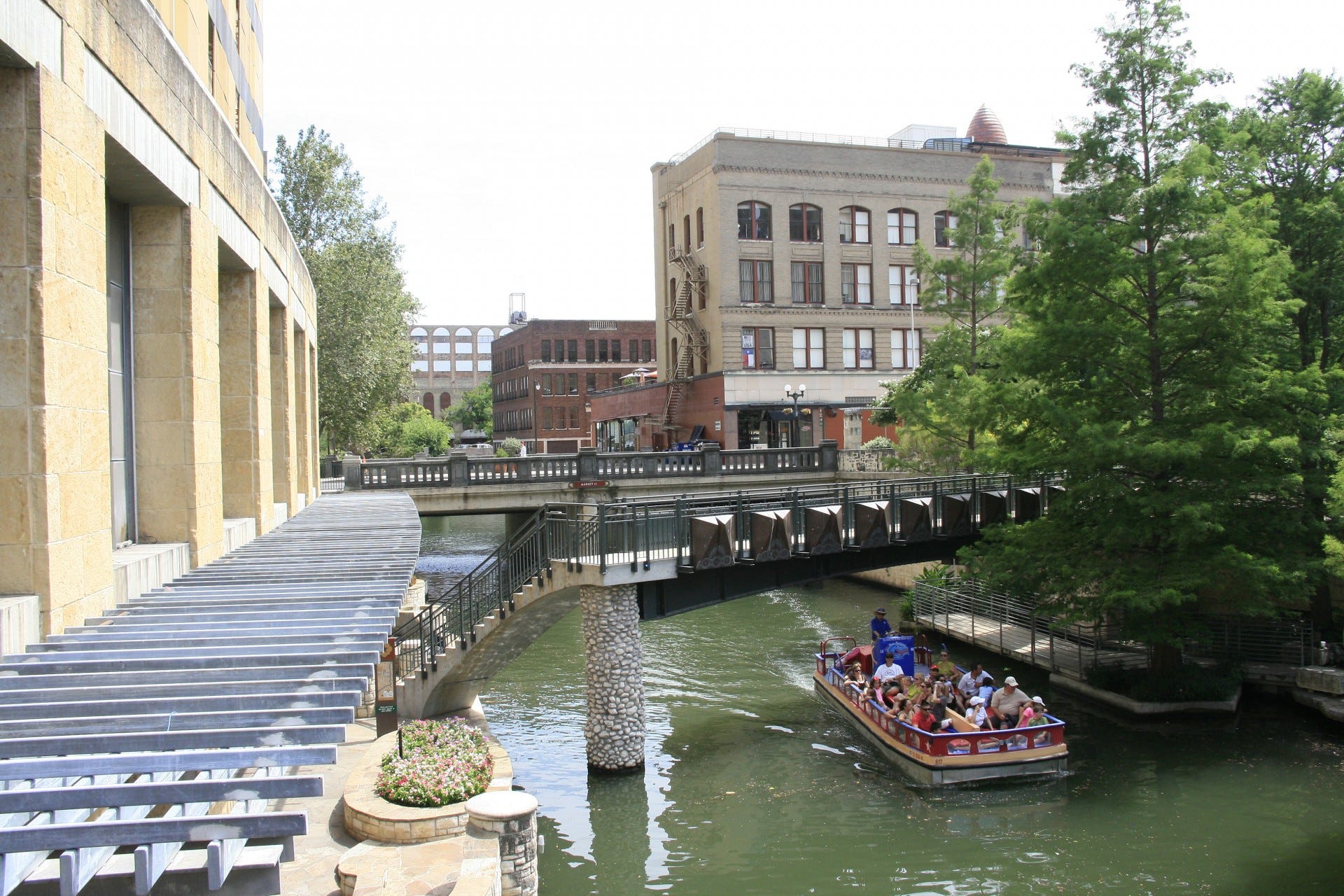
In Texas, the San Antonio Riverwalk is a place (image public domain, courtesy of Holly Chaffin):
More humbly, the Georgetown Square is a place (image credit LaCour, CC BY-SA 4.0):

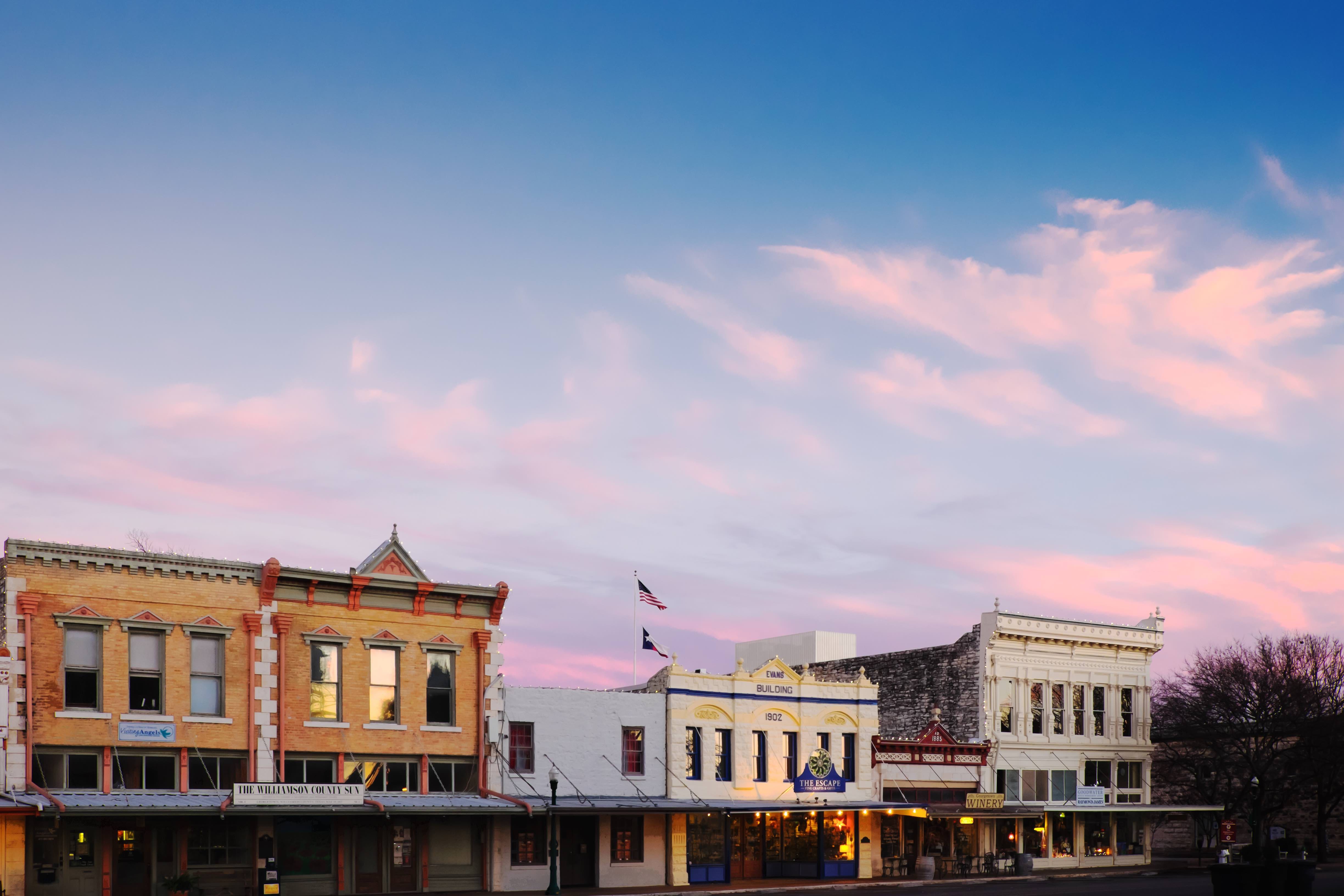
By contrast, almost everything in the state of Texas looks much more like this:
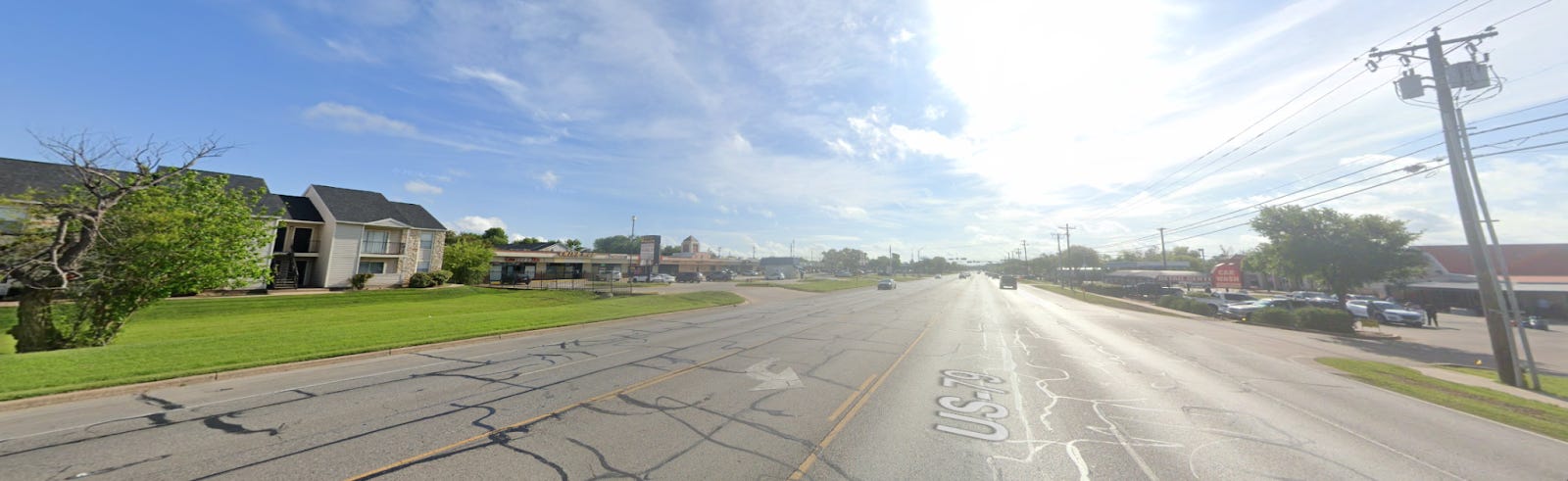
In that context, there is no communal space, no public space worth spending time in, or that you even can spend time in. It’s just liminal space that you pass through. Even when you live there, you don’t spend meaningful, social time outside. You travel in your transporter pod, enter the airlock on the front of your habitat, and then spend time inside, or perhaps in your private, enclosed backyard.
But humans have an innate need for place. So what happens is, we attach to what we have. Even when all we have are a few modest stores or restaurants.
Things like the Movies 8 theater. It’s not at all a thing worth saving—and yet, if somehow there had been a public process that asked me if I was okay with a shoe store replacing the theater, I’m pretty sure I would have said “We should keep the theater!” And I don’t live there anymore and have no rational reason to care.
We should not be surprised when people fight to “save” old buildings or businesses that weren’t even that great.
Repeating Sonja Trauss and Chris Arnade:
Sonja:
If we had unlimited resources, we would organize neutral neighborhood change grief circles, or some other kind of way for people to get together and just feel sad and move through it.
Chris:
Everyone needs to feel a valued member of something larger than themselves, hopefully something that is more than the material and will continue on after their death.
My contention is that pro-growth and pro-housing advocates should not fool themselves into thinking that there’s a path for “NIMBYs” motivated by nostalgia to just “grieve and get over it.” We need to understand that, to some extent, there’s a deeper human need that’s not being met.
In part, that means investing in institutions. If people have stronger, more durable institutional attachments, they’d have more room to accept change. Historically, people would be more attached to traditional institutions like churches and schools,3 but with church membership declining and schools closing, we shouldn’t be surprised that institutional attachment is weak. What could we do to keep churches healthy and schools open? If that isn’t feasible, are there alternatives, like libraries, museums, civic centers, etc. that we can invest in? How broadly accessible and inclusive can we make those institutions?
And while I think institutions are important, I also think that establishing and repairing institutions is difficult. I think it is actually easier to invest in place.
One way to think about this is that every neighborhood deserves a good Main Street close by. A good Main Street is a collection of businesses and institutions connected by a pleasant public street. That makes the place more resilient: individual businesses can come and go and buildings can even be replaced without fundamentally changing the experience of the place. As a result, people can safely be attached and anchored to that place writ large, and feel less threatened by evolution elsewhere, or by smaller changes within the place.
This is ultimately one of the reasons I think the YIMBY movement and the Congress for the New Urbanism need to connect more deeply. I don’t think that we can solve for housing in isolation—I think that in order to build a lot more housing, we need to get much better at creating new places, holistically.
The YIMBYs have brought tremendous energy to overcoming the barriers to housing. The next step in that evolution is to deeply understand placemaking so that we can leverage every new housing project as an opportunity to make the surrounding community better.
The more that we can create places worth caring about, the more we can meet people’s fundamental need for better, healthier anchors of continuity to hold on to. Then they can reminisce about the good old days and feel some nostalgia, without feeling threatened by change. I think that’s the most enduring path to unlock a healthier, more dynamic, and more responsive built environment.
Related Reading:
Northern Virginia Is a Real Place, Revisited
What If You’re the Placeless One?
Thank you for reading! Please consider upgrading to a paid subscription to help support this newsletter. You’ll get a weekly subscribers-only piece, plus full access to the archive: over 1,500 pieces and growing. And you’ll help ensure more like this!
Nocera was actually writing about how, for certain businesses, physical retail is “all they’ve got”; they’ve survived by serving customers who want to shop in person, and making that experience great. But at first glance it made me think of my life in Round Rock: that a handful of local businesses were really the only things Round Rock had, and just a few of them dying off made the whole town essentially feel “gone” to my memory.
Arnade’s emphasis on places that are struggling with disinvestment rather than growth is important, because many more places are struggling with disinvestment rather than growth.
Jerusalem Demsas made similar arguments in her recent piece, “Shoot the Messenger.” She points out that most of the “messenger class,” or what Arnade would call “the front row,” lives in the minority of areas that are gentrifying, while the majority of the country is struggling from disinvestment, not growth. That disconnect between lived experience and broad reality makes it hard for people in the “messenger class” to understand, communicate with, and represent the interests of the broad majority.
The “Front Row” people almost all have the experience of going to a major university, and in the U.S. our major universities are among the strongest and most durable institutions we have. That means we almost certainly have an advantage in terms of “durable institutional attachment” over the majority of people. We should not take that for granted.
 | A guest post by
|
Thanks for the invitation, Addison! It was fun to share a guest piece.
Good article, thanks. One angle I think we need to consider is that attachment to 'place' is not constant over time and appears to be stronger than it used to be (at least in the US). We're not as restless as once were! I saw in the NYT that the share of Americans who move each year is half what it was in the 1950s. Maybe some of it is that other attachments (to religion or school or a social club, as mentioned) have weakened, so place is what remains. But I think the "abundance" folks are correct that some of it is that it's prohibitively costly to move to the locations that have the most economic opportunity. Nostalgia is not a bad thing, but forced immobility is.