
Parking As Access, Or Urbanist Ideals Meet Real Life
What should you think when urbanism really does make your life harder?

So my wife and I had a kind of funny experience the other weekend that made me think again about the whole question of parking, driving, walkability, etc. I wrote about that here, with the headline “Do I Have A Right To Visit A Business?”
We were trying to take some tacos from a taco truck (which I also wrote about) to a brewery, along Route 28 in Manassas Park, Virginia. This is one of those older “stroad” corridors with small suburban homes and some newer developments off the main road, and a lot of older, smaller commercial buildings somewhat close to the road, with relatively small parking lots (there are also a few big shopping centers, which are also on the old side).
Overall it’s an early postwar kind of landscape that hasn’t aged all that well, and is neither particularly drivable, nor very walkable. Nonetheless, I find these sorts of landscapes some of the most interesting, because they’ve been reinvented, often, by immigrant business owners, in this case largely Latinos.
Anyway, we got our tacos from the taco truck sandwiched between a tire shop and a vape shop, and then headed to the brewery. Its property is attached to a Sheetz gas station and a building that houses a few shops and restaurants. Many of the parking spaces are specifically for one of the businesses in the cluster. The main brewery parking area was completely full. Their lot is also long and narrow—so narrow I couldn’t turn around, so I had to reverse the whole way out (past a truck trying to get it), through the gas station driveway, and then back out onto 28.
The brewery does have overflow parking in a business just down 28, so we drove over there, and that was empty. Great! The distance wasn’t much, so we got out to walk back, only to realize that because of the snow mounds from our recent snowstorm, it was impossible to walk from the overflow property, up a small staircase, through a small strip mall parking lot, and finally onto the brewery property. The staircase wasn’t even visible, and the mound was too tall to climb. The only way to walk back would have been to walk along 28 itself, which doesn’t even have a shoulder along this stretch.
So we walked back to the car, drove home, ate our cold tacos, and resolved to only ever visit craft breweries with adequate parking—like the one we went that afternoon in an aging strip plaza in the City of Fairfax with an oversized and barely-ever-full lot.
It also turned out that what we thought was the overflow was actually the lot for the business on that property, a small event center, and we weren’t technically supposed to park even there. The overflow is the small lot above the event center, which would make the walk even longer.
So that you can visualize what I’m talking about, here’s a satellite image. The brewery is the red-roofed building towards the middle here; the overflow lot is the small lot at the very top right:
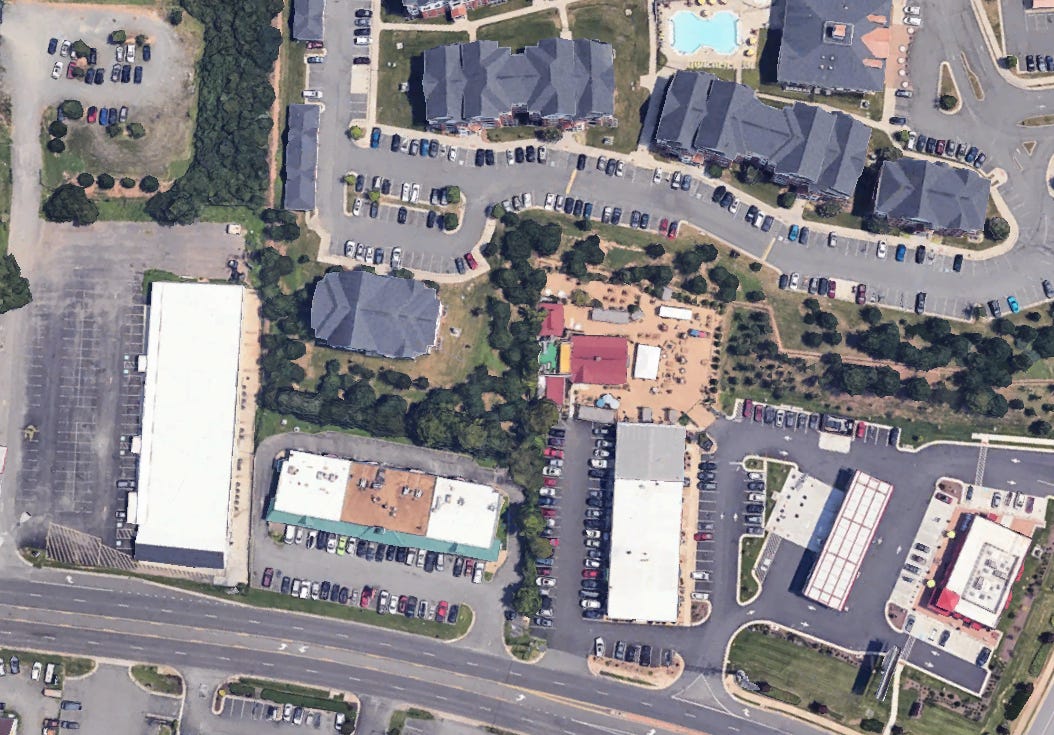
I found this all rather amusing, because the urbanist in me is supposed to love this sort of thing. Here’s a business in the middle of suburbia, thriving despite a limited parking lot, proving that you don’t need more than enough space for motorists to succeed economically. But to remedy their tight parking situation, they made a deal with an adjacent property with different peak times or extra capacity to take their overflow. It’s thinking outside the box; applying a little bit of the logic of an urban block to a highway commercial strip. And it works!
Yet in practice, it’s stressful, uncomfortable, even a little scary. It starts the outing off with a bad impression. You understand why minimum parking ordinances became the law of the land: otherwise, there simply isn’t room for all the cars, and in a place like this, there isn’t any other way to even get there. There are no Metro stops; there are no public parking garages every few blocks.
And even if the path back to the brewery had not been obstructed with the snow—obviously, a special case that I don’t hold against them—because of the way each property is islanded by asphalt or trees or landscaping, there isn’t any natural way to walk back.
The raw distance would be two or three blocks in a town or a city, which is nothing, really. It feels natural in that setting. Here, it feels strange. You feel exposed along a highway, or alone in an expanse of blacktop. You kind of wonder why you’re going to all this trouble when there are a million places you go with enough parking to not even have to spare a conscious thought on the matter.
I suppose my observation here is that merely making driving and/or parking difficult doesn’t necessarily do anything for “urbanism,” writ large. Walkability is not the absence of cars; fewer cars make it easier and safer to walk, but at some point it’s also a design question. Built environments like this, where walkability was at most a back-burner concern, are difficult to render walkable without changes in the connections between the properties, or sidewalk widening, or simply wholesale redevelopment.
More abstractly, I find that no matter what my urbanist principles are, when I’m actually the driver who can’t find a parking space, I feel as if I’m being wronged. I don’t literally think this, but I think a lot of motorists kind of implicitly do, and I suppose on some level I implicitly do too: because, in suburbia, the car is inseparable from access, and driving is impossible without parking, businesses which don’t provide ample parking are engaging in a kind of discrimination.
In other words, to be a motorist in suburbia is immutable or unchosen, and therefore is analogous to race or sex. To serve the public is the same thing as accommodating their private automobiles, and therefore the accommodation of sufficient parking is a matter of equal access and civil rights. I think most suburbanites/frequent drivers think of “motorist” as closer to “white” or “black” than to, say, “owner of a television” or “owner of an electric toothbrush.” And they therefore have no real mental framework to understand the idea of reducing parking availability except as an invidious attack on drivers. That, at least, is the unpacked set of ideas going on inside a lot of people’s heads, I think.
And much as I write this rather tongue in cheek with regard to my own beliefs, nonetheless some part of me really feels it. When I say urbanism requires humility, this is what I mean. At the heart of urbanism is a kind of philosophical pluralism that frankly I think some people find threatening. It requires the humility to accept that not everything is or must be for you; that if a business can survive on meager parking, then obviously there is some way to square this circle, and I should either figure out how, or take my business somewhere else, while not begrudging the places that succeed without catering to me.
That’s hard to do. It feels like refusing to have self-respect or refusing to stand up for yourself. And yet I know that this pluralism is correct. And furthermore, in this particular example, it actually hurts access and hurts business overall to require every individual enterprise to have sufficient parking for peak times.
I think we think of the car as a kind of free lunch, a speed or mobility hack. Of course, in some ways it is—it really is fast, and it really does facilitate mobility. But we don’t truly appreciate what it takes, in terms of space and public expenditure and opportunity cost, to accommodate cars.
Someone left a comment on one of pieces once that I thought was really insightful: something to the effect of, the problem with cars is that they must accommodated everywhere they can go. Or as I like to put it now, driving is the freedom to move, but parking is the freedom to stop. The irony is that parking takes up a tremendous amount of space, and imposes real costs on businesses. The easier it is to park, the less there is to park for.
Nonetheless, as my experience with the brewery illustrates, there really are examples in which many regular people will find that “urbanism” is a thing you sacrifice for: a set of principles you agree with enough to choose to make your own life a little bit worse. Experiencing your world and your mobility via a car makes it very, very difficult to think of urbanism any other way.
That, of course, is part of the problem.
Related Reading:
Maybe Cities Aren’t A Beautiful Inconvenience
Fifty Million Private Realms Might Be Wrong
That Damned Elusive Parking Spot
Thank you for reading! Please consider upgrading to a paid subscription to help support this newsletter. You’ll get a weekly subscribers-only piece, plus full access to the archive: over 1,500 pieces and growing. And you’ll help ensure more like this!
Some breweries get the food truck to park out front so that they don’t have to run a kitchen. I love that model.
I think this is why I find the "pluralism" angle so important: there is a need to accept that there's a cost for the _inherent good_ of making things that work for a broad group of people. Granted, I think *once you get to that pluralistic point* you tend to have a world that's better for almost everyone, but you need some extra oomph to break out of the local equilibria of selfish extraction because that's what human nature will settle for.
I think all of the theory here is still absolutely right (free parking is a massive subsidy that distorts demand, "windshield bias" leads to roads that are plowed every hour while sidewalks have to wait until the snow-packed-to-ice melts in the sun) but you're right that in the moment that theory doesn't tend to count for much unless you've got a supernaturally strong commitment to the cause, heh. More seriously, I think this is why the future of urbanism has to be communities doing some kind of "tactical" or even "symbolic" action together, you need external visibility and internal solidarity to overcome the ruts you mention.