
We All Hop For IHOP
What Do You Think You're Looking At? #273

This IHOP along Route 22 in North Plainfield, New Jersey has been there ever since I was a kid. We often used to go shopping along this corridor, one of central Jersey’s primary commercial strips. I’ve mentioned Route 22 many times, and I fondly remember those drives, along a highway that was a fascinating, transitional mix of shiny new big-box stores and old roadside Americana.
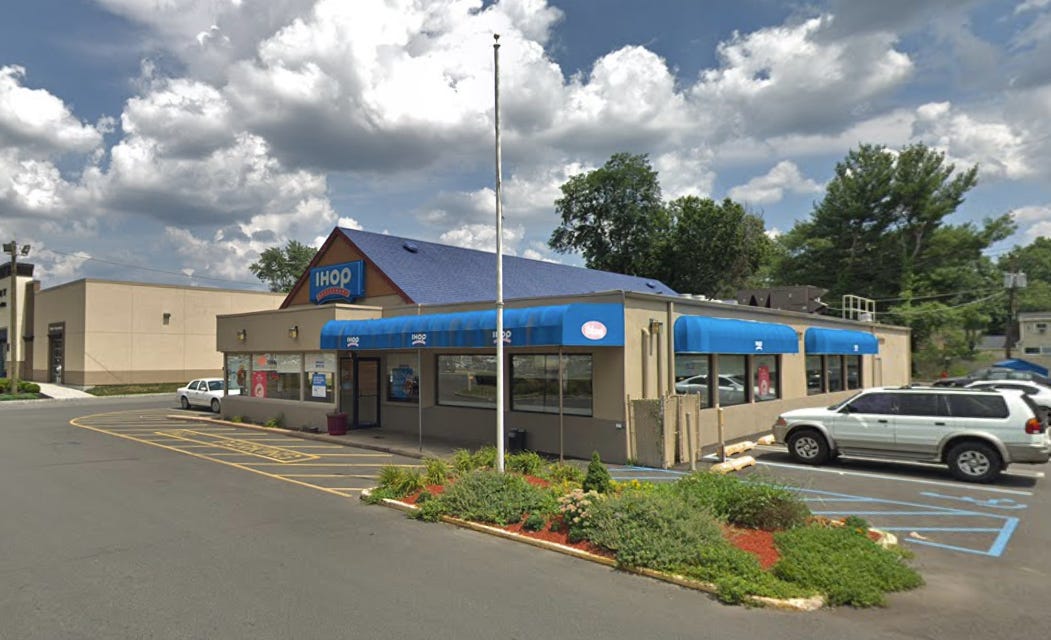
Anyway, this looks like a classic-ish IHOP that retains the A-frame look but is a bit modernized. I’d always assumed it was either a one-off design or a transitional building type between the classic A-frame and the modern square-ish buildings the company uses now.
Now you probably know what a classic A-frame IHOP looks like. But if you don’t, here’s one in the Ballston neighborhood of Arlington, Virginia. It even has the original sign! There are lots of these buildings still standing, but not that many are still IHOPs, so this is pretty neat (my photo, not Google Maps):
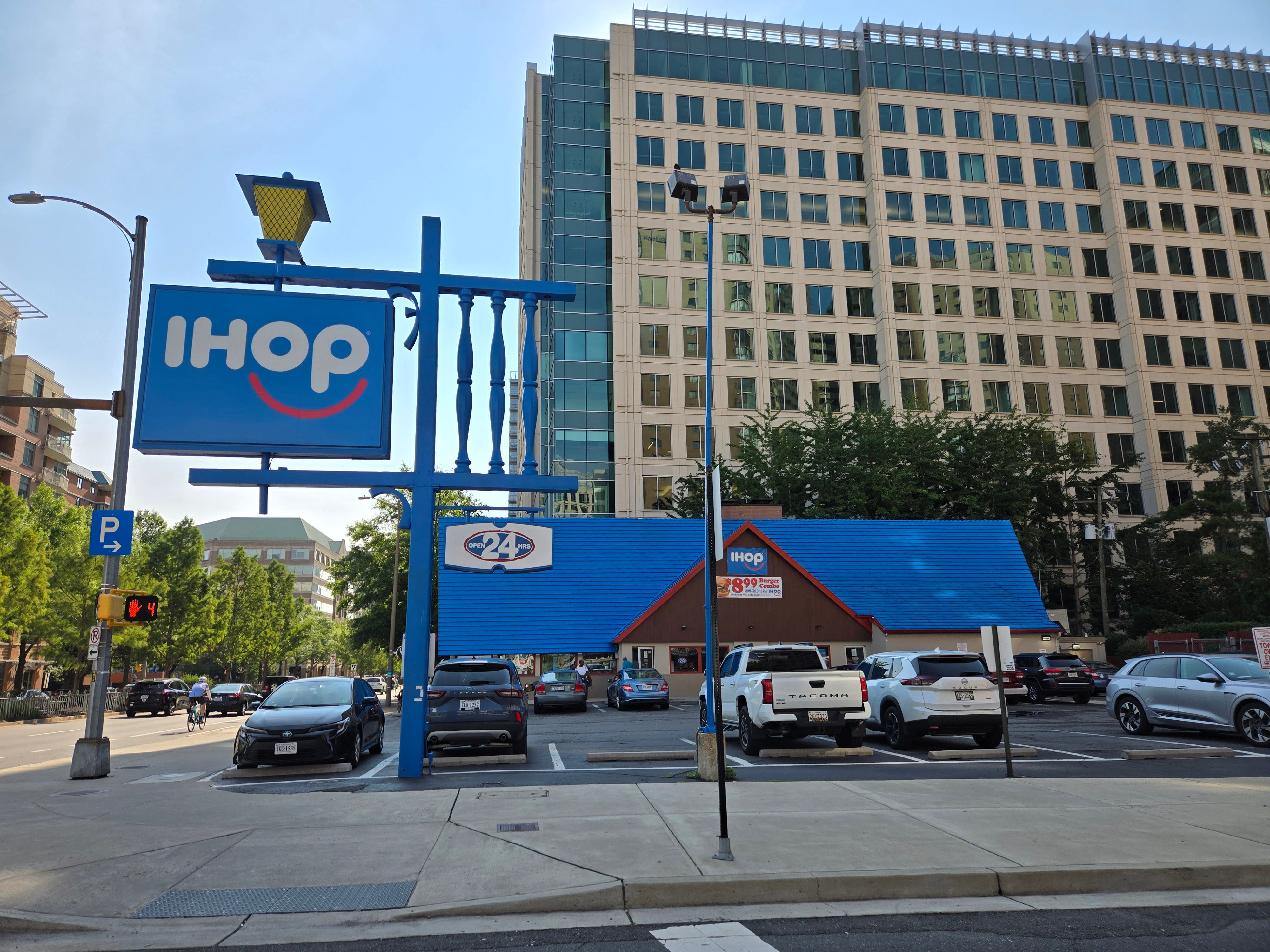
So that North Plainfield location doesn’t look quite like an IHOP, does it?
I was curious if I could find out when it was built or opened, and so I dove into online newspaper archives. Serendipitously, the newspaper that covered the area from Plainfield to Bridgewater covered local business news very heavily, and so it is possible to trace most or all of the history of a lot of buildings/businesses along Route 22.
An April 1970 edition features a hiring ad for a Gino’s restaurant—a fast food chain which served burgers and was also the licensed distributor for KFC chicken in some markets—in the Great Eastern Shopping Center. (This is what the shopping center the IHOP is in was once called; its anchor store was an early discount department store called Great Eastern. The anchor is now a not-so-different Costco, but the Great Eastern building is no longer standing.)
A January 1980 article, on the arrival of K-Mart to the shopping center to replace the then-vacant Great Eastern building, notes that there were no businesses left on the property except for a liquor store and a Gino’s restaurant. And in September 1982, the North Plainfield Gino’s was converted to a Roy Rogers. During these years and some years after, there are no recorded references to an IHOP restaurant in North Plainfield, and there weren’t many other spots in that shopping center where an almost certainly standalone restaurant could have been.
Of course, I’m not mentioning those newspaper clippings for nothing, so you’ve probably guessed that the North Plainfield IHOP was not, in fact, always an IHOP. However, in its current state, it doesn’t exactly look like any other chain’s building.
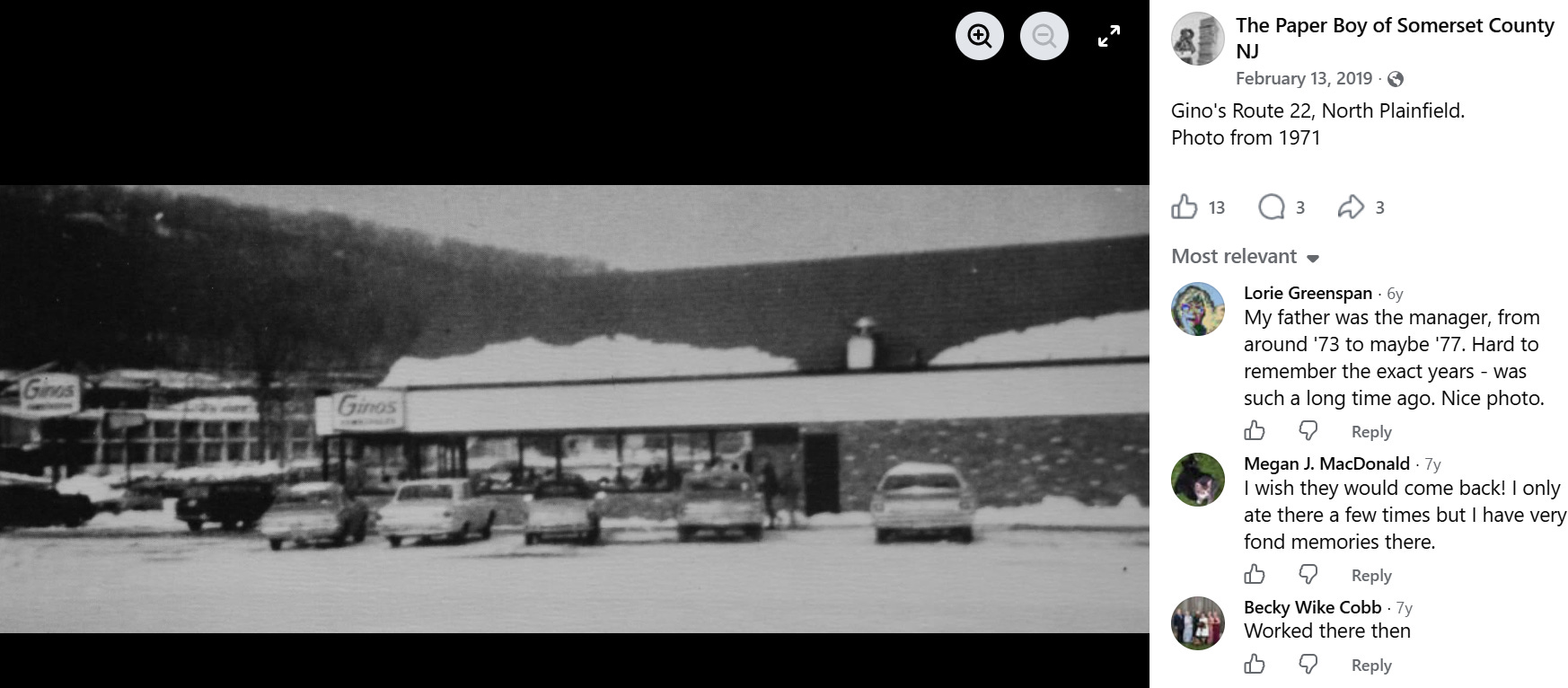
It used to, though. That IHOP did in fact begin life as a Gino’s fast food restaurant! From a Facebook page, a 1971 photo:
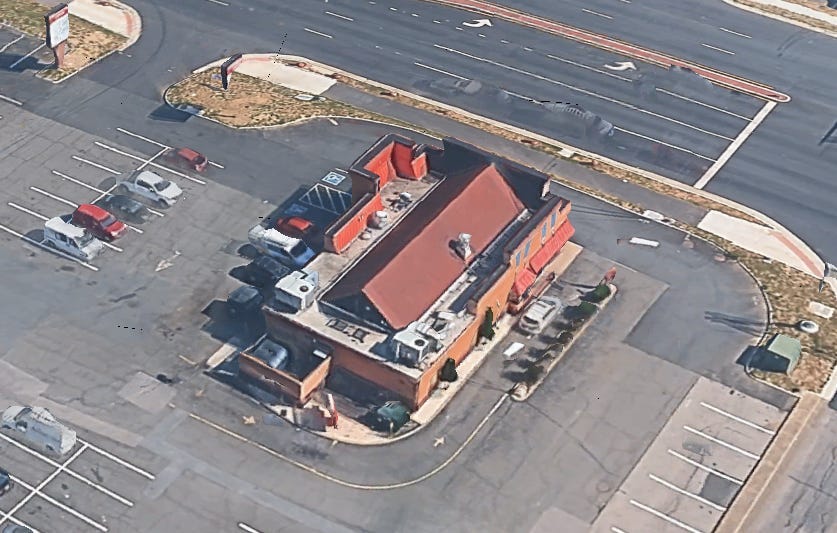
An illustrative aerial from 1987:
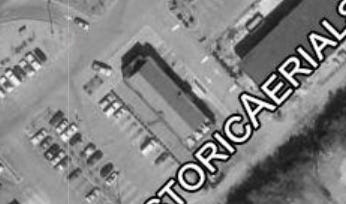
This was built, probably in early 1970. It’s a little tough to tell from those images, but their brand-centric building was a long, red-roofed, steeply peaked A-frame-ish structure. I wrote about an old Gino’s in Woodbridge, Virginia here, which was converted into a Popeyes. On that building, you can see the original Gino’s roof, which was simply blocked by the new facade. This is a clearer illustration of what a Gino’s building would have actually looked like:
What happened in the case of the IHOP, however, is even more interesting than a wrap/re-facade. Here is the satellite view of the IHOP today:
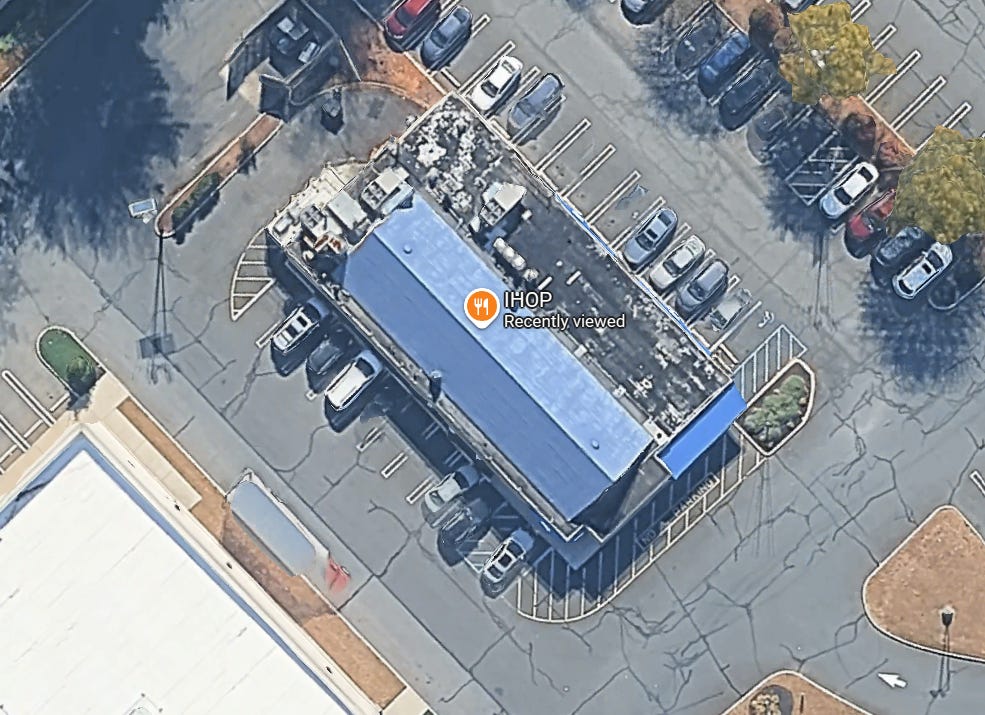
The building was almost doubled in width, with the right-facing (in this orientation) wall of the Gino’s taken down or mostly removed to make a more normal sit-down restaurant. Based on the interior photos, it does look like the inner dividing wall is exactly where the original exterior wall was, so that inner wall may well be the original modified exterior! (In that photo, the original wall would have been the wall on the right-hand side.
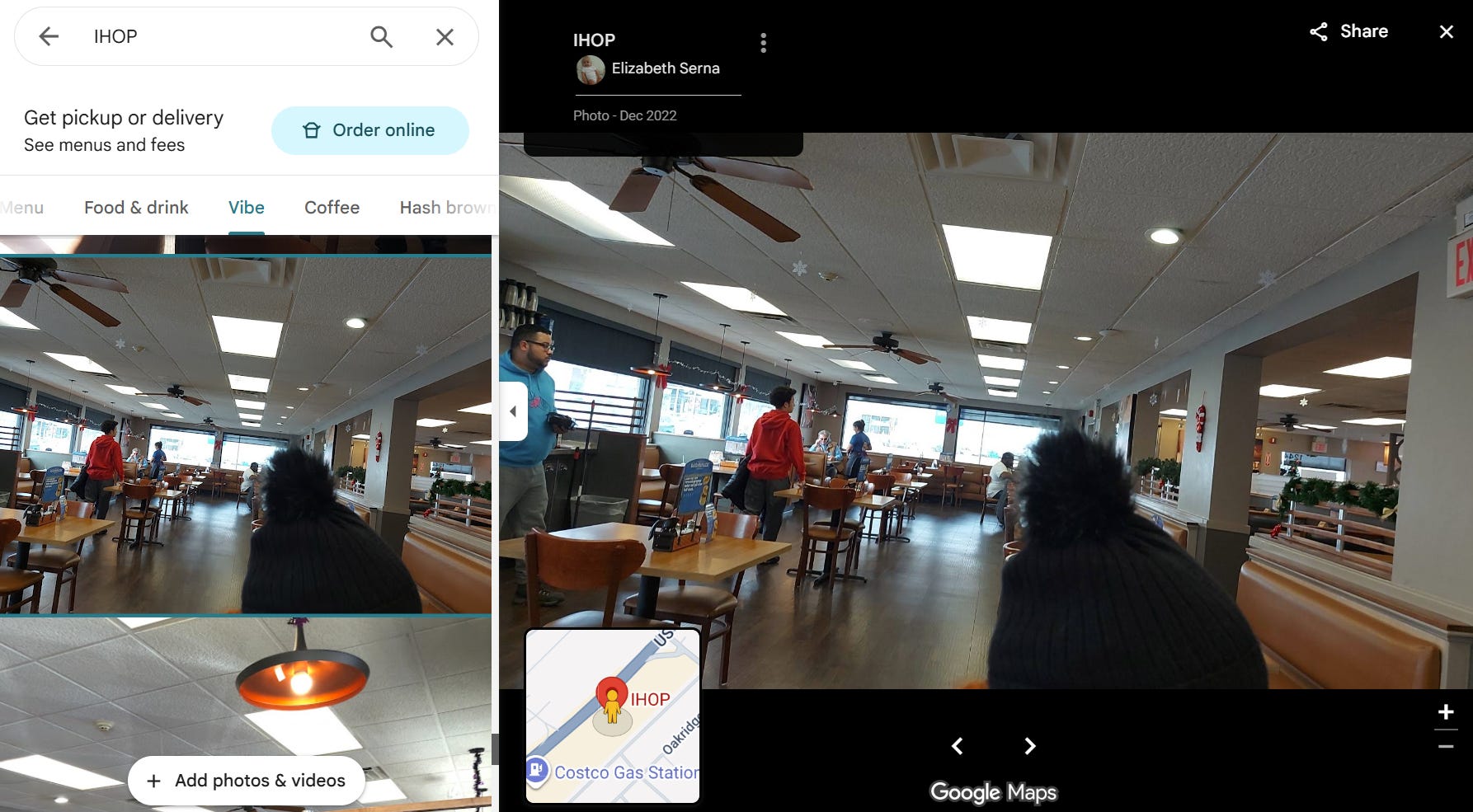
That is one of the weirder conversions I’ve found; it’s not that common for a building to swallow or enclose a preexisting structure. (Though I have covered a couple, here and here, and I always find them really fun.)
I noted previously an astute comment from a reader on these heavy conversion jobs—it was a comment on this edition of What Do You Think You’re Looking At?, on a heavily modified Howard Johnson’s building—who suggested they might have been done to avoid demolition and building permits on a new construction job, not because the actual job itself is cheaper than a new build. I don’t know, but that seems plausible. On the other hand, it isn’t that big a job to extend a building, it’s just a pretty uncommon thing to see on a conversion from one trademark brand building to (almost) another.
I guess that’s why I like this one, because the Gino’s trademark building element works very well, with the blue roof, to suggest IHOP’s own, completely unrelated trademark look. (Although by the time this IHOP opened, I believe in the 1990s, they were no longer building new A-frames.)
Anyway, I just love these little deep cuts of local history, and how they capture the bigger process of incrementally transforming the canvas of the space we live in together.
Related Reading:
What a fun piece! I imagine the IHOP folks must’ve been delighted to find the Gino’s building—so that got a retro IHOP-ish without having to build it.
Sorry couldn't disagree more. I have yet to see an IHOP in a non-car-dependent context.
I prefer to support local businesses that are built into the fabric of the community as well as the infrastructure of places where people are prioritized, not cars.. Thank you very much.