

I’m on Virginia State Route 28, driving through Manassas and its neighboring town, Manassas Park. Most folks who aren’t from here probably know Manassas as a Civil War battle. Maybe as a historic town.
Civil War heritage site and historic old town it is. It’s also a good place to find great tacos.
My journey starts at the beginning of the main commercial strip, near a microbrewery that sits on the property of what was once a racing-pigeon farm, and ends as the highway slims down and becomes the Old Town Manassas main street. This commercial strip is about four miles that look like any place in America. Aging late-midcentury roadside suburban architecture, utterly dependent on cars, and worse for wear.
But I find it striking. Places like this were at one time the newest, shiniest communities in America, with all of the modern postwar comforts. And today, they defy our inherited conceptions of suburbia.
Those who want suburbia to remain the domain of the affluent and upper-class may find suburban Manassas and Manassas Park too rundown and too poor. Those who love city life and support the redevelopment of aging suburbs may look askance at the dismal land use, the preponderance of parking lots, and the near-absence of public transit.
I admit those faults—would you want to walk on a sidewalk sandwiched between a highway and a retaining wall?—and while I’m happy that suburbia is open to people of all incomes and races, I also acknowledge that these places aren’t the most aesthetically pleasing.
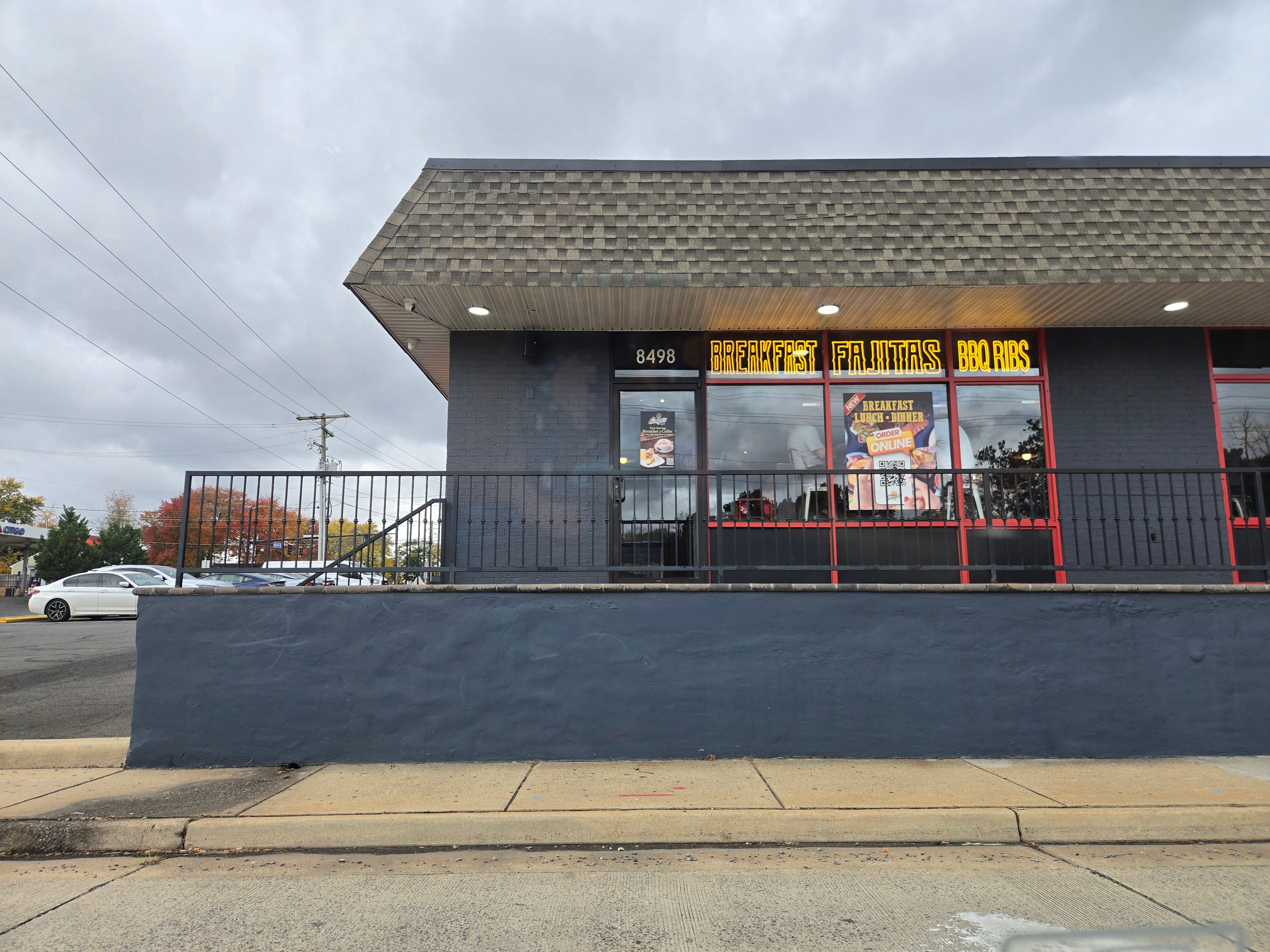
But we sometimes imagine that the world is bounded by our ability to fully see it. This Manassas commercial strip is the kind of place for which we have not yet developed a language or an understanding. We don’t have a category for them. They are physically deteriorated, but they are not blighted. They are heavily populated and buzzing with commercial activity.
This commercial strip, and its adjacent residential neighborhoods, is probably most accurately understood not as a disorderly collection of deteriorating properties, but as an ethnic neighborhood, in the Chinatown or Little Italy mold.
Those old urban immigrant neighborhoods, though still lived in, have largely become tourist attractions or cultural curiosities—given a place in the American story they were not given in their heyday. They are no longer the sort of place where new immigrants actually begin their lives in America.
Had large numbers of Mexican and Latin American immigrants settled in American cities in the late 19th century, we’d have quaint old “Latin Towns” or “Little Mexicos” instead of legacy Little Italies and Chinatowns. Conversely, if Italian or Chinese immigrants were arriving today in the numbers they once did, they would probably be settling in the poorer and somewhat cast-off corners of suburbia. These places are performing, right now, a social and economic function analogous to one we already know how to recognize and celebrate in its historic form.
But for whatever reason—from the fact that suburban, car-oriented landscapes deteriorate rather than age gracefully, to the staying power of a cultural image, to, sadly, ethnic or racial animus—this recognition of rundown suburban commercial strips as cohesive, functional, even successful immigrant neighborhoods is not common, outside of people who take a particular interest in such things.
The closest this phenomenon has gotten to mainstream is probably the bit of food-critic advice that the best and cheapest international food is found in a rundown strip mall. But why that is, and what it signifies, is not yet commonly understood or appreciated.
We should not wait until these places pass into the realm of “history,” remembered on our own terms and not actually experienced, to fully see and appreciate them. And we should work, right now, to see the spirit of these places, laboring beneath their form.
This four-mile stretch of highway is one of those “Little Mexico” neighborhoods—or “Little El Salvador,” or some other name which doesn’t discriminate by country of origin. Manassas and Manassas Park are both roughly 45 percent Hispanic or Latino. And because people tend to self-sort by class if not ethnicity, some pockets of these towns are much more or less Hispanic.
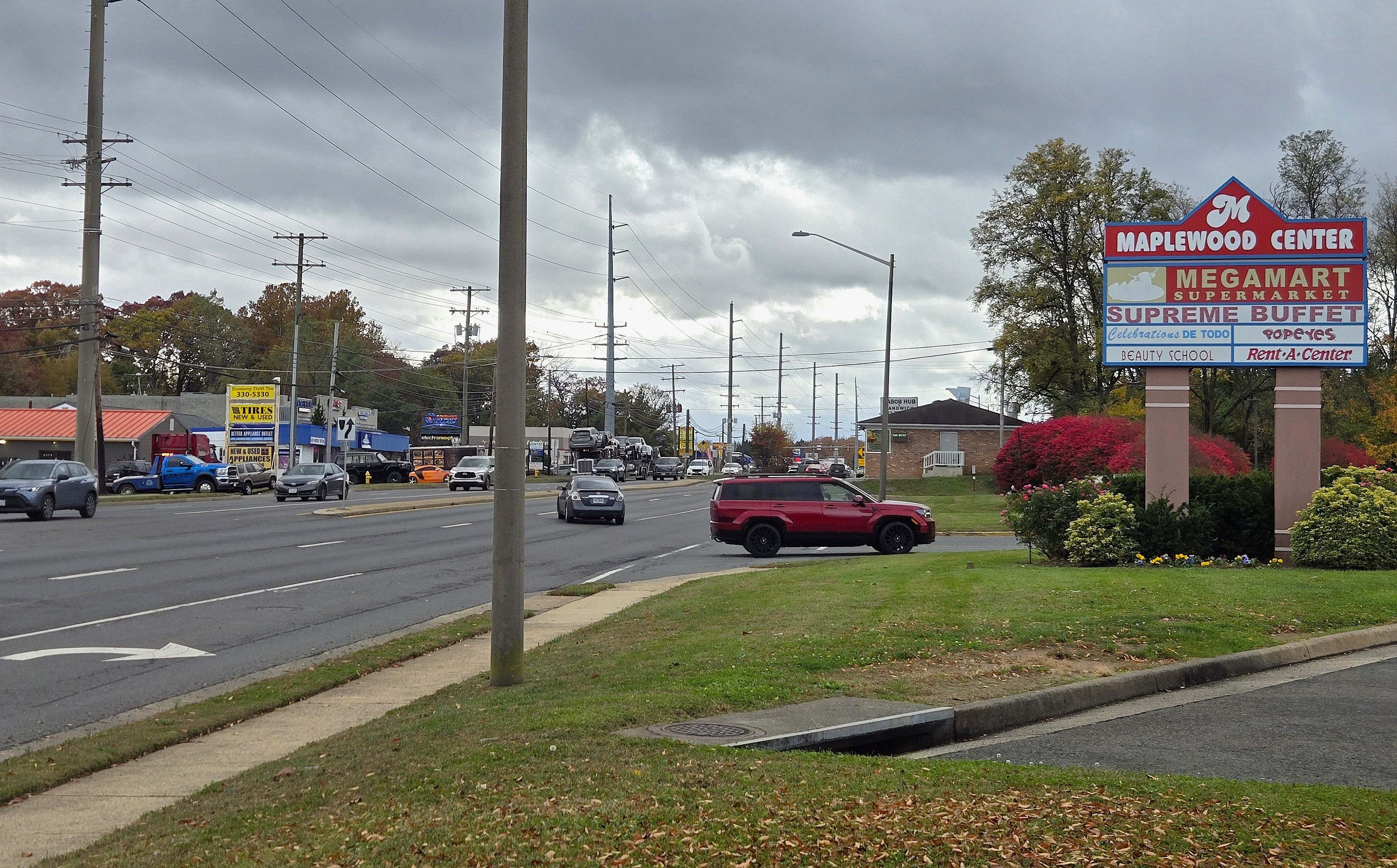
I first stopped to take a look at the Megamart, a regional Hispanic grocery chain. The entrances have signs saying no photos or cameras. I complied, so I’ll just tell you what it looks like. It’s an old retail space, but well maintained, reminiscent of a Kmart interior.
There’s a food court with seating, a huge bakery display, the walls around the produce section festooned with piñatas for sale. In little spaces in the front, there are a few tiny businesses, including a sports jerseys and shoe store, and a mattress and bed store.
Out in the parking lot, there were a lot of folks sitting in cars or work vans, maybe waiting for a job or taking a break.
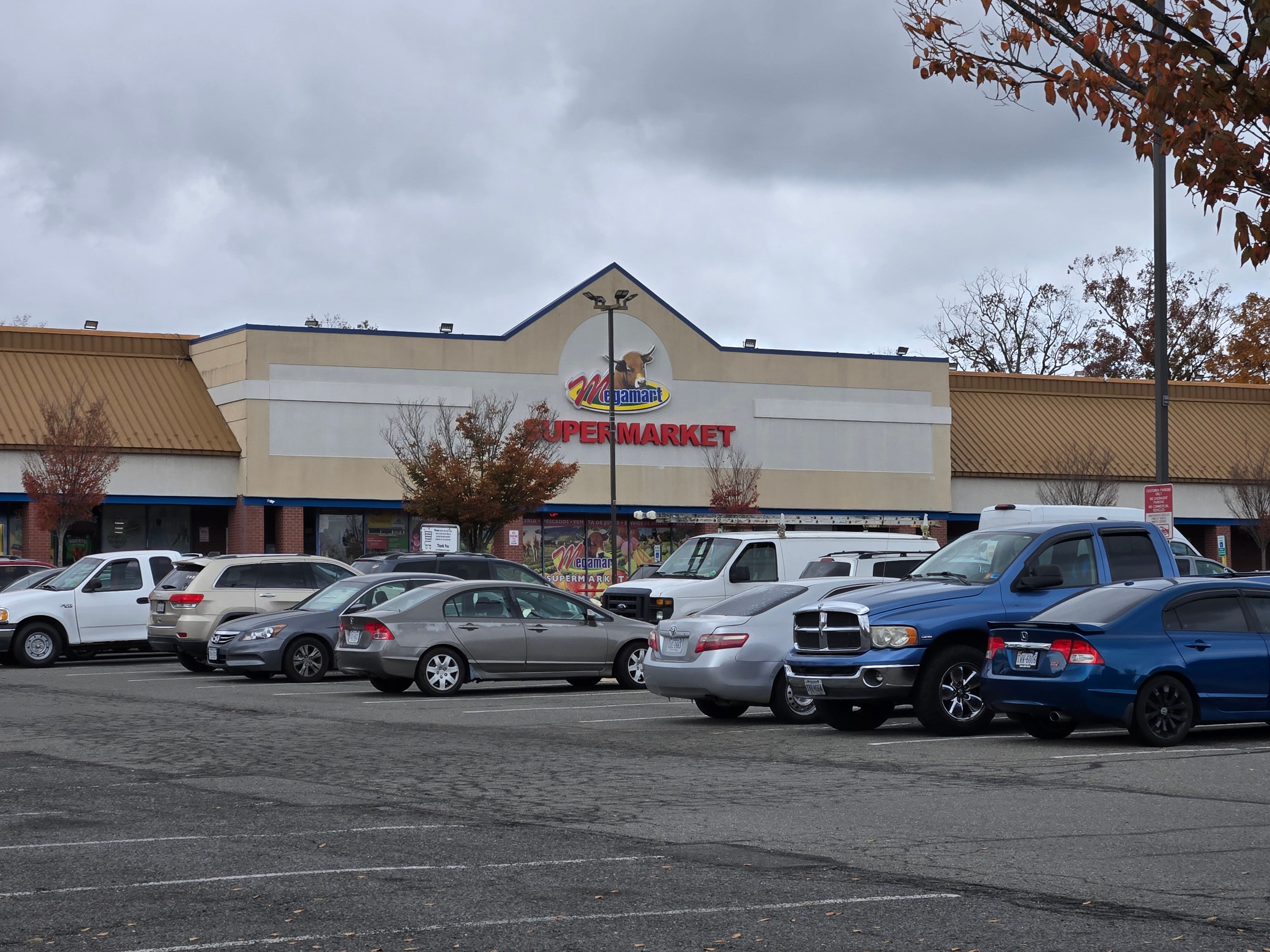
A woman got out of her car and paced around the parking lot to take a phone call. A landscaping truck headed out for the highway. There’s nothing weird about it, but it strikes me how the parking lot takes on an element of public space here that is absent in more affluent communities. There are people around.
Just a little further down is another shopping center, with another former supermarket space; this one’s now a furniture store. It was once a “Marina” Safeway, a brand-centric building famous for its soaring, exposed-wood barrel-vault ceiling. (I could almost make out the barrel vault from the way they placed the drop ceiling.)
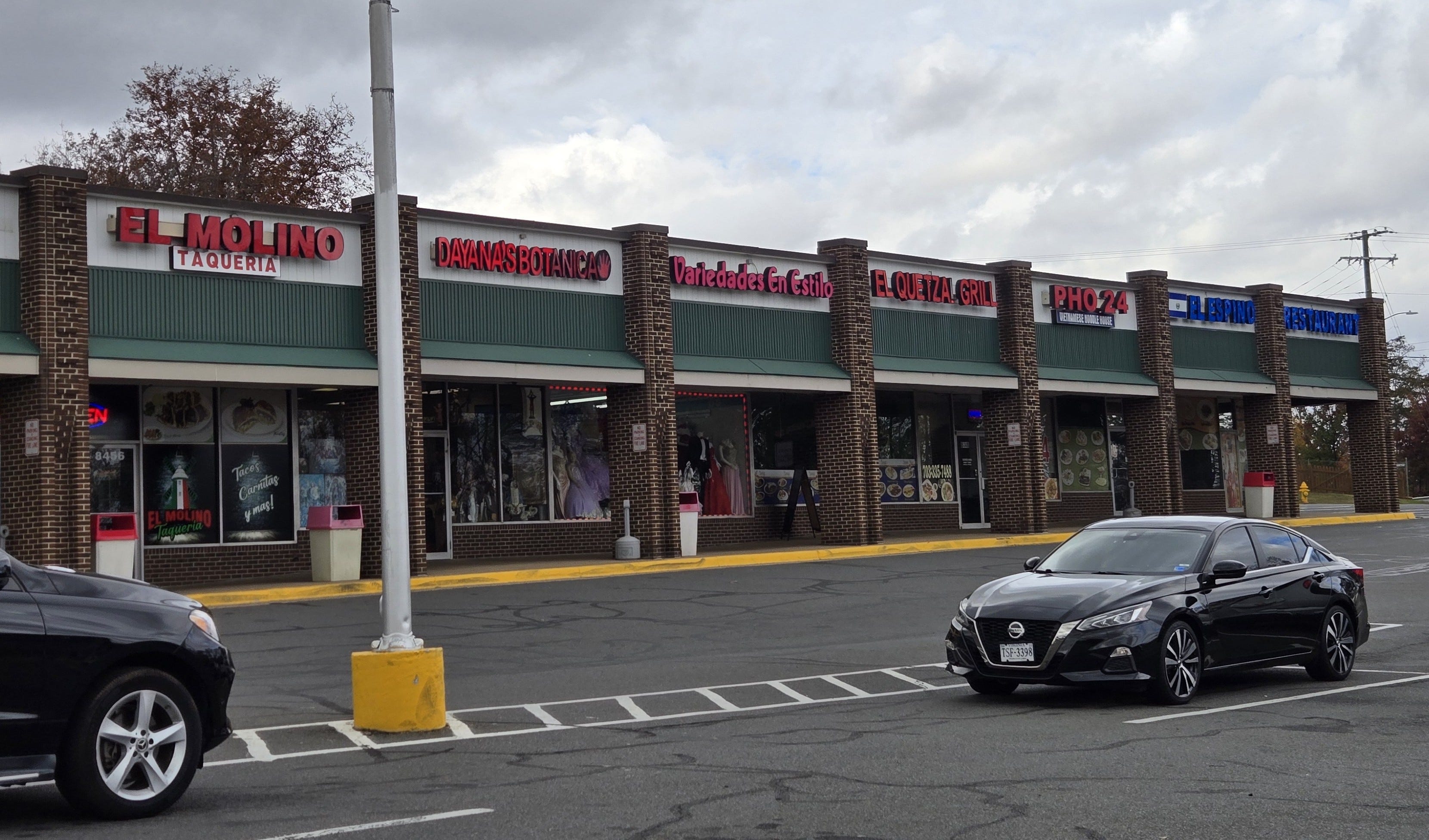
In that same strip, down at the end, there’s a row of Latino businesses, with a pho shop in the middle. There are bits and pieces where you could probably mistake this landscape for a snapshot of somewhere in Mexico or Latin America.
I’m stopping for lunch at Tortilleria Sol de Dia, a Mexican barbecue joint in an old Pizza Hut. It’s notable enough to have gotten a little write-up in the regional lifestyle publication Northern Virginia Magazine.
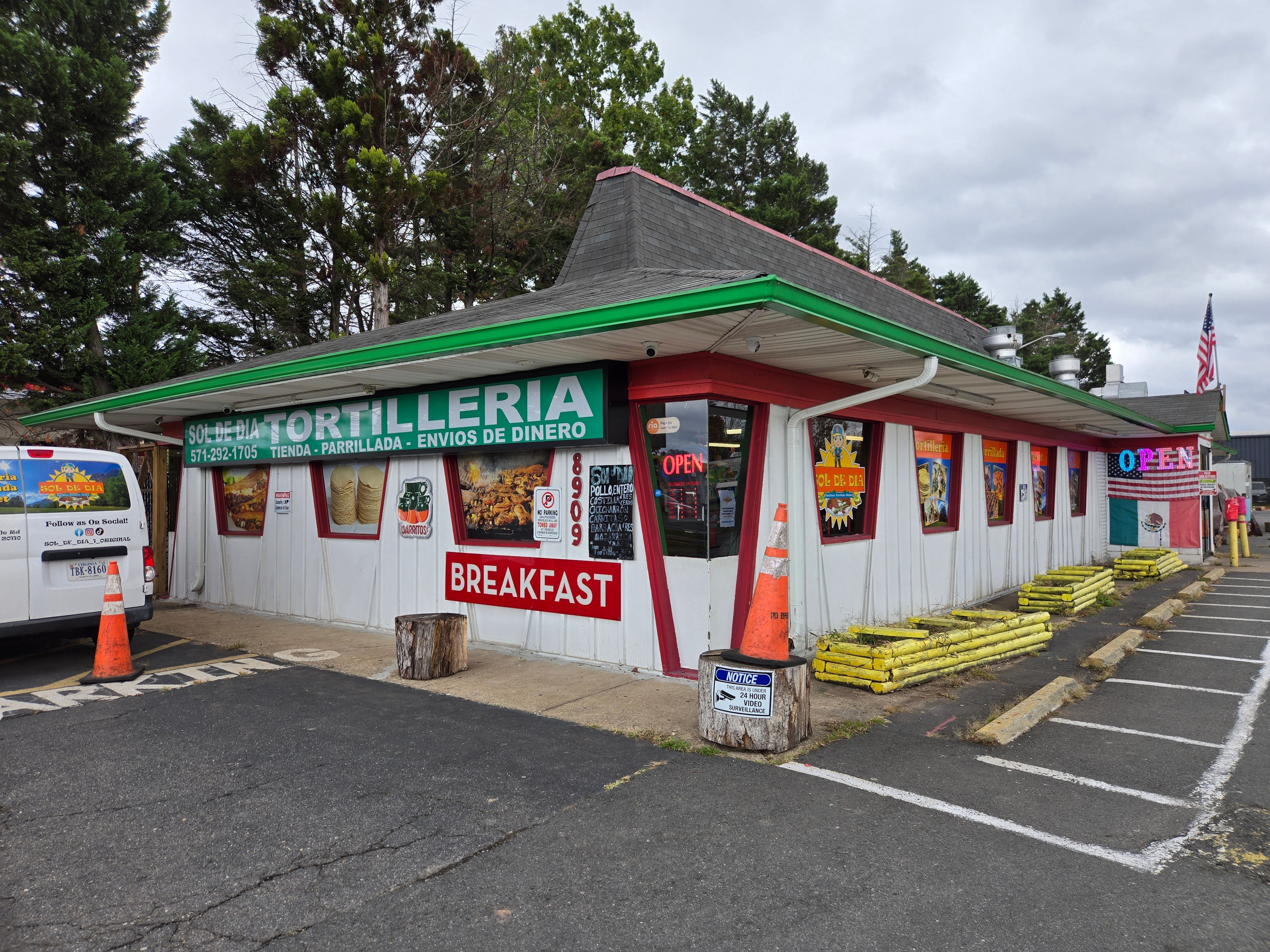
However, despite that little boost, and despite being open for five years, it only has two Yelp reviews—and both in Spanish! That suggests that it isn’t really on the mental maps of a lot of people outside of the community.
There’s nothing left of a Pizza Hut inside; there’s a small market section, an ancient secondhand drink fridge, complete with a vintage woodgrain cabinet; a small seating area; and a little display of food, smoked and charred from the early morning hours over real wood, out in the back of the building in part of the old parking lot.
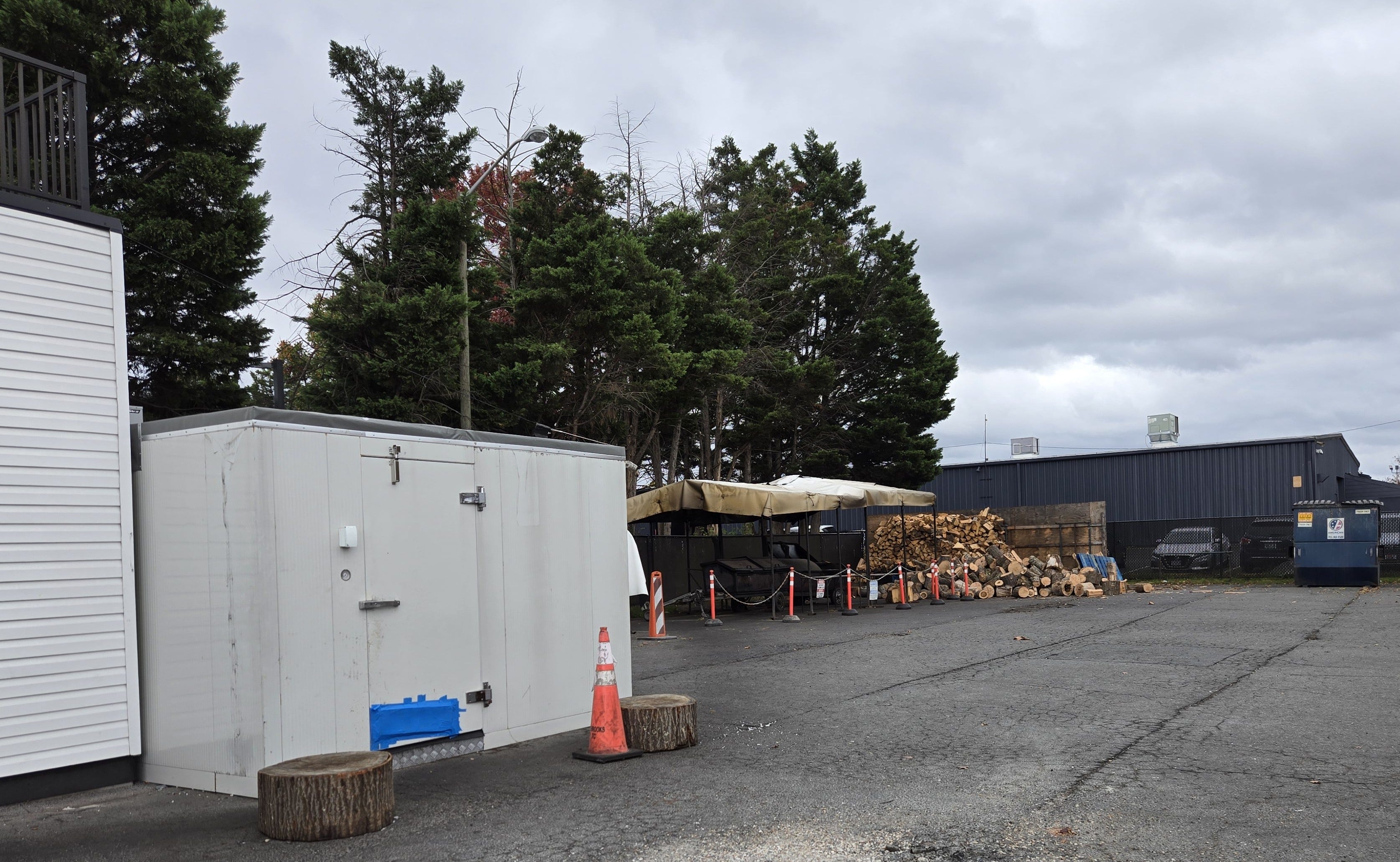
What to order? Carnitas, barbacoa, slices of soft, gelatinous pork skin, stacks of butterflied, char-grilled whole chickens and chicken leg quarters, whole fish, charred vegetables, homemade salsas and tortillas.
I was the only non-Hispanic customer in the place, and it was rather full. To my slight surprise, a fellow gringo who worked in the back overheard me trying to order, and explained to the lady at the counter what I wanted. The menu was in Spanish and English, but if not for me, there probably wouldn’t have been a lick of the latter.
You shouldn’t expect this to be a revelation, or the best meal of your life. It’s food. It’s tasty, affordable, simple, and good. (If you should ever find yourself here, I’d skip the combo with average rice and beans, and stick to the delicious, smoky chicken, the carnitas, and the homemade salsas and tortillas.)
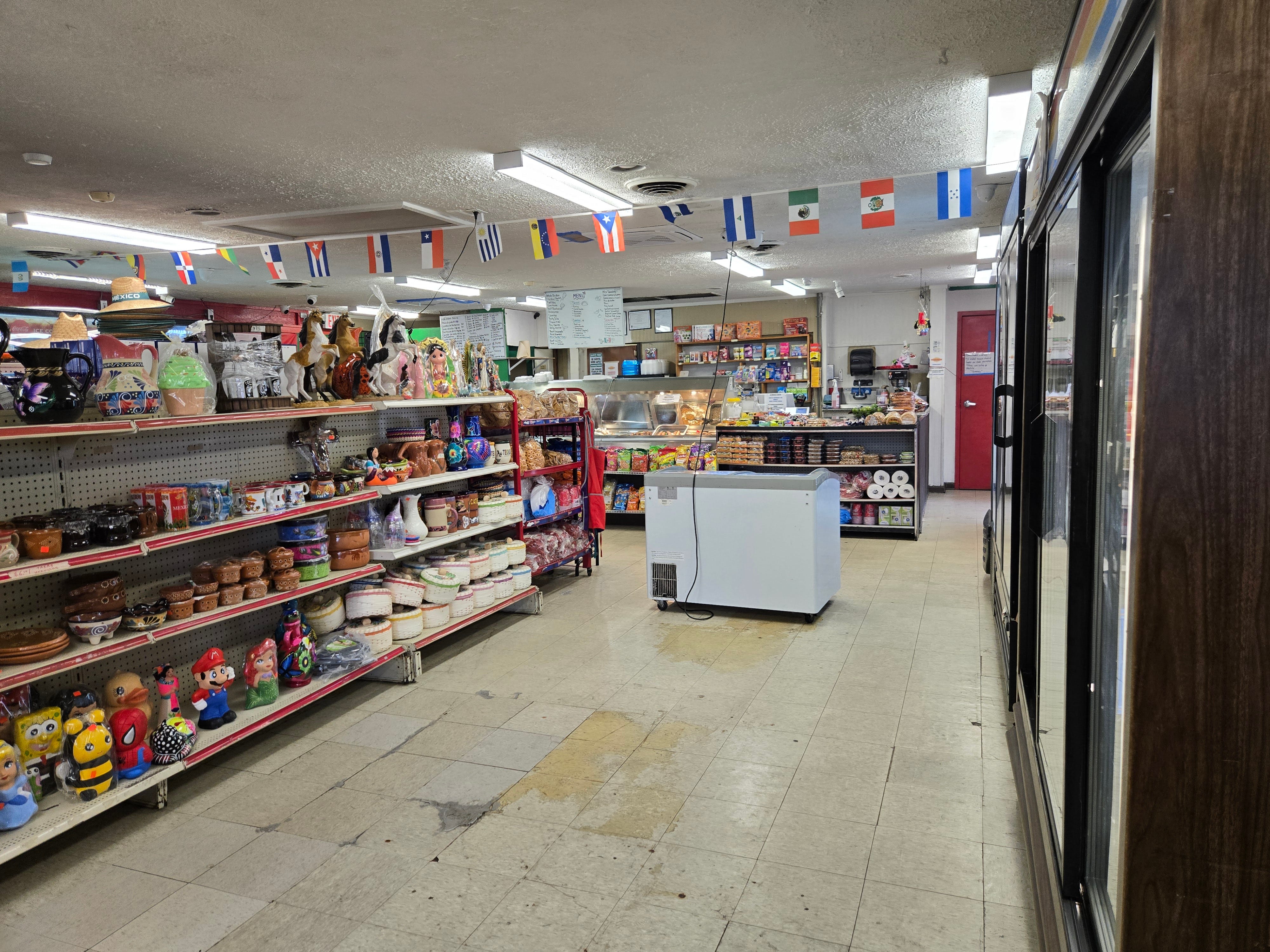
The scale of everything here is human. The smoker and piles of wood in the parking lot, the low ceiling, the building nestled into its little lot right along the highway. It can feel overcrowded and claustrophobic, I suppose.
But later, on my way home, I drove through the area’s newer commercial strip, about 10 minutes away. It boasts extra lanes of traffic—three on each side—larger stores and shopping centers set further back, at strange angles to the highway, behind meandering entrances and faux-landscaping retention ponds. It’s designed entirely for the speed and scale of the automobile. It feels stretched out, confusing, in some way lonely.
There’s something about the tighter, older scale of development that shrinks social and emotional distance, too. Something about a little building you can just park a few feet from, and walk right up to, or around, or out back. Maybe it’s silly to get a little misty-eyed about an old corporate chain building showing its age. But these early suburban strips still have a touch of the proximity and the “good friction” that comes with tight, dense development. The pattern lends itself to flexibility and reinvention. I suspect the second life of the newer commercial strip will be more challenging, if it ever comes.
I saved some room for dessert, because next door, in an old Captain D’s fast-food seafood restaurant, is La Michoacana, a Mexican ice cream and dessert shop (16 Yelp reviews). You can also go around the corner to Nathan’s Dairy Bar for old-school soft-serve at a seasonal stand. Maybe next time.
For a little post-dessert walk, I browsed the H Mart just down the street, which has occupied an old Giant supermarket space for about 10 years. (Adding to the collection of reinvented fast-food buildings, I spotted an old Roy Rogers across the highway, which is now a Peruvian chicken joint.)
H Mart is a Korean grocery chain which mostly stocks Korean and other Asian goods. However, this one has a considerable selection of Latin American foods. It’s quite nice inside. The pepper display was strikingly beautiful.
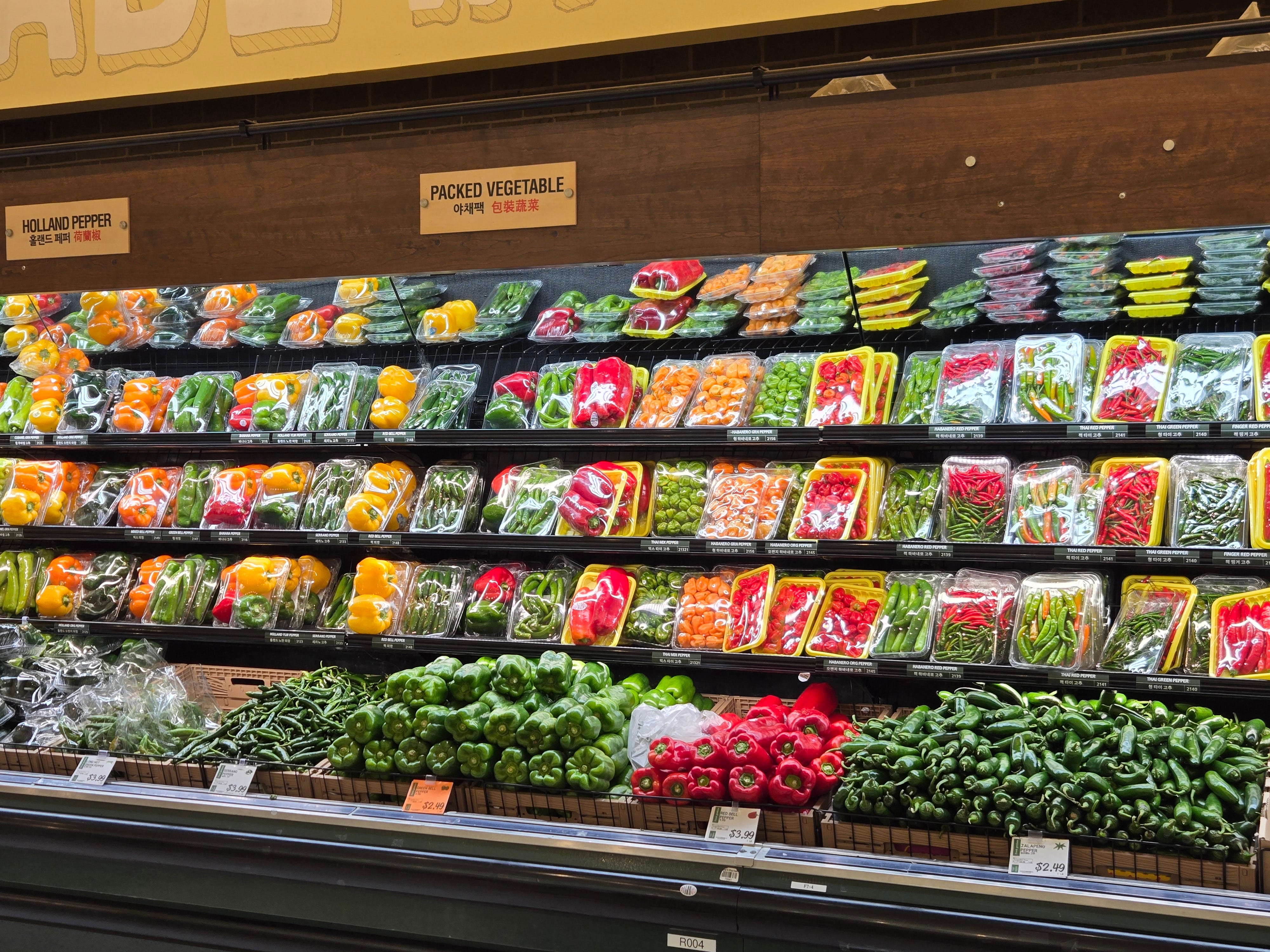
And just out of the frame, signs for “Korean Vegetable,” “Chinese Vegetable,” “American Vegetable,” “Indian Vegetable.” The huge Latino bakery section is next to a Korean food court. There’s a bar displaying a number of different Mexican cheeses. There’s an endcap, “Sale” in huge letters at the top, with Korean tissue boxes, above votive candles with images of the Virgin of Guadalupe and Santa Muerte (“Holy Death”).
We might have some grand abstraction in mind when we talk about diversity or multiculturalism. This is what it actually looks like. This is America.
There’s one more little stop, the last major commercial property before the old town. Unfortunately it’s a bit of a downer, a very old, half-vacant strip mall. One of the outparcels is a very neat-looking old Chinese restaurant, but it’s vacant too. What caught my eye here was a small Latino grocery store, whose sign has a little “Food-Rite” logo, a small regional grocer’s association, like IGA.
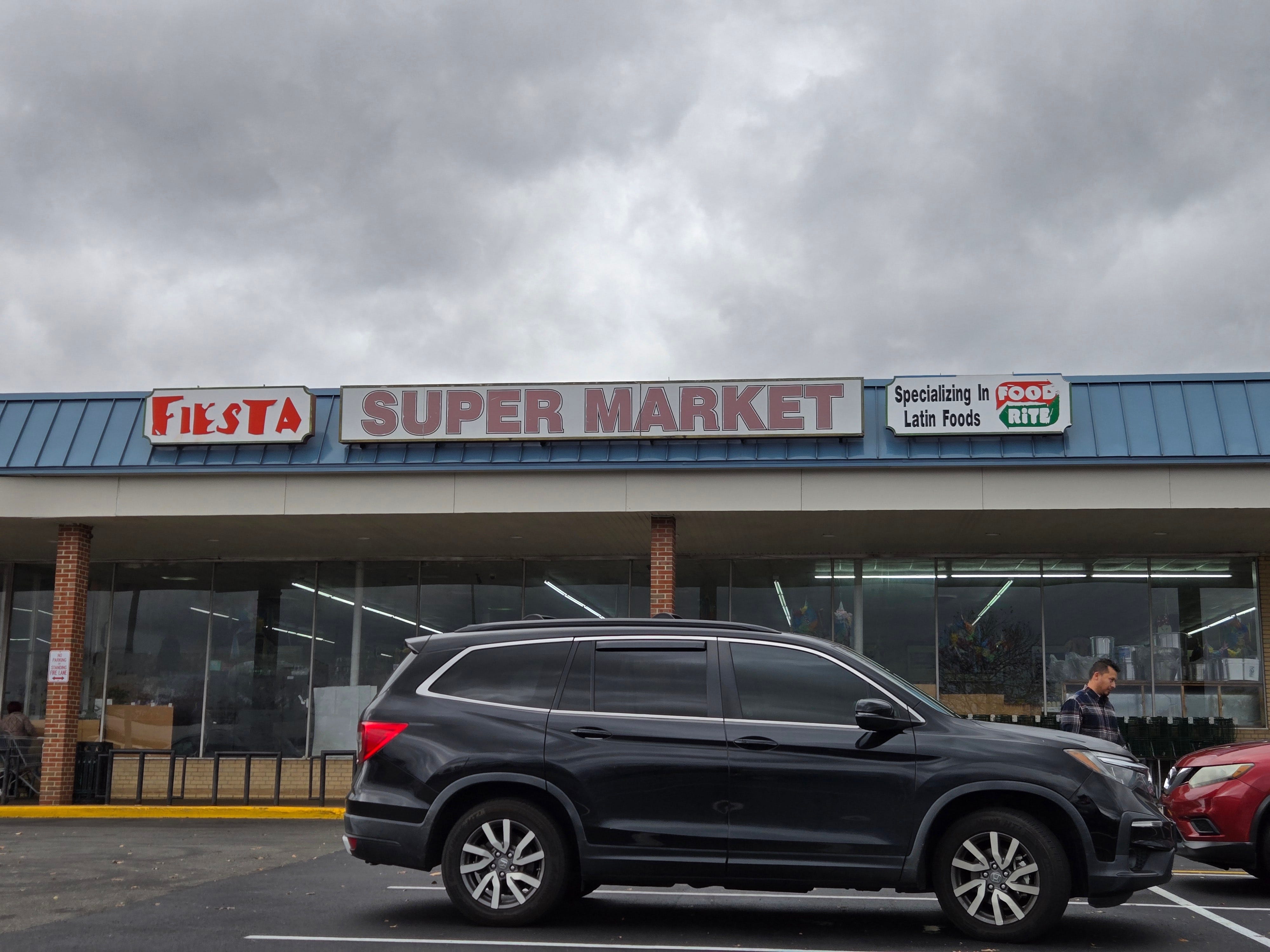
There was also a laundromat, with a neon sign indicating the age of the strip plaza: “Since 1957.”
It’s a long time. Long enough for a culture and a sense of place to mature, even amid the physical deterioration.
In some of these establishments, I might be the only white customer, or the only non-Hispanic customer. At times that can be a little bit uncomfortable. Not because I feel uncomfortable around Hispanics. It’s more like a feeling of, am I supposed to be here? Am I bothering the Mexican barbecue restaurant worker by trying to ask her what the food is or how to order, when she knows no more English than I do Spanish?
Both racism and respect could cause you to hold a place like this at a bit of an arm’s length, as if you’ve crossed some invisible border. This is a different place, not quite for you, whether because you don’t want to be here, or they don’t want you to be here, or you don’t know exactly how to be here.
Part of the reason I take these trips and write these pieces is to dispel that idea, for my readers, and frankly to some extent for myself. This is all right here. If it feels a world away, as it no doubt does to many people in more affluent surrounding communities, it is because it has never become a part of our mental maps. It is not because it is dangerous, exotic, unknowable, or off-limits.
One of the most important “urbanist ideas”—I think of it as an urbanist idea, anyway—that I ever encountered was the idea that not everything has to be for you. So often we seem to think something like, “I don’t like X, therefore nobody should,” or even, “I don’t like X, therefore nobody does.” There is an implicit belief that the demand for things you don’t personally like is somehow not real.
It’s much healthier to accept that some things are just meant for a different audience, a different customer base, people at a different stage in their lives, people of different incomes or backgrounds. And that’s okay. There’s enough to go around. There’s enough room in this great big country for everybody.
But the funny thing is that you might come to realize that, maybe, some of those things are for you. Maybe you’ll find that a taco truck between an auto shop and an off-brand convenience store is in fact your new favorite place to grab a bite. Maybe you’ll come to see a certain charm in the buzzing atmosphere of an aging but vibrant landscape like this. Maybe you’ll see what joins us—food, hospitality, work, everyday life, trying to make it—rather than what seems to separate us. Maybe there is more room and expansiveness in your perception than you thought there was.
When I say “urbanism,” I don’t mean perfectly dense, walkable, mixed-use communities, or I wouldn’t be writing about a late-midcentury commercial strip. I mean an idea. “Urbanism,” for me, is about living together with other people who may or may not quite be like you. It is about cultural sharing, bustling commerce, delight, community, peace.
And of course, food is one of the simplest and yet most deeply symbolic ways of sharing and offering. Take, eat.
America prides itself on its culture of free enterprise. We claim to encourage entrepreneurship, hard work, multiple jobs, hustling, doing whatever it takes. But often, we seem to mean these things very abstractly. We turn up our noses at what that actually looks like.
It looks like multifamily houses, or multiple people splitting an old house. It looks like cheap old commercial buildings, sometimes roughly repurposed, housing a wide array of unique, local businesses. It looks like beater cars. It looks like biking and walking through landscapes that were not designed for cyclists and pedestrians. It looks like cracked, disused parking lots hosting food trucks and other informal businesses.
From the outside—and to those who no longer need it—it can look like disorganized chaos, like deterioration, like slow-motion collapse. In reality, some of what looks like this from the outside is precisely what sets the conditions for success.
We thought we could make poverty disappear by trying to make it invisible. Instead of making it disappear, we multiplied it. We made it harder, in hundreds of little ways, to make a living. To hustle. To just up and do something with whatever you have, right now.
We observed the things that poor or disfavored people did, and squeezed those things out. We pulled away the ladder to help people climb it. We mistake the means of escaping poverty for poverty itself.
There is poverty here, relatively speaking, anyway. Yet driving down this corridor, I feel a sense of energy and opportunity. A sense of climbing, of hope about the future. That’s part of what’s so striking about this world of scrappy entrepreneurship: it’s clear what you get at the other end. That clarity fades as you get richer, and it gets harder to grasp the next rung. It is difficult to distinguish an increase in hardship from an increase in expectations.
These dusty, semi-forgotten, cast-off stretches of obsolete first-generation sprawl have more culture and entrepreneurial hum in an inch than their shiny, sterile successors have in a mile. They are not imperfect versions of somewhere else or something else; they are successful places, and kinds of places, in their own right. And they are places where, quietly, American dreams are still being fashioned.
The tortillas were good, too.
Related Reading:
Archive Dive: The Taco Truck And The Thrift Store
Thank you for this. I LOVE how these suburban commercial strips have evolved over time, always finding new people building new businesses. I certainly never would have expected it, but it's magical in a way that you capture in this essay. I grew up in Annandale, Virginia, and I still visit once in awhile, and every time I go, it's changed to something else, it has never stopped changing. And although it's not for me necessarily, I see it's for other people, and it keeps the place alive. I've seen this in almost every metropolitan area I visited across the US. Wonderful! reuses and adaptations. And always decent food!!!
"not everything has to be for you" is so hard for people, apparently! you see it all the time when people talk about cultural stuff like books and movies too. Sometimes a book isn't terrible, it's just that YOU are not the right audience for it. but look at people talking about/reviewing books or genres of books online and it's clear that many people just do not grasp the concept. And social media would sure be a lot better if people would more often recognize "this post is not for you" and scroll on by instead of opining on it.