

I saw these two social media posts, on the same case, recently:
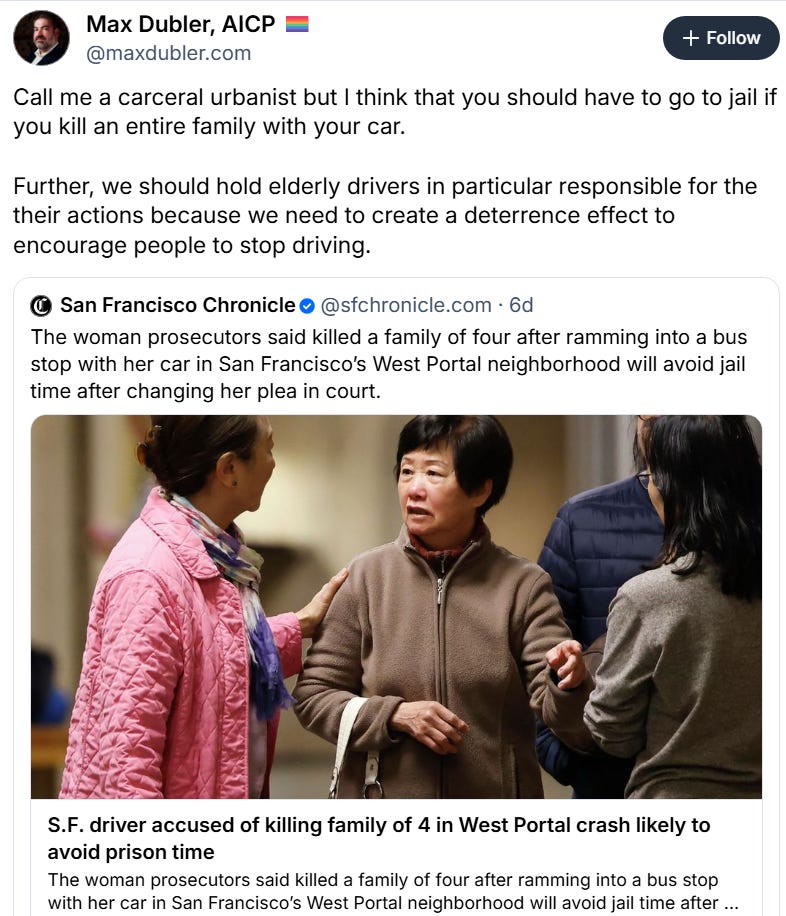
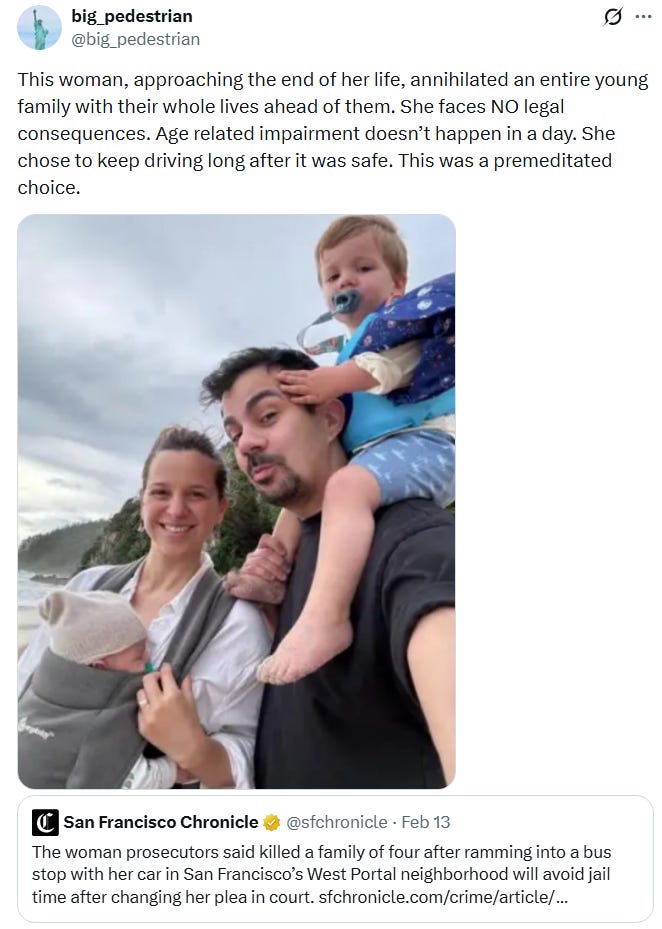
Here’s the article about it. It looks like a driving error, but a pretty extreme one: she was reportedly speeding at around 70 miles an hour in the wrong direction and rammed into a bus stop, where the entire family she killed was waiting.
It isn’t clear to me exactly why, and it suggests she is not or was not capable of driving anymore. Her error seems more in the “reckless driving” than in the mere “confusion/mistake” category—like the cases where someone accidentally accelerates into a building—but it doesn’t seem that she was trying to kill or injure anybody.
So the case sits somewhere within that moral haze of people who aren’t fit to drive still driving because it’s effectively impossible to give up driving given the way we have designed our country. You can view this as obviating any guilt except in extreme cases. Or you can view it as living in a system which may, and often does, compel all of us to eventually visit potentially deadly violence on someone else.
I do know that my first instinct was to bristle at the idea of jailing an old lady. To think of it as slightly sadistic of urbanists to wink at urban crime but then demand the book be thrown at an elderly person (the same way housing folks are happy to eject people from homes they’ve lived in for decades because they can’t afford rising property taxes on fixed incomes). The worse part of me—the part of me that would have been all of me if I had not discovered urbanism—sees why this codes as “entitlement” to some.
I don’t really think all of that. Though I do think the question of jail is less important than the question of licensing and testing of aging motorists, and the question of what exactly people in a largely car-dependent country are supposed to do with themselves as they age out of driving responsibly.1
What I also think is that while I would never want to kill anybody, I would also not want to go to jail if I (accidentally!) did. I’m aware that part of what I may be telling myself is my concern for the elderly is really my own self-interest. On some level, I want to reserve my right to not go to jail for (again, accidentally) killing someone while driving. And I’m uncomfortable with calling for that to be done to someone else. It’s a kind of inverse Golden Rule: let others get away with things you’d like to get away with.
Is that feeling of mine any worse—or, ultimately, any different—than traffic engineers designing for auto traffic first, automakers selling cars with cupholders and entertainment consoles, or municipalities permitting drive-thru restaurants? Every flick of the radio dial, every bite of the cheeseburger or sip of the Coke, is a millisecond in which tragedy can strike. In which doing the most mundane thing, in an extremely dangerous machine disguised and softened for its user, can turn you into an accidental killer or victim. Our society, broadly, has made this trade-off for us, and told us it is worth it.
Cars are widely—if not near-universally—treated as everything other than serious, risk-laden machines for getting from one place to another. Violence and death—which will be caused by someone or another—is already baked into the idea of the car as a comfortable mobile living room to navigate a landscape which is impossible to navigate without it.
If I try to figure out what’s going on in my head—to get past the “final filter” and to the absolute base-level idea—I think it is basically that on some level, driving and drivers are real, while walking and riding transit or biking are just…not quite real. It’s weird to me how much I still feel this bias operating in my brain, even though I obviously don’t think that, or even act like it. (I never drive into the city, and I take the Metro when I can, though it isn’t always convenient out in the suburbs. I certainly don’t think that’s less real or worthy than driving! And I’ve written many times against the idea that driving is a necessary element of growing up or maturing.)
On some level, I suppose, I can block out the danger of driving, and I’m reacting to urbanists reminding me about it. It’s almost a kind of superstition: if you don’t talk about it, it won’t happen. You’re going to get me killed by reminding me that it could happen.
This is one reason I like the Strong Towns framing of these issues so much. In Charles Marohn’s book Confessions of a Recovering Engineer, he sort of blames everyone and no one for traffic deaths. Our roads and our built environments are built and engineered in a manner, he argues, that guarantees destruction, injury, and death. Statistically, it is going to happen. “We should all take driving more seriously” doesn’t solve anything because we aren’t all going to do that. The system—and the human beings who administer it—are chiefly to blame.
But again, do I agree with Marohn’s analysis, or do I like the idea of blaming the system instead of myself? Do I simply empathize with a driver being punished for killing someone more than I empathize with the person being killed?
I don’t think so. In some ways this is analogous to the discourse around crime. Suburbanites tend to be much more aware of the risk of crime, and much more viscerally afraid of it, than they are of the objectively higher risk of injury or death in a car crash. If we’re operating on base self-interest, we should drive less, and we should want to live in environments with fewer cars. So I don’t think it’s exactly a failure of empathy. It’s more that something about living in a car-dependent world pushes the reality of traffic violence2 out of consciousness.
The point is that to imagine the victims of traffic violence as in every respect real people (a thing which, of course, the victims and their families do not need to do), to banish any hint of the idea that by waiting for the bus this family of four was somehow “asking for it”—is wickedly hard in a country where such an awareness is apt to eat into the motoring majority’s own sense of security and comfort behind the wheel.
That famous saying about how it’s difficult to get a man to understand something when his salary depends on his not understanding it could be amended more broadly: it is difficult to get a man to understand something when his way of life depends on his not understanding it.
Related Reading:
Solidarity Or Generational Theft?
Always Treat A Car Like It’s Loaded
Owning a Car Is a Financial Decision
Thank you for reading! Please consider upgrading to a paid subscription to help support this newsletter. You’ll get a weekly subscribers-only piece, plus full access to the archive: over 1,500 pieces and growing. And you’ll help ensure more like this!
The New York Post even reported the story, but not surprisingly ignored the car-dependence angle.
Some people don’t like this term and think it’s too ideological, or that it implies agency when most car crashes are at least partly random. I recall my very conservative father telling me “There’s no such thing as accident. ‘Accident’ is an excuse.” I’ll stick with that.
Seniors in SF or NYC can realistically surrender driving. There are transportation options.
Other places in the US? Not yet. Let’s fix that.
I really liked your observation about cupholders, consoles, and drive-thrus: “Every flick of the radio dial, every bite of the cheeseburger or sip of the Coke, is a millisecond in which tragedy can strike. In which doing the most mundane thing, in an extremely dangerous machine disguised and softened for its user, can turn you into an accidental killer or victim.” Have we collectively decided that this “living room on wheels” design is an acceptable risk?